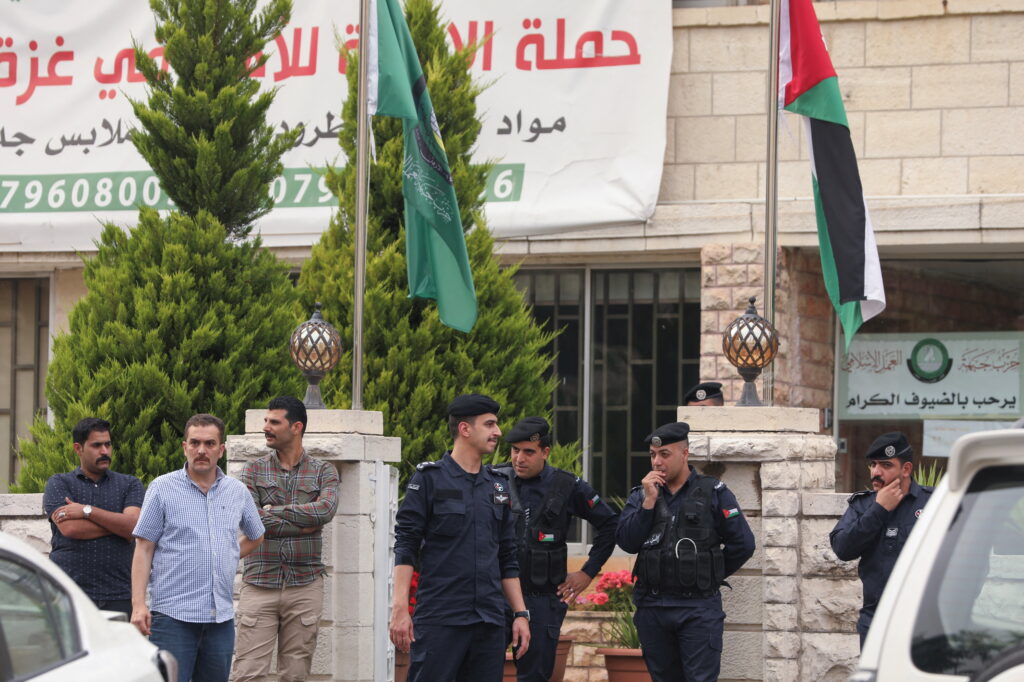
In April 2025, the Jordanian government banned the Muslim Brotherhood, raided its offices, and seized its assets. Jordan’s General Intelligence Department (GID) arrested several members of the Islamist faction, accusing them of manufacturing rockets and drones. Jordanian authorities further charged that the Muslim Brotherhood planned terrorist attacks inside the Hashemite Kingdom after receiving training and funding from the Lebanese wing of Hamas. Although King Abdullah’s tensions with the Muslim Brotherhood go back decades—he called them a “masonic cult” in 2013—last year’s crackdown against the Islamist faction represented a significant government escalation to weaken its power across the kingdom. In September 2024, the Islamic Action Front (IAF), the political wing of the Muslim Brotherhood, won the most seats for any party in the parliamentary election.
Nonetheless, roughly nine months after the government ban, the Muslim Brotherhood’s response has been remarkably restrained. Despite its widespread popularity, the Islamist faction did not organize large-scale protests, lowered its media profile, avoided launching violent attacks against the Jordanian government, and stopped holding internal elections. The Brotherhood’s muted reaction stands in contrast to its activities during the Arab Spring, when it fomented opposition against the government, launching numerous demonstrations that critiqued the Jordanian regime over corruption allegations and rising consumer prices.
Mohammad Abu-Rumman, a professor of political science at the University of Jordan and a former culture minister, explained in a December interview with the author that the Brotherhood would lose its popular support if it were to engage in an “open struggle” with the Jordanian state. Many citizens back the Brotherhood for its unwavering commitment to the Palestinian cause, noted Jordan Times columnist Amer Sabaileh, rather than violently confronting the Jordanian government.
Despite the government restrictions against the Brotherhood, the Islamist faction would have more to lose if it were to engage in a full-scale clash with Jordanian authorities.
Oraib Rantawi, director of the Amman-based Quds Center for Political Studies, explained in an interview with the author that the government’s decision to allow the IAF to continue operating in parliament, even though the Brotherhood itself is now illegal, is a “compromise” that is somewhat acceptable for the Islamist movement. (Certainly, the Muslim Brotherhood would have preferred that the Jordanian government not ban its group, but this was not an option offered by regime officials). If the Brotherhood were to launch a bitter campaign against King Abdullah over the ban, it could also lose the IAF, which still provides it with some influence nationwide.
King Abdullah continuing to permit the IAF to operate even with the Brotherhood ban shows that the dynamics in Jordan are less restrictive than the repression facing other Islamist factions in the Middle East. Since the 2013 coup in Egypt that ousted the Muslim Brotherhood-led government led by Mohammed Morsi, for example, tens of thousands of Egyptians have been arrested, including scores of Muslim Brotherhood members. Saudi Arabia has also designated the Muslim Brotherhood as a terror group, a step that the Hashemite Kingdom has not taken. Abu-Rumman noted that the Brotherhood wing in Amman seeks to avoid the fate of its Islamist counterparts elsewhere in the region by refraining from escalating tensions against the Jordanian government.
It is worth noting that Jordan’s military has access to far more advanced weaponry and resources, partially due to its strategic alliance with Washington, than the Brotherhood. In fact, The Atlantic’s Jeffrey Goldberg noted that the GID was the most “respected” intelligence apparatus in the Arab world. Therefore, if the Brotherhood launched attacks against Jordanian security forces, it would probably endure a stinging defeat with few tangible military achievements. The Muslim Brotherhood “prefers to be pragmatic,” Sabaileh added.
US President Donald Trump’s November 2025 executive order examining whether to designate certain Muslim Brotherhood chapters as terror organizations—including in Jordan for offering what the order called “material support” to Hamas’s military wing—further pushes the Islamist faction to adopt a cautious approach vis-à-vis Jordanian authorities. On January 13, the Trump administration followed through with its threat and designated the Jordanian Muslim Brotherhood as a terror organization. As Washington boosts pressure against the Brotherhood, it is not in the Islamist movement’s interest to alienate the Jordanian government with a full-blown confrontation, especially as the Brotherhood faces increased international isolation.
Some Jordanians remain skeptical of the government’s assertion that the Brotherhood was planning to attack targets inside the Hashemite Kingdom.
Rantawi insisted that the arrested Brotherhood cell was attempting to smuggle weapons to the West Bank to attack Israel, not trying to kill Jordanian security forces. IAF Secretary-General Wa’el Saqqa noted to the author that those suspected of planning attacks were acting in an individual capacity and not representing his faction. Saqqa further asserted to the author that the IAF is completely separate from the Muslim Brotherhood and not connected to the attacks. Abu-Rumman argued that the Brotherhood as an institution has never used violence against the Jordanian government in its eighty year history and declined to join the 1957 coup against King Hussein.
In one of King Abdullah’s first moves after ascending the throne in 1999, the Hashemite ruler expelled senior Hamas officials from the kingdom, angering the Jordanian Muslim Brotherhood. Despite the setback, the Jordanian Islamist movement focused on building its domestic political base, tripling its representation in the most recent national election. After the government announced a ban on the Muslim Brotherhood in April, the Islamic movement decided to play the long game by not aggressively challenging Jordanian security forces at a moment of weakness. It’s a tactic that has served the Brotherhood well, allowing it to maintain significant popular support over decades.
Aaron Magid is the author of a new biography on King Abdullah. A former Amman-based journalist, his articles on the Hashemite Kingdom have appeared in Foreign Affairs, Foreign Policy, and Al-Monitor. He also hosts the podcast On Jordan. Follow him on X: @AaronMagid
Further reading
Wed, Jun 25, 2025
Why King Abdullah’s rule in Jordan has endured despite turbulence
MENASource By
With a struggling economy, little oil, and surrounded by wars, how has Abdullah remained in power for more than a quarter century?
Tue, May 27, 2025
Jordan-Israel security cooperation continues quietly but unabated
MENASource By Emily Milliken
Despite diplomatic setbacks from the Israel-Gaza war, military and intelligence cooperation continues to thrive between the two neighbors.

Wed, Sep 10, 2025
Jordan is building scalable startups—without chasing unicorns
MENASource By
Despite challenges, in the world of privately held startups valued at $1 billion plus—the country has produced several resilient companies.
Image: Jordanian police stand outside the Islamic Action Front office in Amman, Jordan April 23, 2025. REUTERS/Alaa Al Sukhni