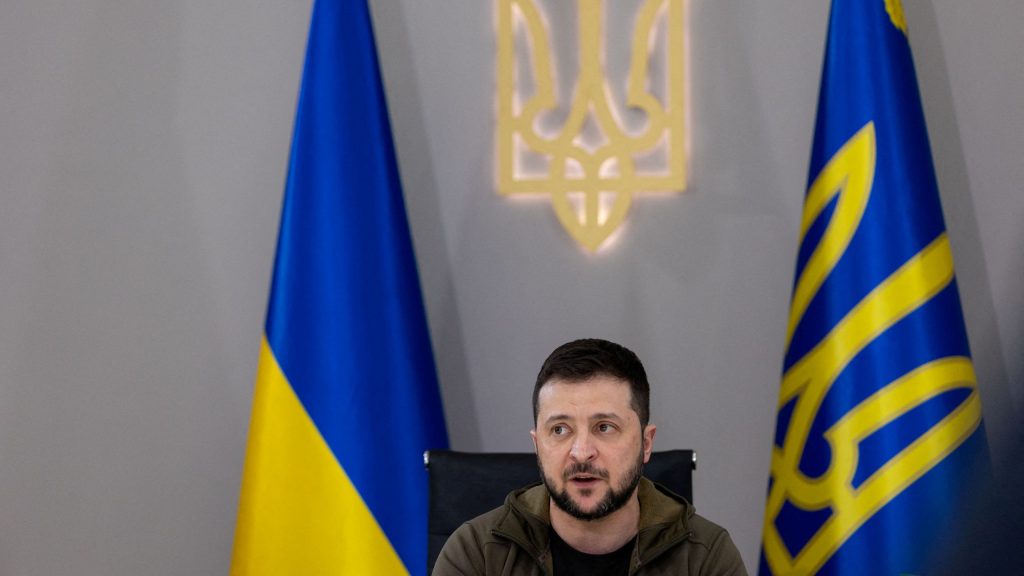
Speaking to reporters this week, Ukrainian President Volodymyr Zelenskyy described the future he sees for his country in unusual terms: as “a big Israel.”
Gone, he said, are hopes for “an absolutely liberal” state—replaced by the likely reality of armed defense forces patrolling movie theaters and supermarkets. “I’m confident that our security will be the number-one issue over the next ten years,” Zelenskyy added.
With Russian forces having withdrawn from around Kyiv, suggesting that Ukraine successfully repulsed the first phase of the Kremlin’s invasion, the time is right for Zelenskyy to contemplate how to prepare for the next—and potentially much longer—phase of this conflict.
But what does he mean by “a big Israel”? With a population more than four times smaller, and vastly less territory, the Jewish state might not seem like the most fitting comparison. Yet consider the regional security threats it faces, as well as its highly mobilized population: The two embattled countries share more than you might think.
So if Zelenskyy really does have Israel in mind as a model for Ukraine, here are some of the key features he might consider for adoption (some of which are already applicable today):
- Security first: Every Israeli government promises, first and foremost, that it will deliver security—and knows it will be judged on this pledge. Ordinary citizens, not just politicians, pay close attention to security threats—both from across borders and from internal sources— and much of the public chooses who to elect by that metric alone.
- The whole population plays a role: The Israeli model goes further than Zelenskyy’s vision of security services deployed to civilian spaces: Most young Israeli adults serve in the military, and many are employed in security-related professions following their service. A common purpose unites the citizenry, making them ready to endure shared sacrifice. Civilians recognize their responsibility to follow security protocols and contribute to the cause. Some even arm themselves (though under strict supervision) to do so. The widespread mobilization of Ukrainian society in collective defense suggests that the country has this potential. In his comments, Zelenskyy reflected this reality when he said security would “come from the strength of every house, every building, every person.”
- Self-defense is the only way: If there’s any single principle that animates Israel’s security doctrine, it’s that Israel will defend itself, by itself—and rely on no other country to fight its battles. The tragedies of Jewish history have embedded that lesson deep in the nation’s soul. Ukraine’s own trauma, forced to fight alone against a larger aggressor, reinforces a similar conclusion: Don’t depend on the guarantees of others.
- But maintain active defense partnerships: Self-defense doesn’t mean total isolation. Israel maintains active defense partnerships, chiefly with the United States, which provides generous military assistance, but also with other nations with whom it shares intelligence, technology, and training. While Ukraine will probably not join NATO any time soon, it can deepen security partnerships with Alliance members and receive aid, weaponry, intelligence, and training to bolster its self-defense.
- Intelligence dominance: From its earliest days, Israel has invested deeply in its intelligence capabilities to ensure that it has the means to detect and deter its enemies—and, when needed, act proactively to strike them. Ukraine will need to upgrade its intelligence services to compete against Russian capabilities and ensure that it’s prepared to prevent and repulse Russian attacks.
- Technology is key: Although it relies on US assistance, Israel also chooses homegrown technology solutions for many of its greatest challenges. Multi-layer rocket and missile defenses, counter-drone systems, and tunnel detection technology are just recent examples. Ukraine—already home to bright technological minds—will know what threats it faces more than any partner; investing in its own solutions will allow it to be most responsive and adapt to new threats.
- Build an innovation ecosystem: The training many Israelis receive in high-tech innovation in the military contributes to a civilian innovation ecosystem, which in turn promotes the development of new security technologies. Ukraine has no lack of talented coders and engineers (many of whom are employed by Israeli startups). Encouraging the free flow of talent and ideas between the civilian and security innovation spaces will pay long-term security and economic dividends.
- Maintain democratic institutions: Israel continues to face the challenge of ending its conflict with the Palestinians in ways that ensure both its security and the Palestinians’ self-determination. But within Israel itself, a constant focus on security hasn’t prevented the upholding of core democratic institutions and practices. Zelenskyy seems aware of this tension, which will require constant maintenance, but also that democracy is a prerequisite: “An authoritarian state is impossible in Ukraine,” he said.
Like Israel in its early wars, Ukraine appears to have fended off an acute existential threat. But the war is far from over. By adapting their country’s mindset to mirror aspects of Israel’s approach to chronic security challenges, Ukrainian officials can tackle critical national-security challenges with confidence and build a similarly resilient state.
Daniel Shapiro is a distinguished fellow at the Atlantic Council and a former US ambassador to Israel.
Related Reading

Image: Ukrainian President Volodymyr Zelenskyy speaks to Ukrainian media in Kyiv, Ukraine, on April 4, 2022. Photo by Ukrainian Presidential Press Service/Handout via REUTERS