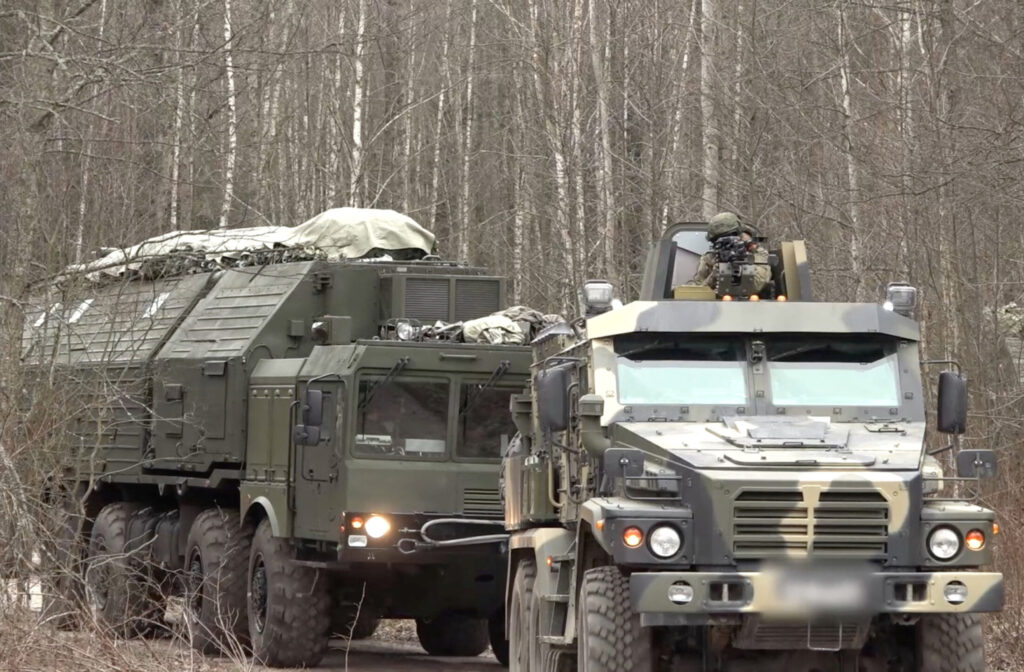
Russian nuclear-capable Oreshnik missiles are now in Belarus, Kremlin officials have confirmed. A video released by Russia’s Defense Ministry on December 30 showed multiple Russian Oreshnik mobile missile systems deployed in the forests of Belarus, a move designed to enhance the Kremlin’s ability to strike targets throughout Europe. This very deliberate act of nuclear saber-rattling has underlined the continued role of Belarus in Vladimir Putin’s war machine at a time when Minsk is also seeking to improve ties with the Trump administration.
In addition to hosting Oreshnik missiles, Belarus has also recently been accused of aiding Russian drone attacks on Ukraine. Ukrainian President Volodymyr Zelenskyy claimed on December 26 that Russian drone units are using Belarusian territory to penetrate Ukraine’s air defense network and strike targets across the country. “We note that the Russians are trying to bypass our defensive interceptor positions through Belarus. This is risky for Belarus,” Zelenskyy commented. “It is unfortunate that Belarus is surrendering its sovereignty in favor of Russia’s aggressive ambitions.”
Meanwhile, Russia is reportedly building a major ammunition plant in Belarus to help supply the ongoing invasion of Ukraine. Construction is said to be underway close to Belarusian capital Minsk, according to opposition group BELPOL, comprised of former members of the Belarusian security services. Responding to news of the plant, exiled Belarusian opposition leader Sviatlana Tsikhanouskaya accused Belarus dictator Alyaksandr Lukashenka of “dragging Belarus deeper into Russia’s war.”
Stay updated
As the world watches the Russian invasion of Ukraine unfold, UkraineAlert delivers the best Atlantic Council expert insight and analysis on Ukraine twice a week directly to your inbox.
Evidence of Belarusian involvement in Russia’s war against Ukraine is not new, of course. On the eve of the invasion, Lukashenka allowed Putin to station tens of thousands of Russian troops in Belarus. The country then served as the main gateway and logistics hub for Russia’s blitzkrieg offensive to seize Kyiv in spring 2022. The Lukashenka regime is also implicated in the Kremlin campaign to abduct and indoctrinate thousands of Ukrainian children.
Reports of Lukashenka’s ongoing involvement in the Russian war effort come amid speculation of a potential thaw in diplomatic relations between Belarus and the United States. In December, 123 political prisoners were freed by the Belarusian authorities, with the US easing sanctions measures in exchange. This followed two smaller scale trade-offs earlier in 2025 as the Trump administration seeks to increase diplomatic dialogue with Minsk as part of ongoing efforts to broker a negotiated settlement to end the Russian invasion of Ukraine.
Despite these headline-grabbing humanitarian steps, there is little sign of a more comprehensive shift in Minsk away from domestic repression or any reduction in support for Russia’s aggressive foreign policy agenda. On the contrary, the available evidence indicates that while Lukashenka may seek increased engagement with the West, he has no intention of turning away from Moscow or ending human rights abuses inside Belarus.
Eurasia Center events

By continuing to provide Moscow with its full backing, Belarus enhances Russia’s ability to wage war in Ukraine. This is undermining the Trump administration’s efforts to end the Russian invasion and secure a lasting peace settlement. Belarus also remains deeply implicated in Putin’s hybrid war against Europe and stands accused of weaponizing everything from migrants to balloons against its EU neighbors.
US outreach to Minsk over the past year has secured the release of many prominent prisoners, but continued arrests mean that the overall number of political detainees in the country remains high. Naturally, Lukashenka is happy to reengage with American officials in order to secure a relaxation of sanctions pressure, but there are also concerns that the current approach risks incentivizing hostage-taking.
Yes, a less isolated and more neighborly Belarus remains a worthwhile goal, but in the current circumstances, Lukashenka has little motivation to compromise. He is looking at possible gains without actually reducing the current level of repression in Belarus.
Sanctions relief would be a significant gain for Lukashenka. In exchange for that, the US should be able to achieve some limits on Belarusian facilitation of Kremlin aggression in Ukraine or, at a minimum, a notable decrease in the number of political prisoners in Belarus.
Mercedes Sapuppo is a fellow at the Atlantic Council’s Eurasia Center.
Further reading
The views expressed in UkraineAlert are solely those of the authors and do not necessarily reflect the views of the Atlantic Council, its staff, or its supporters.

The Eurasia Center’s mission is to enhance transatlantic cooperation in promoting stability, democratic values, and prosperity in Eurasia, from Eastern Europe and Turkey in the West to the Caucasus, Russia, and Central Asia in the East.
Follow us on social media
and support our work
Image: Service members take part in what Russian Defence Ministry says is the deployment of the Russian nuclear-capable hypersonic Oreshnik missile system in Belarus, at an unidentified location in this still image from video released December 30, 2025. Russian Defense Ministry/Handout via REUTERS