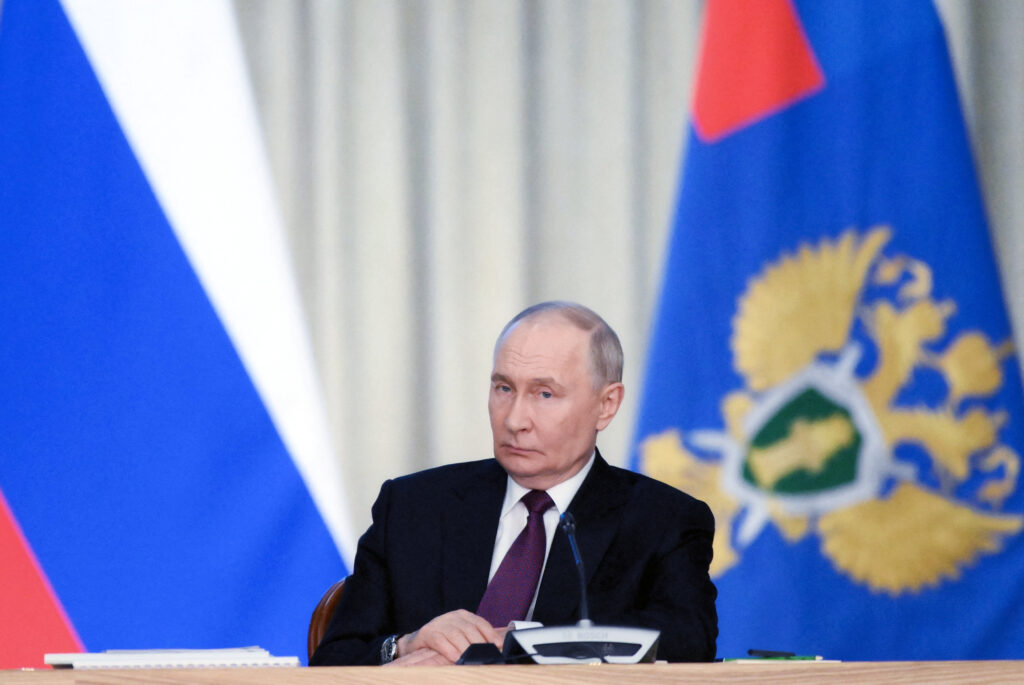
The full-scale Russian invasion of Ukraine recently entered a fifth year and has now been underway for longer than the entire cataclysmic conflict between the Soviet Union and Nazi Germany during World War II.
This historical comparison does not flatter Russian President Vladimir Putin, who has turned veneration of the fight against Hitler into an unofficial state religion. While Red Army troops played a key role in the Nazi defeat and managed to advance thousands of kilometers from Stalingrad to Berlin, today’s Russian army is in many cases still stuck within walking distance of their positions when the invasion first began in February 2022.
Despite this lack of progress on the battlefield, Putin has so far demonstrated zero interest a compromise peace. Instead, he continues to insist on maximalist demands during negotiations that would destroy Ukraine as an independent state and as a separate nation.
This uncompromising stance makes perfect sense when viewed from Putin’s perspective. After all, the invasion he unleashed in 2022 has cost countless Russian lives and plunged the country into a new Cold War. Putin knows that only total victory can justify these sacrifices.
If Putin accepted the peace terms currently on offer, this would leave around 80 percent of Ukraine free and beyond Kremlin control. Most Russians would regard that as a disastrous defeat. Putin’s dreams of entering Russian history alongside Peter the Great, Catherine the Great, and Stalin would be shattered. Instead, he would be condemned as the man who lost Ukraine.
Stay updated
As the world watches the Russian invasion of Ukraine unfold, UkraineAlert delivers the best Atlantic Council expert insight and analysis on Ukraine twice a week directly to your inbox.
In a very real sense, Putin is caught in a trap of his own making and has no real choice but to fight on. At the same time, however, it would be wrong to suggest that the Kremlin dictator is merely seeking to postpone the inevitable. On the contrary, he remains convinced that the goals of the invasion are still achievable and is now counting on Western disunity to hand him victory in Ukraine.
Putin’s low opinion of the democratic world is based on personal experience. Time and again throughout his reign, Russia’s aggressive actions have sparked vocal condemnation from Western capitals followed with indecent haste by calls for a return to dialogue and “business as usual.”
Western leaders loudly condemned Russia’s 2008 invasion of Georgia, but were soon queuing up to reset relations with the Kremlin. The same lack of resolve was on display following Russia’s 2014 seizure of Crimea and invasion of eastern Ukraine’s Donbas region, with minimal costs imposed on Moscow and multiple European countries actually increasing their dependence on Russian energy exports.
It is hardly surprising, therefore, that Putin treats the proclamations of his Western counterparts with thinly veiled contempt. While he has been unpleasantly surprised since 2022 by the scale of support for Ukraine, the Russian leader’s own dealings with his Western counterparts have encouraged him to conclude that this unity will prove temporary. As the war grinds into a fifth year with no end in sight, Putin believes he can ultimately outlast the West.
Eurasia Center events
Shifts within the Western alliance over the past year are fueling confidence in Moscow that current levels of support for Ukraine will not last forever. Since returning to the White House in January 2025, US President Donald Trump has cut military aid to Ukraine and sought to reposition the United States as an intermediary in peace negotiations between Russia and Ukraine.
This has placed the burden of supporting the Ukrainian war effort firmly on Europe. According to recent Kiel Institute data, Ukraine’s European partners have done a good job of filling this gap. However, the majority of aid is now coming from a relatively small group of nations including Norway, Sweden, Denmark, Germany, the Netherlands, and Britain. This places Ukraine’s war effort on fragile foundations.
Meanwhile, a ninety billion euro financing package agreed by EU leaders remains blocked by Hungary. This is part of long-term pattern that has seen Hungary’s pro-Kremlin Prime Minister Viktor Orban repeatedly obstruct or delay efforts by the European Union to strengthen Ukraine or increase pressure on Putin.
With far-right populist parties currently riding high in the polls throughout Europe, Putin also has good cause for optimism over the possible imminent appearance of more Orban-style allies. This could help the Kremlin in its efforts to divide and weaken Europe from within.
Broader geopolitical developments are also placing new strains on Western unity and threatening to undermine backing for Ukraine. The US-Israeli joint operation against Iran is currently causing unprecedented tension among NATO allies, with European countries reluctant to participate in efforts to safeguard the Strait of Hormuz. This has highlighted a growing transatlantic divide that could seriously weaken Ukraine’s position.
Putin cannot risk a compromise peace in Ukraine, but he remains confident that time is on his side. While the Russian army has been unable to defeat Ukraine on the battlefield, Putin is prepared to wait until Western disunity leaves the Ukrainians stripped of support and at his mercy. While this would not mean an immediate end to the carnage, Putin believes a dramatic decline in Western support would finally allow Russia to pummel an exposed and abandoned Ukraine into submission.
Mykola Bielieskov is a research fellow at the National Institute for Strategic Studies and a senior analyst at Ukrainian NGO “Come Back Alive.” The views expressed in this article are the author’s personal position and do not reflect the opinions or views of NISS or Come Back Alive.
Further reading

The views expressed in UkraineAlert are solely those of the authors and do not necessarily reflect the views of the Atlantic Council, its staff, or its supporters.

The Eurasia Center’s mission is to enhance transatlantic cooperation in promoting stability, democratic values, and prosperity in Eurasia, from Eastern Europe and Turkey in the West to the Caucasus, Russia, and Central Asia in the East.
Follow us on social media
and support our work
Image: Russia's President Vladimir Putin attends an expanded meeting of the Prosecutor General's Office board in Moscow, Russia, March 19, 2026. (Sputnik/Pelagiya Tikhonova/Pool via REUTERS)