Two weeks since the outbreak of the Iran war, commentators around the world are already declaring Vladimir Putin the winner. It is easy to see why so many seem to believe that the Russian President will emerge as the main beneficiary of escalating hostilities in the Middle East. After all, from energy exports to the invasion of Ukraine, Putin clearly has much to gain.
The Russian economy has been showing signs of severe strain in recent months as the combined toll of international sanctions, Ukrainian airstrikes, and ballooning defense spending negatively impact the Kremlin coffers. The Iran war now threatens to transform this picture in Moscow’s favor.
With energy prices already spiking and the Strait of Hormuz blocked, the world is entering a fuel crisis that could reinvigorate Putin’s war economy. The United States has already relaxed sanctions on the Kremlin in a bid to ease energy pressures elsewhere. If the current conflict becomes a prolonged campaign, Moscow may be able to repair much of the economic damage done over the past four years.
The Iran war could also provide a more direct boost for Russia’s ongoing invasion of Ukraine. With the Trump administration now firmly focused on the Middle East, the Kremlin will face significantly less diplomatic pressure to engage in US-led peace talks with Ukraine, while Kyiv will struggle to keep Russia’s invasion high on the international agenda.
Crucially, the US is expected to prioritize the supply of air defense interceptor missiles to the Middle East over Ukraine. With limited numbers of missiles produced annually, this means Ukrainian air defense crews might soon find themselves short of the ammunition required to defend their cities and infrastructure against Russian ballistic missiles. The consequences for the civilian population could be disastrous.
Stay updated
As the world watches the Russian invasion of Ukraine unfold, UkraineAlert delivers the best Atlantic Council expert insight and analysis on Ukraine twice a week directly to your inbox.
Despite these potential advantages, there is little sign of celebration in the Kremlin. While Russia appears well-positioned to benefit economically and militarily, the US-led war with Iran has also served to highlight Russia’s declining international influence and has underlined Moscow’s limitations as an ally.
Since the onset of hostilities at the end of February, the Kremlin has restricted itself to a limited number of statements and has largely refrained from any strong condemnation of the United States. While reports indicate that Moscow is providing Iran with military assistance including targeting data and drone warfare expertise, the Russian response has been strikingly muted and has fallen far short of America’s very public support for Ukraine following Putin’s 2022 invasion.
Putin’s cautious reaction is particularly noteworthy in light of the support Iran has provided to Russia over the past four years. Since 2022, Tehran has supplied Moscow with large quantities of drones, missiles, and ammunition. This backing proved especially important during the early stages of the war, before Russia was able to expand domestic production and diversify its lines of supply.
Despite much speculation over an emerging “Axis of Autocrats” including both Russia and Iran, Putin has so far proved unwilling or unable to repay Tehran for its earlier backing. While Russian and Iranian officials hailed the signing of a “comprehensive strategic partnership agreement” in January 2025, this has not translated into significant Russian aid since the current conflict erupted.
Eurasia Center events
Russia’s failure to robustly support its Iranian allies is the latest in a series of similar geopolitical setbacks since the beginning of the full-scale Ukraine invasion more than four years ago. In late 2022, Kremlin credibility was dented by Moscow’s inability to prevent a renewal of hostilities between Azerbaijan and Armenia, leading to the collapse of Russia’s traditional security role in the South Caucasus. US President Donald Trump has since stepped into the void to lead peace efforts in the region.
The fall of Kremlin-backed Syrian dictator Bashar al-Assad was to prove an even more humiliating blow for Putin. For almost a decade, Moscow had invested significant military and diplomatic resources to keep Assad in power. This engagement was touted by Moscow as proof of Russia’s return to great power status. However, when the Assad regime began to rapidly unravel in late 2024, Russia was unable to intervene. Instead, the Kremlin limited itself to offering the ousted Syrian leader asylum.
Likewise, Russia proved powerless to assist Venezuelan President Nicolás Maduro when he was captured by the United States in early 2026. Moscow was seen as a key strategic partner of Maduro and had provided Caracas with a wide range of financial and security backing. Days before the American operation, Russia was still voicing its “full support” for Venezuela. However, the Kremlin ultimately took no action when US forces swooped.
From Armenia and Syria to Venezuela and Iran, Moscow’s obvious inability to aid its allies in times of crisis has seriously damaged Russia’s reputation as a global power. While the Kremlin is still capable of supplying weapons and spreading propaganda, these limited tools are no substitute for the kind of substantial security support that potential partners seek.
For Putin, this matters. Throughout his reign, he has carefully cultivated a strongman image and sought to reassert Russia’s claims to superpower status. However, the world’s leading powers do not maintain their influence through rhetoric alone.
Following the full-scale invasion of Ukraine, Russia’s repeated failure to defend its international allies has revealed the underwhelming reality behind Putin’s posturing. This loss of prestige has very practical implications for Moscow’s ability to attract partners and project strength on the world stage. Putin hoped that by conquering Ukraine, he could return Russia to the dominant role it occupied during the Cold War. Instead, he has become bogged down in an invasion that has ruthlessly exposed modern Russia’s geopolitical limitations.
William Dixon is a senior associate fellow at the Royal United Service Institute specializing in cyber and international security issues. Maksym Beznosiuk is a strategy and security analyst whose work focuses on Russia, Ukraine, and international security.
Further reading

The views expressed in UkraineAlert are solely those of the authors and do not necessarily reflect the views of the Atlantic Council, its staff, or its supporters.

The Eurasia Center’s mission is to enhance transatlantic cooperation in promoting stability, democratic values, and prosperity in Eurasia, from Eastern Europe and Turkey in the West to the Caucasus, Russia, and Central Asia in the East.
Follow us on social media
and support our work
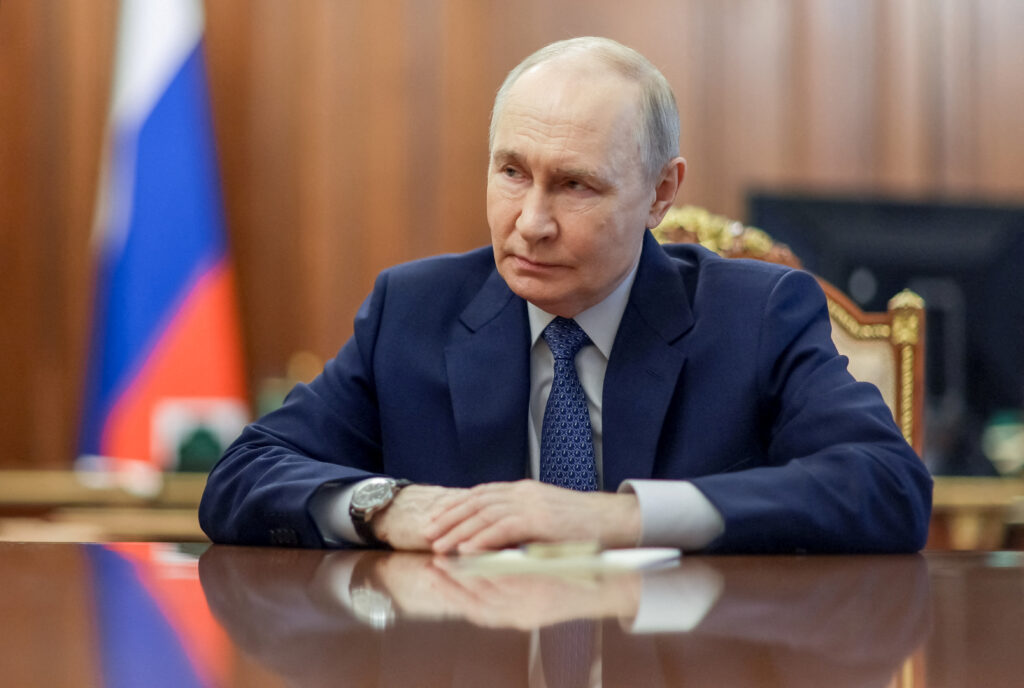
Image: Russian President Vladimir Putin attends a meeting with Denis Pushilin, Moscow-installed leader of the Russian-controlled parts of the Donetsk region, at the Kremlin in Moscow, Russia March 10, 2026. (Sputnik/Gavriil Grigorov/Pool via REUTERS)