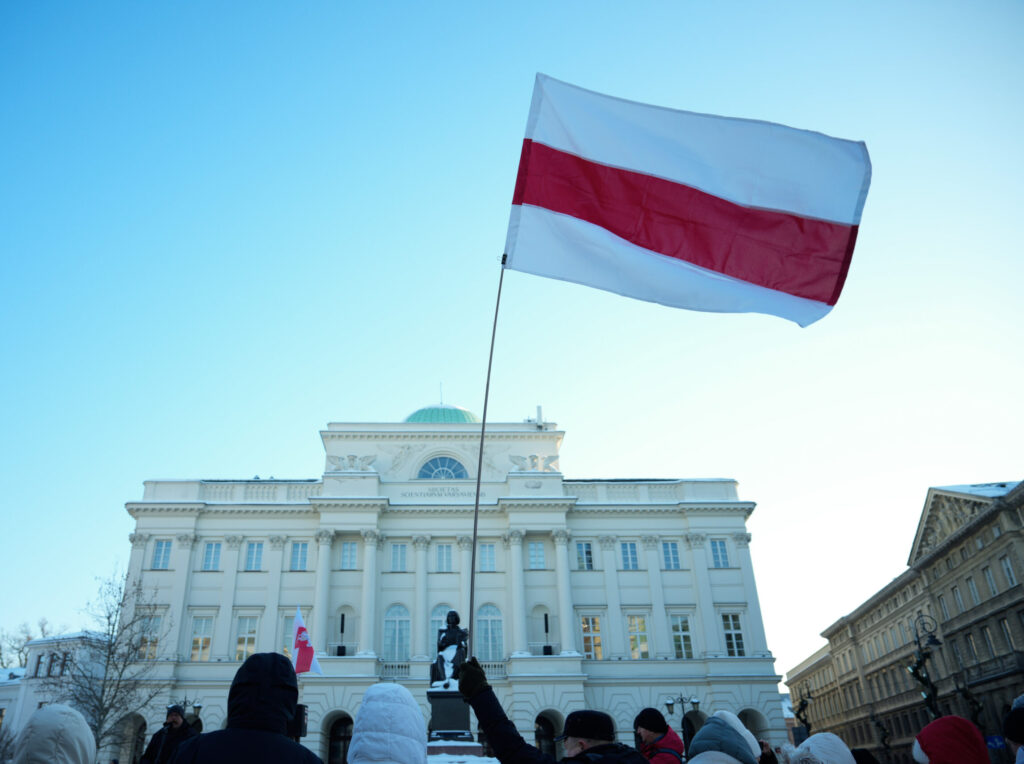
Ukrainian President Volodymyr Zelenskyy held his first official meeting with exiled Belarusian opposition leader Sviatlana Tsikhanouskaya last weekend during a visit to Vilnius. Their meeting was the latest indication of a significant policy shift underway in Ukraine toward the country’s northern neighbor that could have implications for the wider region.
For years, Zelenskyy had kept the Belarusian democratic opposition at arm’s length as part of Ukrainian efforts to avoid angering Belarusian dictator Alyaksandr Lukashenka and pushing him further toward the Kremlin. That approach has brought few benefits. Ukraine now appears to have recognized that a new strategy to bilateral relations may be more appropriate.
Sunday’s meeting did not come as a complete surprise. Days earlier in Davos, Zelenskyy had identified Belarus’s 2020 pro-democracy protests as a turning point for the region and a missed opportunity for Europe. The Ukrainian leader argued that the democratic world made a mistake by failing to support nationwide protests in Belarus. As a result, the country now poses a threat to all Europe and serves as a forward base for Russia’s hybrid war against the West.
During his recent visit to Lithuania, Zelenskyy addressed the Belarusian population directly and expressed his support for their European future. He also met with recently released Belarusian political prisoners and paid tribute to Belarusian volunteers serving alongside Ukrainian forces in the fight against Russia’s invasion.
Ukrainian officials have recently made clear that Lukashenka and his regime must be held accountable for complicity in Russia’s aggression. Meanwhile, in a further indication that Ukraine is moving toward more systemic engagement with the Belarusian democratic opposition, plans have emerged to potentially appoint a special envoy and host Tsikhanouskaya in Kyiv.
Stay updated
As the world watches the Russian invasion of Ukraine unfold, UkraineAlert delivers the best Atlantic Council expert insight and analysis on Ukraine twice a week directly to your inbox.
Some analysts believe this recent change in tone toward Belarus may reflect the growing influence of former Ukrainian spymaster Kyrylo Budanov, who was recently appointed as President Zelenskyy’s new chief of staff. Budanov has long been involved in contacts with the Belarusian side and helped facilitate the transfer of released political prisoners to Ukraine in December 2025.
Kyiv’s apparent pivot may also reflect the fact that Russia’s military footprint in Belarus continues to grow. Ukrainian officials claim Russia uses Belarus to conduct drone attacks on Ukraine and evade air defenses. Lukashenka recently announced the deployment of nuclear-capable Russian Oreshnik missiles to Belarus, which Zelenskyy described as a threat to both Ukraine and the European Union.
Meanwhile, Russia’s integration of the Belarusian military industrial complex continues, with up to 80 percent of Belarusian enterprises reportedly now engaged in production for Russia’s military needs. Belarus is accused of supplying ammunition, providing repair services for Russian equipment, and channeling sanctioned technology to Russian defense companies.
Lukashenka is understandably eager to distance himself from any direct ties to the Russian invasion of Ukraine. However, the available evidence indicates that his regime is becoming more deeply embedded in the Kremlin war effort. This is the reality confronting the Ukrainian authorities. As long as Belarus remains firmly under Kremlin control, it will continue to pose a serious security threat along Ukraine’s northern border.
Eurasia Center events

Europe should be paying particular attention to indications of a new Ukrainian approach to Belarus. As US foreign policy priorities shift, responsibility for managing relations between Belarus and the West will increasingly fall on the European Union. EU officials must decide between freezing the Belarus issue or recognizing the country as a strategic challenge that requires European leadership.
Belarus has most recently made headlines due to a series of prisoner releases tied to partial US sanctions relief. The humanitarian impact of these deals should not be underestimated, but it is also important to underline that more than one thousand Belarusian political prisoners remain incarcerated. Some skeptics have argued that without a broader strategy, reducing sanctions pressure on Minsk in exchange for prisoner releases risks strengthening the current regime and reinforcing an oppressive system that imprisons political opponents.
This presents opportunities for Europe to demonstrate its ability to take the lead on the international stage. While the US seeks practical short-term results such as the release of political prisoners, Europe can push for more systemic change and democratic transition in Belarus. In this context, sanctions should be seen as a tool to undermine authoritarian rule rather than locking in the current status quo. This can be achieved by closing existing loopholes while targeting the revenue streams and logistical networks that sustain the Lukashenka regime and support the Russian war machine.
In the current geopolitical climate, any talk of a neutral Belarus is delusional. Lukashenka will not turn away from his patrons in the Kremlin voluntarily. If European policymakers wish to see genuine change in Belarus, they will need to demonstrate a readiness to increase the pressure on Minsk. The enticing prospect of future European integration can play a crucial role in these efforts.
Belarus now occupies a strategic position in Europe’s rapidly shifting security landscape. The country remains deeply involved in Russia’s invasion of Ukraine and also represents a key challenge for European leaders as they seek to prove that the continent is capable of defending itself in an era when US support can no longer be taken for granted. The Ukrainian authorities clearly feel the time is right for a more proactive approach to Belarus. The question now is whether Europe will follow suit.
Hanna Liubakova is a journalist from Belarus and nonresident senior fellow at the Atlantic Council.
Further reading
The views expressed in UkraineAlert are solely those of the authors and do not necessarily reflect the views of the Atlantic Council, its staff, or its supporters.

The Eurasia Center’s mission is to enhance transatlantic cooperation in promoting stability, democratic values, and prosperity in Eurasia, from Eastern Europe and Turkey in the West to the Caucasus, Russia, and Central Asia in the East.
Follow us on social media
and support our work
Image: Belarusian nationals rally in Warsaw, Poland on 18 January, 2026. Several dozen protesters waved opposition flags and held pictures of political prisoners held by the Belarusian authorities. Since the 2020 the Belarusian populations in Poland has more than doubled in large part due to those seeking politicial asylum. (Photo by Jaap Arriens / Sipa USA)