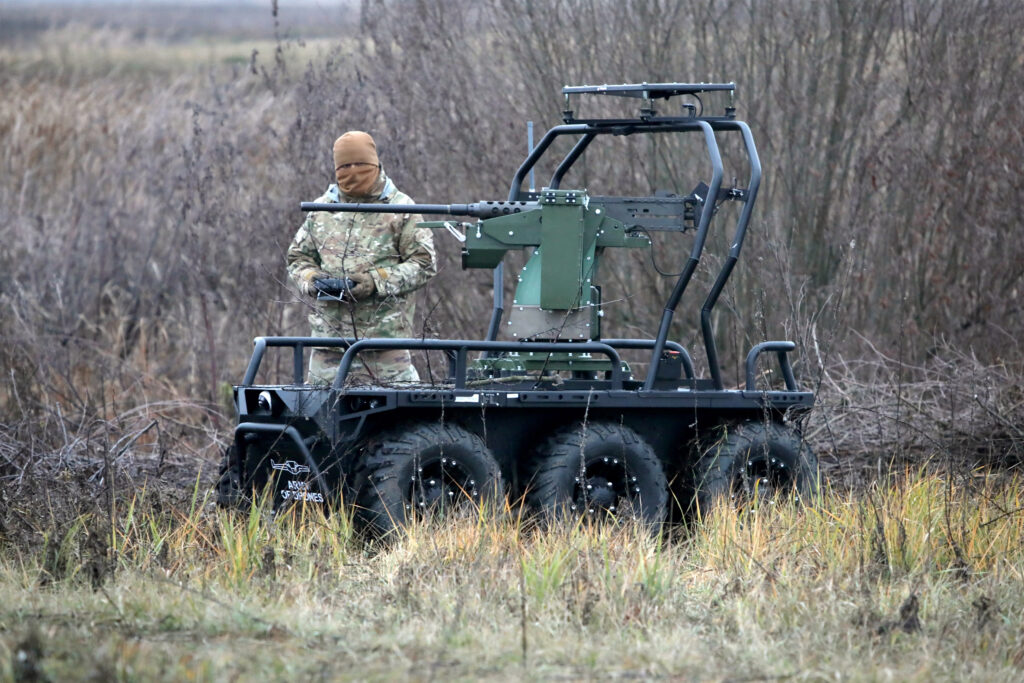
Ukrainian army officials claim to have made military history in late 2025 by deploying a single land drone armed with a mounted machine gun to hold a front line position for almost six weeks. The remote-controlled unmanned ground vehicle (UGV) reportedly completed a 45-day combat mission in eastern Ukraine while undergoing maintenance and reloading every 48 hours. “Only the UGV system was present at the position,” commented Mykola Zinkevych of Ukraine’s Third Army Corps. “This was the core concept. Robots do not bleed.”
News of this successful recent deployment highlights the potential of Ukraine’s robot army at a time when the country faces mounting manpower shortages as Russia’s full-scale invasion approaches the four-year mark. Robotic systems are clearly in demand. The Ukrainian Ministry of Defense has reported that it surpassed all UGV supply targets in 2025, with further increases planned for the current year. “The development and scaling of ground robotic systems form part of a systematic, human-centric approach focused on protecting personnel,” commented Defense Minister Denys Shmyhal.
Stay updated
As the world watches the Russian invasion of Ukraine unfold, UkraineAlert delivers the best Atlantic Council expert insight and analysis on Ukraine twice a week directly to your inbox.
The current emphasis on UGVs is part of a broader technological transformation taking place on the battlefields of Ukraine. This generational shift in military tech is redefining how modern wars are fought.
Since the start of Russia’s full-scale invasion in February 2022, homegrown innovation has played a critical role in Ukraine’s defense. Early in the war, Ukrainian troops deployed cheap commercial drones to conduct reconnaissance. These platforms were soon being adapted to carry explosives, dramatically expanding their combat role. By the second year of the war, Ukraine had developed a powerful domestic drone industry capable of producing millions of units per year while rapidly adapting to the ever-changing requirements of the battlefield.
A similar process has also been underway at sea, with Ukraine deploying domestically produced naval drones to sink or damage more than a dozen Russian warships. This has forced Putin to withdraw the remainder of the Black Sea Fleet from occupied Crimea to Russia itself. Recent successes have included the downing of Russian helicopters over the Black Sea using naval drones armed with missiles, and an audacious strike on a Russian submarine by an underwater Ukrainian drone.
By late 2023, drones were dominating the skies over the Ukrainian battlefield, making it extremely dangerous to use vehicles or armor close to the front lines. In response to this changing dynamic, Ukrainian forces began experimenting with wheeled and tracked land drones to handle logistical tasks such as the delivery of food and ammunition to front line positions and the evacuation of wounded troops.
Over the past year, Russia’s expanding use of fiber-optic drones and tactical focus on disrupting Ukrainian supply lines has further underlined the importance of UGVs. Fiber-optic drones have expanded the kill zone deep into the Ukrainian rear, complicating the task of resupplying combat units and leading to shortages that weaken Ukraine’s defenses. Robotic systems help counter this threat.
Eurasia Center events

Remote controlled land drones offer a range of practical advantages. They are more difficult to jam electronically than aerial drones, and are far harder to spot than trucks or cars. These benefits are making them increasingly indispensable for the Ukrainian military. In November 2025, the BBC reported that up to 90 percent of all supplies to Ukrainian front line positions around Pokrovsk were being delivered by UGVs.
In addition to logistical functions, the Ukrainian military is also pioneering the use of land drones in combat roles. It is easy to see why this is appealing. After all, Ukrainian commanders are being asked to defend a front line stretching more than one thousand kilometers with limited numbers of troops against a far larger and better equipped enemy.
Experts caution that while UGVs can serve as a key element of Ukraine’s defenses, they are not a realistic alternative to boots on the ground. Former Ukrainian commander in chief Valerii Zaluzhnyi has acknowledged that robotic systems are already making it possible to remove personnel from the front lines and reduce casualties, but stressed that current technology remains insufficient to replace humans at scale.
Despite the advances of the past four years, Ukraine’s expanding robot army remains incapable of carrying out many military functions that require infantry. When small groups of Russian troops infiltrate Ukrainian positions and push into urban areas, for example, soldiers are needed to clear and hold terrain. Advocates of drone warfare need to recognize these limitations when making the case for greater reliance on unmanned systems.
UGVs will likely prove vital for Ukraine in 2026, but they are not wonder weapons and cannot serve as a miracle cure for Kyiv’s manpower challenges. Instead, Ukraine’s robot army should be viewed as an important part of the country’s constantly evolving defenses that can help save lives while raising the cost of Russia’s invasion.
David Kirichenko is an associate research fellow at the Henry Jackson Society.
Further reading

The views expressed in UkraineAlert are solely those of the authors and do not necessarily reflect the views of the Atlantic Council, its staff, or its supporters.


The Eurasia Center’s mission is to enhance transatlantic cooperation in promoting stability, democratic values, and prosperity in Eurasia, from Eastern Europe and Turkey in the West to the Caucasus, Russia, and Central Asia in the East.
Follow us on social media
and support our work
Image: Klymenko Oleksandr/Ukrinform/ABACA via Reuters Connect