For more than twelve years, Ukraine has been defending itself against an escalating Russian invasion that seeks to erase the Ukrainian state from the map of Europe and overturn the existing world order. So far, Russian dictator Vladimir Putin has been unable to defeat Ukraine on the battlefield or break the Ukrainian nation’s resistance. Despite this lack of progress, however, he shows no sign of compromising on his maximalist goals.
Many in the West are still in denial over the scale of the threat posed by Putin’s Russia and continue to believe a negotiated settlement is the only realistic option to end the war. This is dangerously delusional. In reality, attempting to make deals with Putin today is as shortsighted as seeking to bargain with Adolf Hitler at the height of World War II. In the 1940s, the allies rejected that idea because they recognized Hitler would never stop and had to be defeated. There is a desperate need for such clarity today.
For the past year, Putin has sabotaged US-led peace talks with endless stalling tactics and diplomatic distractions. It should now be obvious that the Russian ruler is only engaging in negotiations for cynical reasons. First, he seeks to avoid further pressure from the United States. Second, he wishes to buy time to continue destroying Ukraine’s critical civilian infrastructure. Third, he intends to divide the West and deter further support for Kyiv.
Putin signals his lack of interest in peace by making absurd demands that no Ukrainian government could possibly accept. He calls for Ukraine to surrender the country’s most heavily fortified region without a fight, despite the fact that the Russian army has been unable to capture this territory for more than a decade. He demands a Russian veto over security guarantees for postwar Ukraine, while insisting on the right to interfere in Ukrainian domestic affairs. He questions the legitimacy of the Ukrainian government and calls for wartime elections, despite having systematically dismantled Russia’s own fledgling democracy during his twenty-six year reign.
Stay updated
As the world watches the Russian invasion of Ukraine unfold, UkraineAlert delivers the best Atlantic Council expert insight and analysis on Ukraine twice a week directly to your inbox.
Putin’s uncompromising position makes perfect sense when viewed through the prism of Russian imperialism. The peace terms being offered by Trump, which would allow Moscow to retain the approximately 20 percent of Ukraine currently under Russian occupation, may seem generous, but the Kremlin dictator knows he cannot accept anything less than Kyiv’s complete capitulation. For Putin, the survival of a sovereign, democratic Ukraine would be a political death sentence. Russian audiences would view such a deal as a defeat of historic proportions. Rather than securing his legacy as one of Russia’s greatest rulers, Putin would be condemned as the man who lost Ukraine.
In practical terms, Putin has also come to depend on the war. Over the past four years, it has become the main source of his legitimacy and power. The Russian economy now relies heavily on war-related spending. Russian society as a whole has undergone a radicalization, making it possible to impose new levels of censorship, repression, and propaganda. Without the war, this entire edifice could collapse.
Then there is the issue of Russia’s military veterans. Almost a million men are currently serving in Ukraine. Most have been brutalized by a daily ration of war crimes amid staggering casualties. The vast majority are also now accustomed to receiving salaries far in excess of anything they could hope to earn in Russia. Putin is no doubt painfully aware that if he demobilizes these damaged and dangerous men, he would be unleashing a destabilizing force that could cause chaos across Russia. The only way to prevent this is by extending the invasion indefinitely.
Eurasia Center events
None of this means that peace is impossible. In order to secure a sustainable settlement, however, current efforts to appease Putin must end. It is a grave mistake to treat the aggressor and the victim as equals, and an even bigger blunder to pressure the victim into further concessions. Bringing Putin out of international isolation only emboldens him. In Putin’s zero-sum world, goodwill gestures are signs of weakness. It is no coincidence that as calls for a compromise deal have grown louder over the past year, Russia’s bombardment of Ukraine’s civilian population has intensified.
Western leaders must instead send an unambiguous message to Moscow that they are not prepared to reward Russian aggression. The objective should be to raise the costs of the invasion for the Kremlin until continuing the war poses risks to Putin’s grip on power inside Russia. This goal is realistic. With Putin’s army struggling to achieve any major breakthroughs in Ukraine despite suffering catastrophic casualties, rumblings of discontent are growing. Meanwhile, on the domestic front, the Russian economy is beginning to show signs of serious strain. Now is the time to increase the pressure on Putin.
Tightening economic sanctions is critical. This means tougher measures against Russia’s energy exports along with Putin’s shadow fleet of tankers. It also means implementing secondary sanctions against those who fund the war by purchasing Russian oil and gas. Recent decisions to relax sanctions temporarily in response to the US war in Iran and spiraling global energy prices are a step in the wrong direction that threatens to rescue the Russian economy and fuel international instability. Putin will not stop the invasion until he runs out of money.
Kyiv’s partners must also provide Ukraine with the military backing to defeat and deter Russia. This should include credible long-term commitments that dash any Russian hopes of outlasting the West in Ukraine. Western countries must overcome their crippling fear of escalation and provide Ukraine with the long-range weapons that will make it possible to strike deep inside Russia. This will allow Ukraine to target Putin’s war machine and create the kind of deterrence that could prevent future repeats of the current invasion.
If Putin is unable to advance in Ukraine while facing mounting economic costs and escalating destruction on the home front, he may finally have to accept that continuing the war poses very real dangers for the stability of his regime. At that point, genuine peace talks could prove possible.
Subsequent negotiations must focus on protecting Ukraine against further Russian aggression. It is vital that any security guarantees transcend political cycles in Western capitals and leave Putin in no doubt that a renewed attack on Ukraine could spark the collapse of the Russian Federation.
The best security guarantees of all remain NATO membership or nuclear status. If these options are currently not feasible, Ukraine needs to receive clear commitments from its major partners that spell out the responses Russia can expect.
Above all, Ukraine’s own armed forces must receive the necessary support to serve as the country’s ultimate security guarantee. European countries have an obvious self-interest in maintaining Ukraine’s military strength. After all, a strong Ukraine is now indispensable for Europe’s broader defense strategy as the continent confronts resurgent Russian imperialism.
Current Western efforts to broker a compromise peace with Putin are based on false assumptions and wishful thinking. This misguided approach only encourages Russia and other authoritarian regimes including Iran, China, and North Korea to pursue aggressive foreign policies. If the West wants a sustainable peace in Europe, it must work to ensure Putin’s defeat in Ukraine.
Oleksandr Merezhko is a member of the Ukrainian Parliament for the Servant of the People Party and Chair of the Ukrainian Parliament’s Foreign Affairs Committee.
Further reading

The views expressed in UkraineAlert are solely those of the authors and do not necessarily reflect the views of the Atlantic Council, its staff, or its supporters.

The Eurasia Center’s mission is to enhance transatlantic cooperation in promoting stability, democratic values, and prosperity in Eurasia, from Eastern Europe and Turkey in the West to the Caucasus, Russia, and Central Asia in the East.
Follow us on social media
and support our work
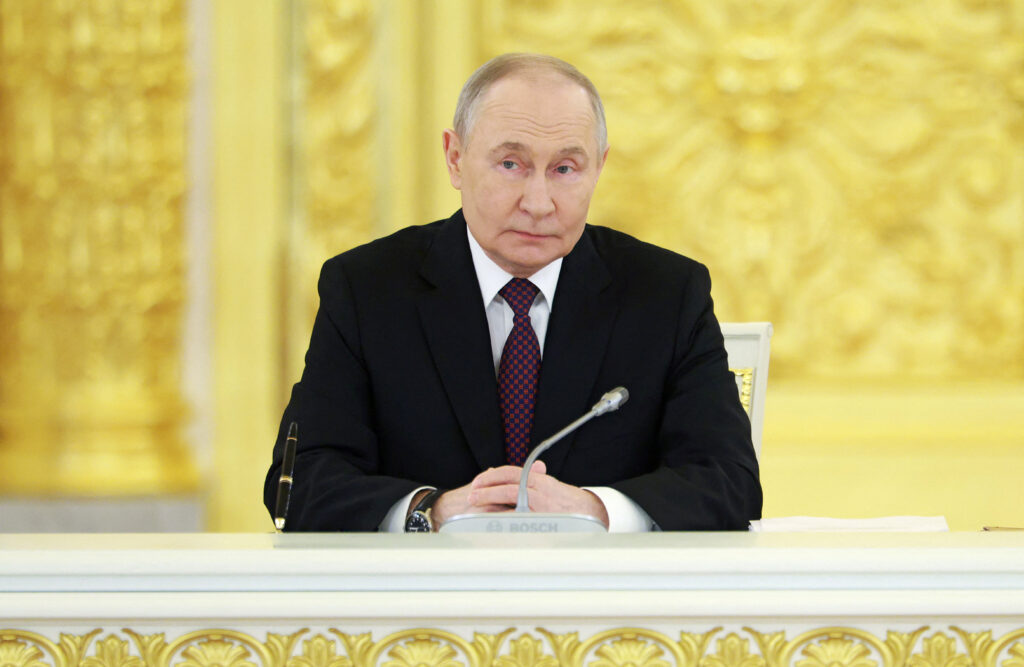
Image: Russian President Vladimir Putin attends a meeting of the Supreme State Council of the Union State of Russia and Belarus in Moscow, Russia February 26, 2026. (REUTERS/Ramil Sitdikov/Pool)