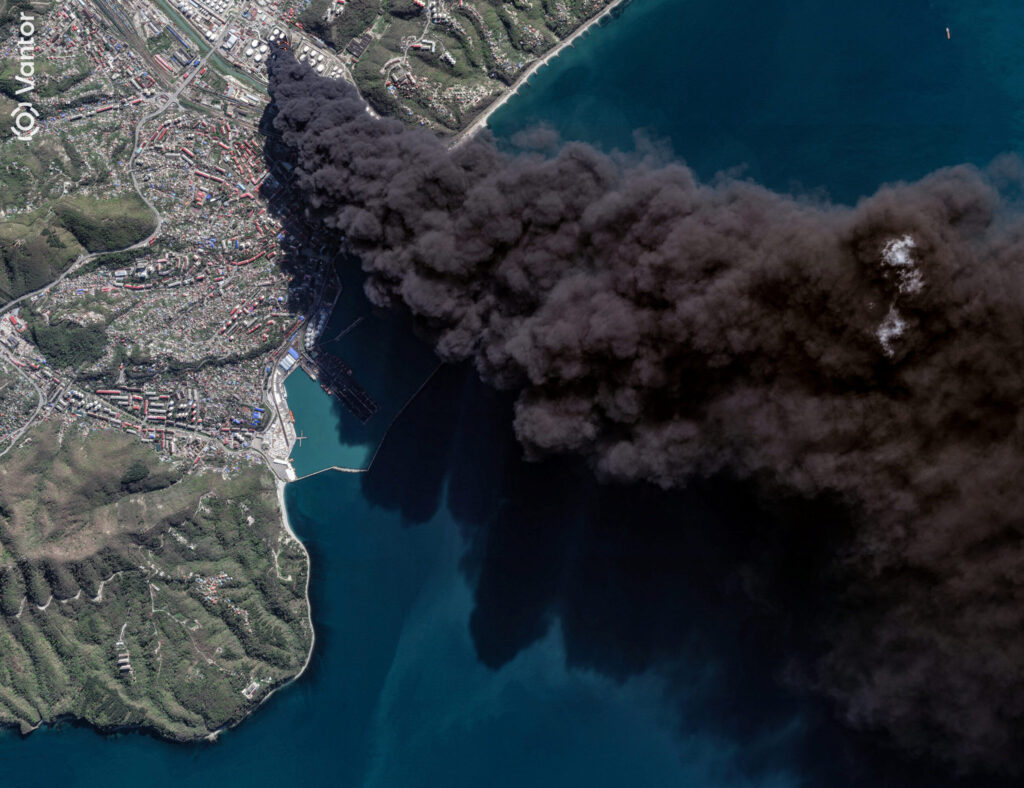
In recent months, Ukraine has intensified its strategic bombing campaign against Russia’s oil industry with a series of drone strikes on key infrastructure including ports, pipelines, and refineries. Priority targets have included the oil terminals that serve as the gateway for Russian energy exports to global markets. These attacks have inflicted significant damage on Moscow’s war economy, while also underscoring the expanding reach of Ukraine’s domestically developed long-range drone fleet.
This approach is not new. Ukraine has been bombing Russian energy infrastructure since the early months of the war as Kyiv seeks to cut the Kremlin’s primary source of revenue. However, the most recent Ukrainian bombing offensive represents a significant escalation in the air war as it has involved more drones than previous waves and has been far more destructive.
Ukrainian drone units have focused their attention on the Baltic Sea and Black Sea ports that Russia relies on to load oil for shipment. This reflects Kyiv’s determination to deny Putin a windfall as global oil prices surge amid the US-Israeli war against Iran. Prior to the outbreak hostilities in the Middle East, the Russian economy was widely thought to be under severe strain. During the first two months of 2026, oil and gas revenues plummeted by 47 percent, while mounting sanctions pressures and runaway defense spending were taking a heavy toll.
The outbreak of the Iran war abruptly reversed this trend, sparking a spike in oil prices along with the temporary relaxation of US sanctions on Russian energy exports. This led to a flurry of statements and commentaries declaring Russian President Vladimir Putin the main beneficiary of the war in the Middle East and predicting that the Kremlin war chest to fund the invasion of Ukraine would soon be overflowing.
Kyiv had no intention of sitting idly by and watching as Putin cashed in on the emerging global energy crisis. Instead, Ukraine moved quickly to increase drone strikes on Russia’s port infrastructure. The logic behind these attacks seems self-explanatory. After all, soaring oil prices are of little use to the Russians if they are unable to load and transport their product to foreign customers.
The Kremlin has sought to conceal the full extent of the the damage caused by Kyiv’s drone offensive, but research conducted by Reuters in late March indicated that Ukrainian attacks on port infrastructure had temporarily reduced Russia’s oil export capacity by approximately 40 percent. In a further indication that Ukraine’s drone strategy is working, Ukrainian President Volodymyr Zelenskyy and his influential chief of staff Kyrylo Budanov have both reported receiving requests from Kyiv’s Western partners to scale back strikes amid concerns over the impact these attacks are having on global energy markets. So far, Ukraine has resisted this pressure.
Stay updated
As the world watches the Russian invasion of Ukraine unfold, UkraineAlert delivers the best Atlantic Council expert insight and analysis on Ukraine twice a week directly to your inbox.
A number of contributing factors have helped make Ukraine’s air offensive notably more effective since the start of 2026. The main reason is the continued development of Ukraine’s domestic drone industry, which has expanded rapidly from humble beginnings in 2022 to emerge as a production powerhouse and a world leader in drone warfare innovation.
Ukraine is now producing record quantities of long-range drones, with new models regularly appearing featuring upgraded technologies designed to aid navigation and evade Russian countermeasures. Meanwhile, according to analysis by ABC News, Ukraine launched more cross-border attack drones than Russia during March 2026, the first time this has happened in any one-month period since the start of the full-scale invasion more than four years ago.
Ukraine’s booming drone industry has been recognized internationally as a major asset and is receiving strong backing from many of the country’s key allies. This support includes financing to expand drone production inside Ukraine. In recent months, Ukrainian drone companies have also concluded a number of joint ventures and production cooperation agreements with European partners.
Eurasia Center events

Ukrainian attacks on targets deep inside Russia have been aided by a sustained and coordinated campaign to degrade Russia’s air defense network with strikes on individual air defense units and radar systems. These targeted bombings have created inviting gaps in Russia’s aerial defenses for Ukrainian long-range drones to exploit, setting the stage for the large-scale attacks that have made headlines during the first few months of 2026.
There are also indications that Ukrainian drone tactics are evolving. Whereas earlier bombing campaigns often appeared sporadic or uncoordinated in nature, the most recent wave of attacks has featured multiple repeat strikes on high-value targets. These raids have been carefully timed to undermine repair efforts and increase cumulative damage. Ukraine’s April 20 attack on Russia’s Tuapse port was the latest example of this trend, coming just four days after the previous Ukrainian bombardment of the Black Sea oil export hub.
Ukraine’s air offensive against Russia’s energy infrastructure looks set to continue gaining momentum in the coming months as new Ukrainian drone and missile capabilities become available. The prospect of a further escalation in long-range Ukrainian attacks is sparking considerable alarm in the Kremlin.
Moscow recently signaled its unease by issuing a warning to Kyiv’s European partners over their continued support for Ukrainian drone production, with the Russian Ministry of Defense taking the unusual step of publishing the addresses of European companies involved in joint weapons production with Ukraine. In an accompanying statement, Kremlin officials accused European leaders of “increasingly dragging these countries into the war with Russia.”
Moscow’s thinly veiled threats are unlikely to deter Ukraine. Kyiv recently underlined its intentions by signing a series of bilateral security cooperation agreements with European countries that aim to build on Ukraine’s burgeoning reputation as a drone superpower. As Kyiv’s drone arsenal continues to grow and Russia’s stocks of air defense systems become increasingly depleted, the Kremlin may soon find it even more difficult to guard the country’s vast and vulnerable energy industry.
Giorgi Revishvili is a geopolitical analyst a former senior advisor to the Georgian National Security Council.
Further reading


The views expressed in UkraineAlert are solely those of the authors and do not necessarily reflect the views of the Atlantic Council, its staff, or its supporters.


The Eurasia Center’s mission is to enhance transatlantic cooperation in promoting stability, democratic values, and prosperity in Eurasia, from Eastern Europe and Turkey in the West to the Caucasus, Russia, and Central Asia in the East.
Follow us on social media
and support our work
Image: A satellite image shows smoke billowing from fire, following Ukrainian drone attacks on a Russian oil facility in the Black Sea port of Tuapse, Krasnodar Krai, Russia. April 16, 2026. (Vantor/Handout via REUTERS)