
Featured analysis

Latest analysis

EconoGraphics

Apr 7, 2015

Is Europe still vulnerable to a Greek default?

By Global Business & Economics Program

Private banks throughout Europe have significantly reduced their exposure to Greek debt (bank, public, and non-bank private sector debt) over the last five years. After Greece came under market pressure and eventually obtained ECB and IMF financial assistance in 2010, most European banks started to rapidly reduce their exposure to Greece. For instance, between 2010 and 2014 French banks’ holdings decreased from $63 billion to $2 billion.

Economy & Business
Eurozone

EconoGraphics

Mar 31, 2015

The IMF’s Changing Role in Europe

By Global Business & Economics

The International Monetary Fund’s purpose and scope of work have changed since its founding after World War II. Whereas at first the Fund aimed to maintain monetary and exchange-rate stability among its members who were primarily advanced economies, today it faces its first credible challenge to its status as the world’s lender of last resort.

Economy & Business
Financial Regulation

EconoGraphics

Mar 24, 2015

How Much Does it Cost for Cubans to Access Information?

By Global Business & Economics

When President Obama announced his landmark policy shift towards Cuba, easing the 54-year-old embargo, one of the first companies to announce they would begin operating in Cuba was Netflix. The online video company’s decision was surprising, if only because Cuba’s internet is one of the slowest in the world.

Americas
Cuba

EconoGraphics

Mar 17, 2015

Who Will Finance Public Debt?

By Global Business & Economics Program

Today, the cap on US government spending (or the “debt ceiling”) is officially reinstated, and with it, the threat of another clash over the national debt. Policymakers will have a runway of just months before they must decide to lift the cap on borrowing or temporarily allow it to be raised

Brazil
China

EconoGraphics

Mar 11, 2015

The Benefits of a Strong Dollar: Where Should You Go on Your Next Vacation?

By Global Business & Economics

There’s never been a better time to be a tourist—as long as you’re paying in dollars. Major currencies worldwide have plunged in value, meaning each US dollar buys more euros and renminbi today than it did one year ago.

Americas
Economy & Business

EconoGraphics

Mar 3, 2015

Who Will Collapse First?

By Global Business & Economics

Both the Ukrainian and Russian economies are suffering from recent events. While weak domestic institutions and a fight with insurgents in the country’s East plague Ukraine, sanctions and low prices for oil and gas are hurting the Russian economy.

Economic Sanctions
Economy & Business

EconoGraphics

Feb 24, 2015

Is the US Still Leading in Global Trade?

By Global Business & Economics Program

In the last two decades, the Asia Pacific region has signed sixty-five free trade agreements. South America, Eurasia, and Europe combined have signed over one-hundred and fifty agreements. Over the same period, the US has signed twelve agreements.

Americas
East Asia

EconoGraphics

Feb 17, 2015

EconoGraphics – EU Energy Dependency

By Global Business & Economics Program

A great part of Europe is highly dependent on Russian energy, which helps to explain many of the concerns Europeans have over the developments in Ukraine.

Economy & Business
Energy & Environment

EconoGraphics

Feb 10, 2015

Is Austerity to Blame for the Collapse of the Political center in the European Union?

By Global Business & Economics Program

Radical political parties in the Eurozone—including Syriza in Greece, Podemos in Spain, and Sinn Féin in Ireland—are riding a wave of popularity. The continent’s debt crisis has pitted the creditor countries, most importantly Germany, against debtor countries like Greece. On an international level, the northern European creditors have managed to implement policies that are forcing […]

Economy & Business
European Union

EconoGraphics

Feb 3, 2015

Where is the Greek Business Model Going?

By Global Business and Economics Program

Greece has once again thrust itself into the headlines as the new Syriza government led by Alexis Tspiras pledged to go back to the drawing board and renegotiate with the nation’s creditors.

Content

Econographics

Jun 2, 2023

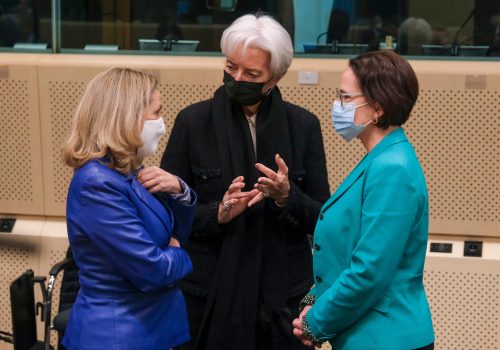
Only 11 percent of finance ministers and central bank governors are women

By Jessie Yin

Some of the most powerful economic institutions in the world are led by women at the moment, but their success hasn’t translated to broad representation. Structural barriers continue to prevent many women from reaching top roles in finance and economics.

Economy & Business
Inclusive Growth

Econographics

May 25, 2023

Global Sanctions Dashboard: US and G7 allies target Russia’s evasion and procurement networks

By Kimberly Donovan, Maia Nikoladze, Benjamin Mossberg and Castellum.AI

Tackling export controls circumvention by Russia; the enforcement and effectiveness of the oil price cap; the failure of the US sanctions policy towards Sudan, and how to fix it.

Africa
Economic Sanctions
Sunset at the Treasury Department

Econographics

May 23, 2023

There is no alternative to US Treasuries

By Josh Lipsky

In the wake of a US default, investors searching for safe assets may have no viable alternative to US Treasuries.

China
Economy & Business

Econographics

May 19, 2023

Can FedNow bring the US closer to real-time payments?

By Piret Loone

This year, the US will launch its FedNow instant payment network. But even after FedNow launches, the US will still have a ways to go before consumers can access instantaneous digital payments.

Economy & Business
Financial Regulation

Econographics

May 15, 2023

The US debt ceiling stalemate threatens money market funds—and financial stability

By Hung Tran

Money markets would be the first to react to a debt ceiling breach, heightening market turmoil at the wrong time and helping to raise the odds of a severe recession.

Economy & Business
Financial Regulation

Econographics

May 10, 2023

What is the G7 still exporting to Russia? 

By Niels Graham

One year into the Russia's invasion G7 nations continue to export nearly $5B a month to Moscow. A new proposal by the US at the G7 could greatly reduce this.

Economic Sanctions
Economy & Business

Econographics

May 8, 2023

Japan’s monetary trilemma is a warning to the world

By Mark Siegel

High inflation, high levels of debt, and uncertain financial stability - Washington, London, Brussels, Frankfurt and beyond have much to learn from Tokyo's experience.

Economy & Business
Financial Regulation

Econographics

May 1, 2023

Russia Sanctions Database: May 2023

Explore featured insight part of the May 2023 edition of Atlantic Council's Russia Sanctions Database.

Russia
Ukraine

Econographics

Apr 27, 2023

The root causes of geopolitical fragmentation

By Hung Tran

Geoeconomic fragmentation is on the rise. Policymakers need to address the root causes: inequality left in the wake of globalization, and the crisis of trust between major countries.

Americas
China

Econographics

Apr 26, 2023

Why emerging markets are stocking up on gold

By Phillip Meng

Financial stability concerns, sanctions, and inflation contributed to the largest net purchases of gold in over seventy years last year—raising questions about its potential role in de-dollarization.

Africa
Americas