Content

New Atlanticist

Jul 27, 2020

Two years after Rose Garden deal, Europe prefers to wait it out

By Bart Oosterveld

Two years after the Juncker-Trump summit, a realistic scenario for transatlantic trade discussions in the next few years is progress on minor aspects. Think of lullaby topics like closer alignment of insurance regulation. With such political uncertainty, policymakers on both sides of the Atlantic will hope for agreements that the press tunes out quickly and make sure that farmers do not block the access roads to Paris.

European Union
Eurozone

The future is here

Jul 27, 2020

Spain quarantine measures roil travel industry, vacation plans; US stimulus in focus

By Atlantic Council

New UK quarantine measures on travelers returning from Spain roiled Europe’s travel industry and disrupted summer vacationers' plans. Coronavirus cases increased from Hong Kong to Australia, while talks about a new US package of economic stimulus measures garner attention in the week ahead.

Coronavirus

New Atlanticist

Jul 27, 2020

Europe and the US should remember their Rose Garden intellectual property pledge

By Marc L. Busch

While progress on protecting intellectual property since the summit has been disappointing, it still provides a compelling opportunity for the United States and Europe to join forces to protect this key economic freedom.

European Union
Eurozone

New Atlanticist

Jul 27, 2020

The curious case of the US Treasury and Gaz Group

By Brian O’Toole

The US Treasury Department’s Office of Foreign Assets Control (OFAC) very quietly issued two extensions of general licenses on July 22 related to Vladimir Putin-tied oligarch Oleg Deripaska’s Gaz Group that, while apparently going unnoticed, constitute a significant change in the sanctions on Gaz, which can now seemingly operate according to something like business as usual.

Economic Sanctions
Russia

Event Recap

Jul 27, 2020

Event recap | Increasing resilience by assuring trust in medicine, credentials, and supply chains

By Henry Westerman

On Thursday, June 18, 2020, the Atlantic Council’s GeoTech Center hosted Mr. Yves Daccord, Former Director General of the International Committee of the Red Cross, Dr. Philippe Gillet, Chief Scientific Officer of SICPA, Mr. Toomas Hendrik Ilves, The former President of the Republic of Estonia, Dr. Idris Guessous, Head of the Division of Primary Care Medicine at the University Hospitals of Geneva, Mr. Peter Rashish, Senior Fellow and Director of the Geoeconomics Program at the American Institute for Contemporary German Studies, Ms. Danielle Tavino, VP and Co-Founder of Code-X, and Dr. Divya Chander, Faculty Chair Neuroscience at Singularity University.

Coronavirus
Economy & Business

UkraineAlert

Jul 24, 2020

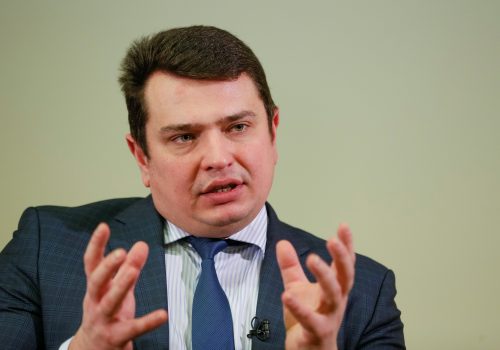
Ukraine’s anti-corruption efforts go up in smoke

By Peter Dickinson

A July 23 arson attack on the home of leading Ukrainian anti-corruption activist Vitaliy Shabunin has sparked concerns over the country's continued commitment to reforms under President Zelenskyy.

Corruption
Democratic Transitions

EnergySource

Jul 24, 2020

The ACWA Power–Air Products joint venture for green hydrogen: A new Saudi energy policy?

By Jean-François Seznec and Samer Mosis

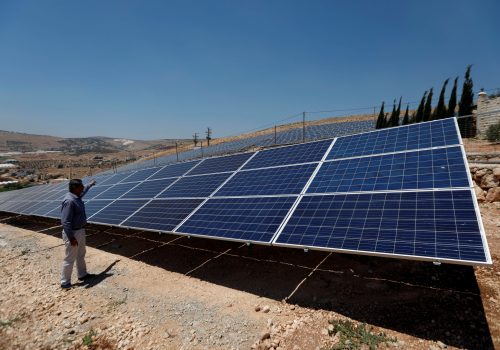
In early July 2020, the city of Neom and ACWA Power of Saudi Arabia signed a joint venture agreement with Air Products of the United States to build the largest green hydrogen and green ammonia plant in the world. As the energy transition gains speed, this announcement is a significant step forward in establishing a new role for Middle Eastern oil-exporting countries in a future global economy less dependent on hydrocarbons. That said, the scale and relative inexperience of key project partners means the project still faces an uphill battle.

Energy & Environment
Energy Markets & Governance

EnergySource

Jul 24, 2020

Searching for the missing link: Options for firm zero-carbon power

By Stephen S. Greene

“Firm” zero-carbon generation resources, which are not necessarily intended to run all the time, but can be available at any time, will be needed to complement renewable resources in the future, without emitting the CO2 produced by today’s fossil energy system. These resources might include, for example, fossil-fuel power plants with carbon capture, nuclear power plants with improved dispatchability, geothermal power, and bio-fueled generators. But the path to developing, and certainly deploying, such resources has been slower and more fraught than for renewables; these “firm” electricity generation resources represent a missing link in the path towards a decarbonized electricity grid.

Energy & Environment
Nuclear Energy

The future is here

Jul 24, 2020

India cases surge to record; Europe economic recovery increases pace after lockdowns

By Atlantic Council

Cases surged in India, with a record daily increase in cases and the western state of Maharashtra severely affected. Many states in the United States saw record increases too, while the pace of economic recovery picked up in Europe following the easing of lockdowns.

Coronavirus

IranSource

Jul 24, 2020

Why did Iran back Mustafa al-Kadhimi as Iraqi prime minister?

By Hassan Ahmadian

A key reason for this is that the American-installed political structure in Iraq after the overthrow of Saddam Hussein has never really been successful in terms of fulfilling the main responsibilities of a state: providing security and basic necessities of life to the Iraqi people.

Iran
Iraq