Latin America and the Caribbean in 2026: Ten defining questions for the year ahead
2026 could redefine Latin America and the Caribbean’s political and economic future.

The past year reshaped Latin America and the Caribbean in ways that will echo into 2026. The return of Donald Trump to the White House introduced new US priorities and a greater regional focus, as the administration imposed new tariffs and elevated the Western Hemisphere as a top priority.
Elections brought mixed outcomes. Argentina handed President Javier Milei a legislative boost in the midterms. In Bolivia, voters rejected the ruling party’s candidate. Honduras held presidential elections November 30 after logistical challenges and institutional disputes. (No winner had been announced as of this writing in mid-December.)
In Venezuela, increased US military operations in the Caribbean added pressure on the Maduro regime amid a renewed focus on countering drug trafficking. Across the Caribbean, countries continued calling for more support to strengthen resilience after Hurricane Melissa caused widespread damage.
The year ahead will test the region on multiple fronts, from the long-anticipated review of the US-Mexico-Canada Agreement (USMCA) trade pact to high-stakes elections in Colombia, Brazil, and elsewhere—as well as an exciting summer marked by the World Cup.
What might be in store for Latin America and the Caribbean in 2026? Read on for our annual ten questions about the year ahead.

Will Nicolas Maduro still be in power at the end of the year?
Hopefully not.
Maduro’s dictatorship has been devastating for the Venezuelan people, the country’s institutions, and the Latin American region at large. Eight million Venezuelans have been forced to flee their homes as his repressive and parasitic regime exacerbates hyperinflation and poverty and erodes democratic processes in the country.
When Maduro stole the presidential election from the democratically elected Edmundo González in July 2024, Venezuelan authorities carried out brutal systematic repression campaigns to suppress any political dissent.
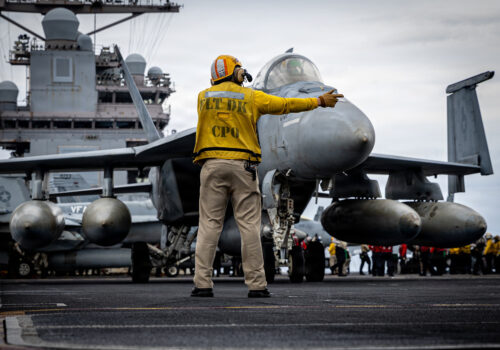
The US military positioning in the Caribbean—which includes the world’s largest aircraft carrier, the USS Gerald R. Ford—adds pressure on Maduro’s regime, as does the recent announcement of a blockade of all sanctioned oil tankers. Illegal oil revenue that comes through a shadow fleet of tankers helps to prop up Maduro. The Trump administration has yet to show its cards regarding whether it will attempt to negotiate an exit deal with Maduro, if it will seek to remove him through military action, or pursue another option. The US military deployment, which began in late August 2025, is one of the largest to take place in the Caribbean. But pressure will escalate for it to deliver results, and Maduro must come face to face with his increasingly limited options. There are many factors at play when it comes to the possibility of Maduro leaving power in Venezuela. The real goal should be not just for Maduro to leave power, as he could be replaced by a similarly repressive ally, but a real, long-awaited democratic transition.

After Colombia elects a new president, will Bogota and Washington return to a closer partnership?
Yes.
The next year is bound to be an important one for US-Colombia relations, as a presidential election will be an opportunity to begin forging closer ties. Colombia has historically been one of the United States’ closest partners in the hemisphere, designated a major non-NATO ally and seen as central to preserving regional stability. In 2025 the relationship hit lows it hasn’t seen in decades. Tensions have largely been tied to clashes over the last few years between President Gustavo Petro and his American counterparts, however, rather than changes in the overall relationship at a subnational or people-to-people level.
With approximately ninety presidential pre-candidates and more than one-quarter of voters telling pollsters they are undecided, the election’s outcome is anyone’s guess. Regardless of who wins, the next Colombian administration will inherit a complex security landscape marked by rising violence and increasingly fragmented criminal organizations, making a partnership with Washington essential. Bilateral ties are unlikely to bounce back immediately or to revert to the way they were. But both sides will have strong incentives to rebuild trust, with Bogota focused on securing US support for counternarcotics efforts and Washington aiming to control the threats of transnational organized crime.
It will be important for the next Colombian president to show early willingness to cooperate with Washington, set a pragmatic tone, and restore predictable channels of communication. Doing so, despite any political or ideological differences, will be key to rebuilding a new type of partnership that may be more focused in scope, especially at the outset.

Will the left regain ground across Latin America in the 2026 elections?
No.
Over the last two years, voters across the region have rewarded candidates running on hard security, market-friendly, and anti-establishment platforms (think José Antonio Kast in Chile, Milei in Argentina, Nayib Bukele in El Salvador, and Daniel Noboa in Ecuador). The trend is similar at the subnational level. Chile’s 2023 constitutional council was decisively conservative, though it was rejected by voters. Brazil’s 2024 municipal races strengthened Jair Bolsonaro-aligned forces, and Colombia’s 2023 local elections punished Petro’s left coalition.
Considering the regional pendulum swung left earlier in the decade and produced a crowded “pink” map, it would be simplistic or misleading to say that a conservative wave is now sweeping over the region. Voters seem to be driven more by anti-incumbent sentiment and security fears than by any left or right ideology.
Heading into 2026, right-leaning forces are well positioned in Costa Rica, Brazil, Colombia, and Peru, where crime, migration, and the state of the economy dominate voter concerns. Trends and leading candidates in Costa Rica, for example, suggest that voters are backing more personalistic candidates from nontraditional parties rather than more traditional and conservative parties. So, while we could expect at least a few of the aforementioned countries to lean right, security, anti-corruption, and economic competence might matter more than left-right labels.

Will the review of the US-Mexico-Canada Agreement reshape North American trade?
Maybe.
The review comes at a moment when all three countries face economic and political pressures. The United States might push for stronger enforcement of labor and environmental standards, and a baseline of protections for the US to prevent countries such as China from shipping their goods through USMCA countries and then trying to claim “rules of origin” benefits.
And while US Trade Representative Jamieson Greer noted December 10 at the Atlantic Council that he continues to meet separately with Mexico and Canada, the United States’ USMCA partners may also seek additional updates. Mexico could press for more flexibility in energy and automotive rules. Canada might seek updates on digital trade, dairy market access, and environmental cooperation. These issues matter but expect governments to act cautiously, with the possibility of separate bilateral protocols in the final agreement. Reopening too many chapters could create uncertainty for businesses and supply chains that depend on stable and predictable rules.
Because North America’s economies are so interconnected in autos, agriculture, and energy, even small changes could have large effects. For this reason, the most likely outcome is an integral review that keeps at least the core benefits of the USMCA intact. The three governments might add clarifications, strengthen enforcement tools, or expand cooperation without fundamentally rewriting the deal.
USMCA review can provide a pragmatic roadmap for reshaping North America’s trade, if parties are open to discussing the fundamentals to be strengthened at this point. These include enforcing clear rules of origin, transparent technical frameworks, customs modernization, interoperability, and the rule of law to protect investment and provide overall security to businesses.

Will Milei’s economic reform agenda gain momentum?
Yes.
Argentina has long needed sizable structural revamps across key areas including tax, labor, and pension systems to unlock sustained growth, strengthen competitiveness, and ease pressures on businesses and consumers alike. While Milei has advanced parts of his agenda through executive action, the country has now reached the point at which deeper and more transformative changes require congressional approval. The challenge is that, although the government will enter next year with a sizable minority in congress, its caucus will still need to work with moderate opposition legislators to pass key legislation.
Many legislators appear willing to engage in dialogue to allow meaningful progress, and securing their support would both make these measures viable and send a powerful signal to markets that Argentina’s political class is broadly committed to long-term stability and modernization. That is why progress is likely, particularly when it comes to tax and labor reform. But the ultimate outcome will depend heavily on the administration’s ability to negotiate with provincial governors, whose delegations form a majority of the moderate opposition bloc. Watch out for early successes in the first months of 2026, which might set the tone for the legislative agenda throughout the year, defining the scale of the administration’s ability to pass reforms.

Will Latin America and the Caribbean surpass their growth projections for 2026?
Yes.
Although Latin America is expected to continue experiencing relatively slow growth in 2026 compared to other emerging-market regions, progress in US-Latin America economic engagement and improvements across several key macroeconomic variables create a credible pathway for the region to exceed current projections.
Economic forecasts suggest that 2026 will not be a transformative year for most countries. Argentina and Guyana are the primary exceptions, with Guyana standing out as the only Caribbean country among the world’s thirty fastest-growing economies. Even so, the region has meaningful upside potential on trade. Stronger-than-expected export performance could lift regional growth, especially if recent announcements on commodities lead to further reductions in trade barriers with the United States. A pickup in demand from major markets, including China, could provide an additional boost. These improvements would help offset the decline in the region’s overall trade surplus projected by the International Monetary Fund (IMF).
At the same time, a gradual easing of monetary policy in the European Union (EU) and the United States could help revive foreign direct investment flows, which have slowed since the post-pandemic surge. When combined with country-specific recoveries such as Argentina’s stabilization process and continued gains from energy and mineral projects across the region, these factors create a realistic opening for Latin America and the Caribbean (LAC) to surpass the current IMF growth projection of 2.3 percent for 2026.

Will the United States counter Chinese investment more aggressively in Latin America?
Yes.
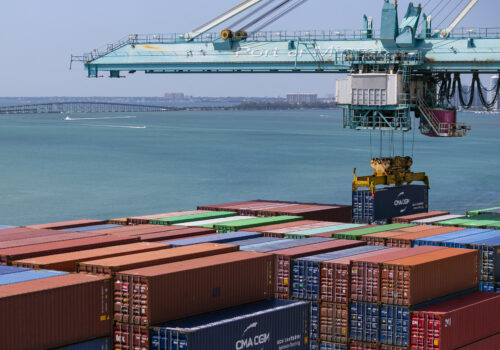
The Trump administration’s sharp rhetoric toward governments seen as aligning with Beijing has already signaled a tougher stance, and this pressure will grow as Washington confronts the strategic nature of China’s investments in the region. While US companies invest far more than Chinese firms in overall volume, much of that investment in the region goes to low-risk service sectors.
China, meanwhile, is expanding its influence through targeted bets on critical minerals, energy, infrastructure, and transport, which shape long-term supply chains and political leverage. For the United States to remain competitive, it will need to shift its policies to encourage more strategic investment. This means reducing costs and risks for US firms, expanding development finance tools, and partnering more closely with multilateral banks to help US companies enter the sectors in which China currently dominates.
The US International Development Finance Corporation (DFC) is due to be reauthorized and recapitalized in 2026. This will help to provide some of the capital necessary to lower the barrier of entry to US companies engaging in capital-intensive projects such as infrastructure and extractives—two sectors in which China has had stronger influence in LAC. The unveiling of a holistic economic diplomacy initiative by the White House, such as America Crece 2.0 (a more comprehensive version of its predecessor during Trump’s first term), could further support US efforts in the region.

Will the Caribbean improve hurricane response and coordination?
Maybe.
Better coordination will require stronger regional planning and risk management, but past storms have shown the severity of the challenge. Partnerships with the Inter-American Development Bank and programs such as One Caribbean can help prepare projects, support public-private partnerships, and manage political risk.
Local participation in risk mitigation remains essential because many Caribbean firms operate as family businesses with deep community ties. If countries and investors work together by expanding financing tools, strengthening regional institutions, and supporting resilient infrastructure, the Caribbean can recover more quickly and prepare for stronger storms.
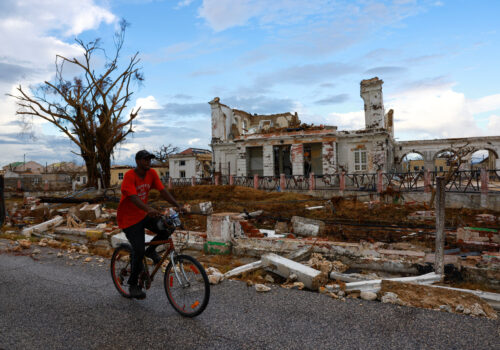
Jamaica is an example of the daunting challenge ahead. For more than a decade, Jamaica kept a primary surplus above 3 percent of gross domestic product (GDP) and reduced its debt, earning US bipartisan recognition for steady governance. In September 2025, Standard and Poor’s (S&P) Global Ratings upgraded Jamaica to BB minus with a positive outlook. But Hurricane Melissa caused almost $8 billion in damage, nearly half of Jamaica’s annual GDP. The country’s $250-million catastrophe bond will likely pay out in full. Yet that amount cannot cover losses of Melissa’s scale.
Across the region, Caribbean Community (CARICOM) countries lose an estimated 2 percent of their infrastructure capital stock each year to climate-related damage. The growing frequency of severe storms raises insurance costs and stretches already limited public budgets.

Will security remain the top voter priority across upcoming elections?
Yes.
Voters across Costa Rica, Peru, Colombia, and Brazil will head to the polls with security top of mind.
In Costa Rica, concern over rising violence jumped from 30.3 percent to 43.7 percent between November 2024 and April 2025. Fifteen of the twenty presidential candidates have placed security at the center of their agendas, with many proposing education reform and youth-focused opportunities to tackle the roots of violence.
Peru has seen one of its most violent years since 2017. Homicides are up 12.8 percent and extortion complaints 27.4 percent compared to 2024. Instability peaked after the attempted assassination of a cumbia band triggered President Dina Boluarte’s impeachment and the swearing in of Jose Jeri as her successor. With protests, unrest, and a surge in criminal extortion targeting informal workers and small businesses, voters will demand immediate solutions.
In Colombia, “total peace” efforts fell short, deepening the security crisis and straining relations with the United States, the country’s long-standing security ally. Armed groups expanded control, coca cultivation reached record highs, and violence surged. This included large-scale displacement in Catatumbo, an attack on a police helicopter that killed thirteen officers, and a bombing in Cali. Nearly one-third of Colombians now see security as the country’s top problem.
In Brazil, security will compete with economic concerns, but October’s Operação Contenção in Rio de Janeiro, the deadliest police raid in the country’s history with 120 victims, has pushed violence to the center of public debate. Gangs continue to control neighborhoods and challenge state authority. While economic pressures remain significant, security is poised to drive the political conversation in 2026.

Will the United States lift the additional 40 percent tariffs on Brazilian goods?
Yes.
The additional 40 percent tariffs on Brazilian goods are likely to be lifted or significantly reduced in 2026. Trump and Brazilian President Luiz Inácio Lula da Silva had a positive meeting in Malaysia in late October, and trade negotiations have been ongoing and a priority ever since. The United States and Brazil share a long-standing diplomatic relationship, and the United States has historically enjoyed a trade surplus with Brazil. Many imports from Brazil supply US demand for products that are not produced domestically, such as coffee and bananas; others are imported as input for US manufacturing, such as wood panels and airplane parts.
The Trump administration has already begun rolling back some of the additional duties. On November 20, several Brazilian products were removed from the list of those subject to the additional 40 percent tariffs, including beef and coffee, for which Brazil is the United States’ top supplier. A Supreme Court decision on the legality of International Emergency Economic Powers Act (IEEPA)-based tariffs—expected soon—would also impact Brazilian and global tariffs: Because the administration cited IEEPA to levy the tariffs, a ruling against the use of IEEPA in this way could put all of the administration’s added tariffs on Brazil at risk. Together, the diplomatic momentum, economic reasoning, and legal backdrop all point toward favorable conditions under which many of these tariffs could be lifted in 2026.

Bonus question: Will Argentina repeat its World Cup title?
Maybe.
Argentina will enter the 2026 tournament with its eyes firmly on back-to-back glory, but the biggest wildcard is Lionel Messi. The captain has given no guarantees that he will lead the team next summer, leaving fans wondering whether “La Pulga” will take one more shot at the world’s biggest stage. Even without certainty about his presence, Argentina remains one of the strongest contenders, backed by a talented roster.
But the region will not make it easy. Colombia returns to the World Cup after eight years with a revitalized team eager to prove it can compete with the best. Brazil will arrive hungry to reclaim its historic position in the World Cup hierarchy, with pressure mounting after more than two decades since it last lifted the trophy. Mexico will face the added pressure of competing as a host nation. Ecuador, Paraguay, and Panama will all look to make their mark and test regional rivals.
The tournament will unfold across the United States, Mexico, and Canada, setting the scene for an unforgettable summer. Argentina is well positioned, but the path to glory will be anything but simple. There is no certain answer for now.
This publication was updated December 17 to reflect news developments.
Related content
Explore the program
The Adrienne Arsht Latin America Center broadens understanding of regional transformations and delivers constructive, results-oriented solutions to inform how the public and private sectors can advance hemispheric prosperity.
Image: Photo by analuisa gamboa on Unsplash