Trump is fighting two wars with Iran. He needs to win both.
The newest edition of the Economist puts it this way: “The conflict ravaging the Middle East may best be understood as two parallel wars. One is the campaign of American and Israeli air strikes against the Iranian regime; the other is Iran’s war on the global economy.”
If US President Donald Trump fails to address both simultaneously and successfully, he risks turning what has thus far been a tactical military success into a strategic failure with longer-term consequences for international stability.
The first war is one of missiles, drones, and Israel’s targeting of Iranian leaders, now entering its fourth week. By most measures, Iran is losing that war, as the United States and Israel reduce Iranian conventional military capabilities more every day. Nevertheless, Washington thus far has underestimated the Iranian regime’s resilience, dispersal of critical weaponry, and ability to continue attacking its neighbors.
That brings us to the second conflict unfolding in shipping lanes, in energy markets, and among political leaders. In its war on the global economy, Iran maintains dangerous leverage. Tehran’s moves to halt shipping in the Strait of Hormuz, a narrow artery in the global energy economy’s circulatory system, has produced shocks to the global system.
Trump’s ultimatum to Iran over the weekend to fully open the strait within forty-eight hours or suffer attacks on its power plants, and Iran’s threats to further clamp down on the waterway and retaliate against US and allied infrastructure in response, have vividly underscored the linkages between these two wars.
How Iran claims ‘victory’
Geoeconomic weaponry will be as critical as military materiel in determining the outcome of this two-front conflict. Iran can’t defeat the United States and Israel militarily, but it may not need to. It only needs to ratchet up the cost of military action to a level that fractures American political will. Iran’s relatively inexpensive tools—missiles, drones, proxies, mines, even just the fear of the use of these tools—can disproportionately disrupt systems built on predictability.
Conventional wisdom holds that Trump must decide which war to prioritize because he can’t win them both. Some argue, for example, that to relieve the economic pressure Iran is applying, Trump should bring his military efforts to a rapid close even if the mission isn’t yet complete. Nothing, however, could be more short-sighted than leaving a vengeful and still formidable Iranian regime in place—one that can further rebuild its military capabilities over time and conduct terrorist attacks, after achieving the “victory” of countering the United States and Israel through asymmetric means.
For Tehran, regime survival would be sufficient triumph. It will tell its people, its proxies, its partners China and Russia, and the wider world that it absorbed the blows of the world’s greatest military power and exposed its vulnerabilities. That narrative will travel far beyond Iran, serving as a playbook that other US adversaries will employ.
How the US emerges victorious
For the United States, winning the two-front war doesn’t mean an open-ended military campaign with maximalist goals. What it would require is something that has been difficult to discern so far: a concerted strategy by the Trump administration that recognizes the larger stakes of this moment for the United States and its still-hedging allies.
What would such a strategy look like in practice? It would start with US forces stepping up their targeting of the missile, drone, and maritime capabilities that underpin Tehran’s asymmetric strategy, weakening them to the point that they are an occasional nuisance but not an ongoing threat. The United States also must decisively break Iran’s ability to hold the global economy hostage, beginning with opening the Strait of Hormuz. This step can be taken together with Gulf allies that now have no remaining doubt that their adversary is Iran, not Israel. These countries will proceed to structure their militaries and defense plans accordingly.
Beyond opening the strait, Trump will need to reach into his familiar geoeconomic toolkit if he hopes to win the economic war with Iran. As the Atlantic Council’s Josh Lipsky has written in the Wall Street Journal, such tools—from shipping insurance to asset seizures—used to be far more commonplace in conflict. On Friday, Trump temporarily waived sanctions on Iranian oil in order to calm global markets, but that was a defensive economic move rather than a proactive one. The United States possesses not only the world’s strongest military but also its largest economy. As his tariffs have shown, Trump is not afraid to leverage that power.
Israeli forces, for their part, should continue targeting the Iranian regime, particularly leaders of the Islamic Revolutionary Guard Corps (IRGC). Undermining the IRGC would have the additional benefit of weakening Iran’s regional proxy networks, which have done so much harm over the past half century. If the IRGC remains strong after this conflict is over, it would allow the Iranian regime to regenerate its coercive power—both within Iran and across the region.
Even if the US and Israeli campaign does not result in regime change in Tehran, it should aim to produce a changed regime that lacks capacity to seriously threaten its neighbors, the United States, and the global economy. It may have been wishful thinking for Trump to call on Iranians to rise up against their despotic leadership, particularly after the regime killed as many as 30,000 demonstrators earlier this year. However, the more that the United States, Israel, and its partners defang Iran’s regime and its enforcers, the greater the chance of the regime’s eventual collapse.
Trump’s forty-eight-hour deadline has focused the world’s attention on the immediate future. But his administration also must focus on building what comes after the war: a more resilient and robust Gulf security architecture in which Saudis, Emiratis, and their neighbors join in common cause despite their inevitable differences. Given the economic and strategic significance of the region, the United States will need to join with European allies and Asian stakeholders, including China, to share the burden and responsibility of safeguarding the world’s economic lifelines.
Many US allies opposed the Trump administration’s decision to go to war alongside Israel in Iran. Some supported it. But particularly as the war continues across two fronts, one aimed at the global economy, all have a stake in its outcome. The Trump administration now must stay the course to win both aspects of this war. As it does so, Washington would do well to rediscover the neglected value of coalition-building and alliances in managing a world where continued volatility will require every friend the Trump administration can muster.
Frederick Kempe is president and chief executive officer of the Atlantic Council. You can follow him on X @FredKempe.
This edition is part of Frederick Kempe’s Inflection Points newsletter, a column of dispatches from a world in transition. To receive this newsletter throughout the week, sign up here.
Further reading
Fri, Mar 20, 2026
Tracking US military assets in the Iran war
Trackers and Data Visualizations By
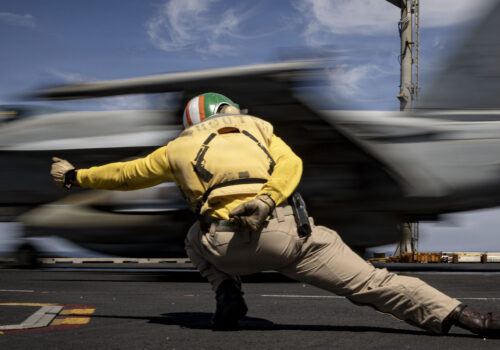
What is the US military committing to the war in Iran? How will that affect the US presence in other theaters around the world—including the Pacific, where the United States faces its most consequential challenge? We’re tracking the aircraft carriers, bombers, and missile defense systems deployed to Operation Epic Fury.
Wed, Mar 18, 2026
Now that the Iran war is here, the US must complete its mission
Inflection Points By Frederick Kempe
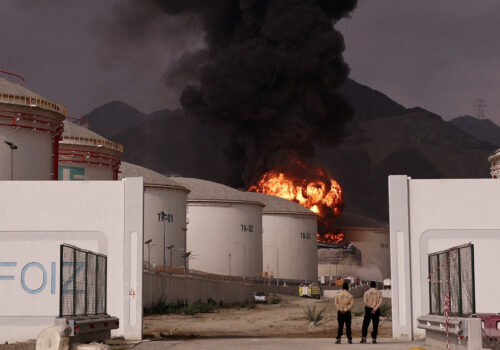
The US-Israeli operation in Iran is a historic opportunity to neutralize the Middle East’s greatest destabilizer over the past four decades.

Wed, Mar 11, 2026
Twenty questions (and expert answers) about the Iran war
Dispatches By
As the US-Israeli war against Iran reverberates across the Middle East and the globe, Atlantic Council experts bring clarity to the fast-moving events.
Image: Symbolic mock-ups of Iranian missiles are displayed on a street, amid the U.S.-Israeli conflict with Iran, in Tehran, Iran, March 22, 2026. Majid Asgaripour/WANA (West Asia News Agency via Reuters Connect)