BRUSSELS—You’ve heard the joke: Heaven is where the police are British, the cooks are French, the mechanics are German, the Italians . . . are in charge of romance, and it’s all organized by the Swiss. The punchline makes hell a place where these roles are redistributed in a less ideal way, where the mechanics are French and the romantics Swiss. Outdated as the joke may be, it does offer some slight reassurance. Europe is a continent of many talents and can stay ahead if everyone plays their part.
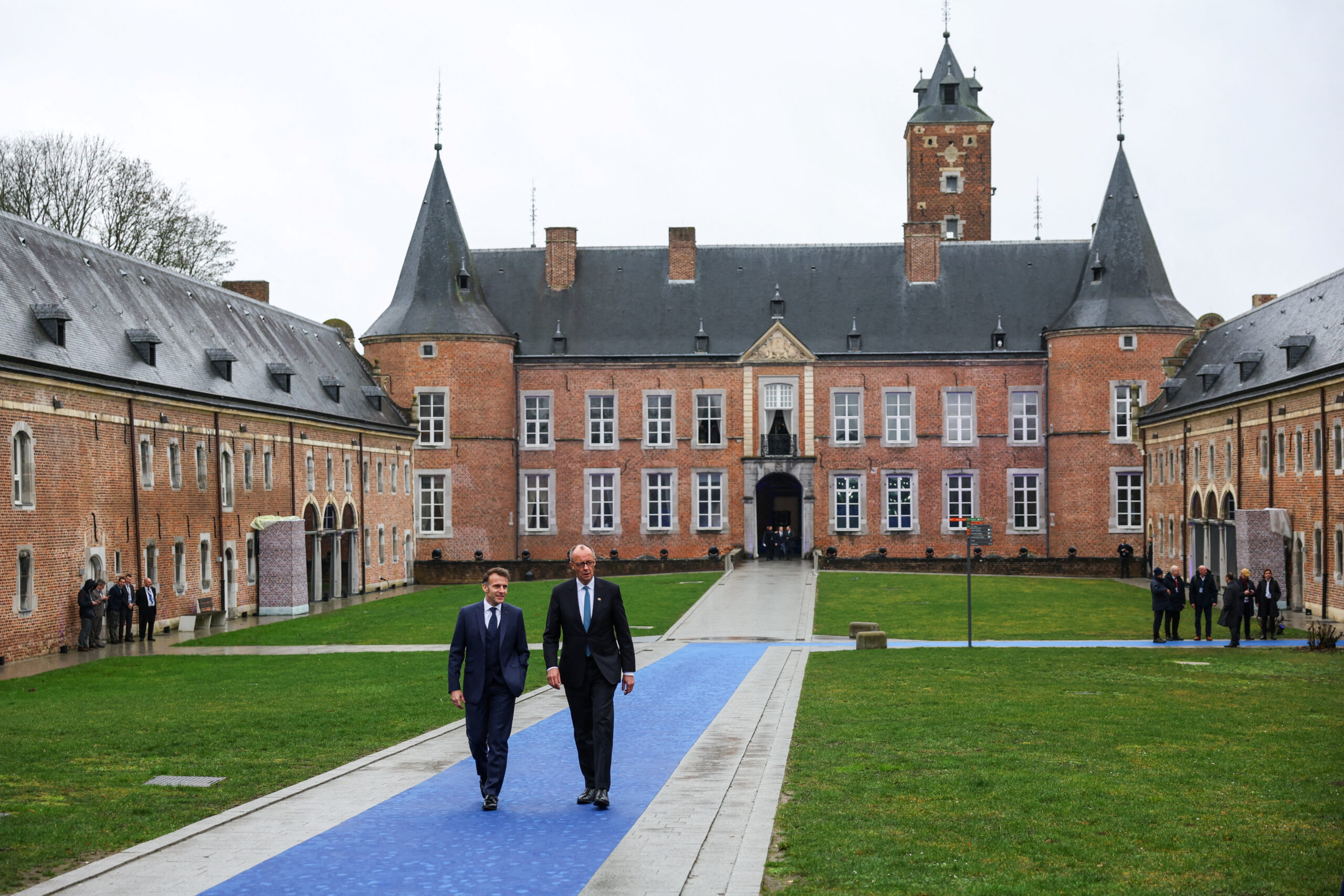
Last week, in a Flemish castle that gives the best châteaux a run for their money, the European Union’s (EU’s) heads of state and government gathered in Limburg, Belgium, for an informal summit on competitiveness. Sluggish growth and Europe’s dwindling share of export markets have imposed a sense of urgency. The summit didn’t end with a joint statement given its informal nature, but the message carried by most leaders on their way in was that tinkering with the single market and new trade deals will not be enough to jumpstart European competitiveness.
Europe’s problems are clear. In April 2024, former Italian Prime Minister Enrico Letta’s report for the European Commission outlined what afflicted the single market. In September of that year came former European Central Bank President Mario Draghi’s report on European competitiveness. Both reports point to needed reforms, but these will take time. More immediately, action is needed to protect Europe’s industrial capacity, which has fallen by 9 percent in the important chemicals sector since 2022. Shoring up what remains of this capacity demands lower energy prices, with targeted subsidies by national capitals and an EU-wide loosening of the Emissions Trading System. Even protective measures might be necessary.
It is commonplace to assume Europe isn’t up to the challenge. Europe currently appears weak because the geopolitical and economic certainties that it has relied on have been disrupted by Russia, China, and lately the United States. On occasions when it hasn’t remained a spectator, it has managed to shift things: on Greenland, with modest deployments of soldiers and the threat of tariffs, and on Ukraine, with money and intelligence-sharing to backfill the United States’ contributions. But addressing the EU’s economic weakness is more challenging; the results are measured in euros and jobs. The need for “quick wins” smashes against the big dichotomies that define the bloc, where economic sovereignty can be pooled but not national security, and talk of a “fiscal union” remains a red flag to the electorates of the less-indebted member states.
Nonetheless, European leaders now appear to be moving with a welcome sense of urgency. The situation is not without its irony: Predominantly French ideas—strategic autonomy engineered by a degree of industrial policy—have been vindicated by events, but now France itself appears paralyzed by political dysfunction.
French President Emmanuel Macron’s main message ahead of the Limburg summit was a call for €1.2 trillion annually in new debt taken on by the whole EU, in addition to member-state borrowing. The projects this debt would fund might indeed be valuable, such as boosting infrastructure resilience and preparing Europe for quantum computing. But there’s a lingering sense that this plan will allow Paris to delay its efforts to raise the retirement age in France and, more broadly, to avoid addressing the sustainability of its social model. When the embattled French Prime Minister Sébastien Lecornu undid some of Macron’s pension reforms to secure a parliamentary majority for the 2026 budget, the spread between French and German debt went down, not up, as a reward for short-term stability. The early resignation of Banque de France Governor François Villeroy de Galhau, who plans to step down in June—allowing Macron to appoint his successor before the 2027 French elections—adds to a sense that the French elites feel the political extremes are ever more likely to win power. Few mainstream French politicians will want to increase the extreme parties’ odds by forcing through unpopular reforms before the next election.
If even the markets can’t be expected to discipline France, then Paris will remain a poor advocate for joint debt issuance. After the Munich Security Conference, for instance, German Foreign Minister Johann Wadephul said that France would have to make more of an effort on updating its social model to have a credible path to meet the new NATO defense and defense-related spending goals of 5 percent of gross domestic product by 2030.
This means that the push for joint debt issuance will have to come from unusual voices, starting with Germany. Joachim Nagel, president of the Bundesbank, said recently that common European debt instruments deserve serious discussion—a signal that would have been unthinkable from Frankfurt even three years ago. Berlin is also engaging more constructively than in the past with the French Group of Seven (G7) presidency’s ambitious agenda to create a roadmap toward moderating macroeconomic imbalances that stem from uneven trade flows. A cynic would say this is because China has surpassed Germany as the main current account surplus powerhouse. The more charitable view is that—through its push for military spending—Berlin is now behaving the way imbalances experts would have wanted ten years ago.
All the issues at hand are complex, yet the demand for “quick wins” by smaller member states is not misplaced given the very real prospect of more industrial capacity disappearing. Seeking one such win, several Central European states have focused on lowering energy prices. The recently returned Czech prime minister, Andrej Babiš, even said that all other measures would be futile if this isn’t addressed. The loosening of the Emissions Trading Scheme, which Germany and Italy had put forward earlier in the year (before Berlin played this down), is proving popular, although it won’t allow member states to match France’s low electricity prices for heavy industry, the result of (you guessed it) coordinated infrastructure spending and subsidies over decades.
Beyond energy prices, the EU needs a larger push toward simpler regulation. To achieve this, EU policymakers will need to determine which regulations are genuinely strangling industry and which can be actively wielded to protect the single market from competition that is over-subsidized, dirty, or both. The Carbon Border Adjustment Mechanism and the Emissions Trading System are cases in point. Both have come under fire from industries looking for relief, but they will actually prove useful in the coming months as Europe uses their frameworks to justify barriers against Chinese overcapacity.
The ball is now back in the European Commission’s court ahead of the European Council meeting in March. On my recent tour of European capitals, even the most adamant supporters of the European project grumbled that European Commission President Ursula von der Leyen failed to seize an opportunity this past April, when uncertainty in the United States gave European assets a new appeal and a sense of a “European moment.” Facing a similar set of circumstances, several officials told me, her predecessor Jacques Delors would have found a unifying banner and a deadline under which to ram more awkward compromises through, just like the single market, which was launched on January 1, 1993.
It isn’t too late for von der Leyen to push for a similarly large move. Call it “Sovereign Europe 2028.”
Europe has grown since 1993, and member states will need the option to not take part in some new policies. It shouldn’t be a surprise that “enhanced cooperation” between member states is being talked up as an alternative to taking every step as a bloc. Overall, one must hope that every member state can bring its own unique contribution to the competitiveness drive. From Czech pragmatism on energy prices to the Belgian prime minister’s consistently good jokes, Europe is showing it is capable of taking a hard look at its contradictions and overcoming them. The clear political dysfunction in France and even Germany can be slightly offset by stability where it used not to exist, such as Greece and even Italy (though Prime Minister Giorgia Meloni’s domestic reforms have been somewhat lacking).
A new “Sovereign Europe” banner might also make the more existential compromises seem less outlandish. Headlines this week are focusing on Berlin’s frustrations with the Franco-German-Spanish Future Combat Air System (FCAS). There is enough blame to go around. France is trying to pool the cost of developing a new fighter jet which responds to its strategic priorities, including on nuclear warheads. Germany is pretending to be discovering this only now. A sense of direction is needed to help lift Europe out of long-standing skirmishes.
There is some excitement ahead of Macron’s upcoming speech on the role of France’s nuclear deterrent in Europe. This may include commitments to the whole of the EU. In return, could German acceptance of a modest common safe asset become more palatable? If, for example, the United States wound down its commitment to Europe, France’s nuclear umbrella might be the only credible European deterrent on offer, and the contours of a deal might then emerge that could oil the machine and deliver results.
Wait—now you want the French mechanics?