
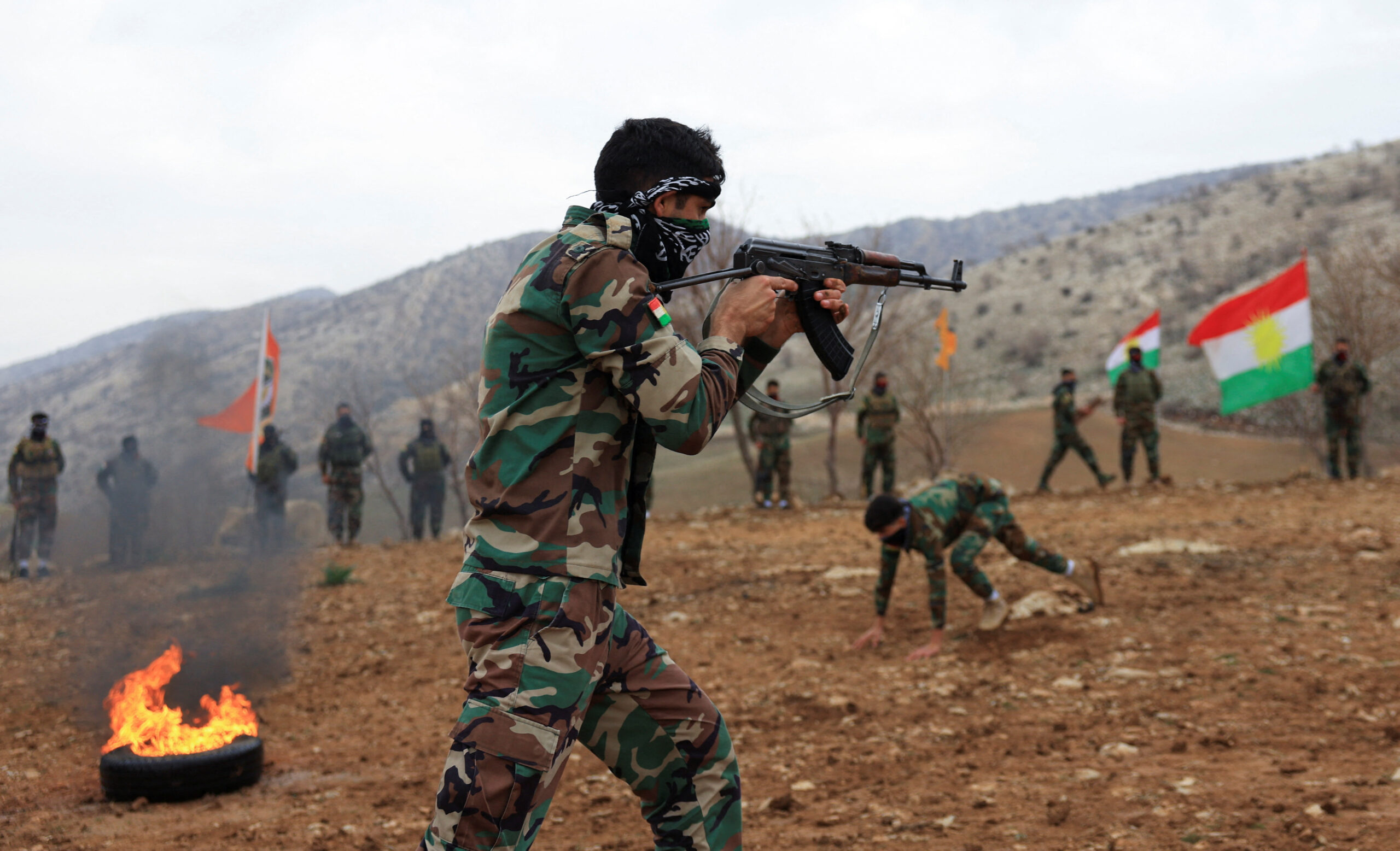
“I’d be all for it.” That’s what US President Donald Trump said Thursday when asked about the prospect of an offensive by Kurds in Iran, with reports swirling that the United States and Israel are arming the ethnic minority group in an effort to put further pressure on the Iranian regime. The idea of armed Kurdish groups entering the war launched last weekend by the United States and Israel raises all sorts of questions. We turned to our experts for answers drawing on their decades of experience in the region.
1. Who are the Iranian Kurds, and what is their relationship with the Iranian regime?
The Kurds are an ethnic minority group with a distinct language and culture that make up 10-12 percent of Iran’s population and have lived along the western border of what is now modern-day Iran for more than four hundred years. Iranian Kurds have struggled for more autonomy within a centralized Persian state for centuries—including during the Pahlavi dynasty preceding the Islamic Republic of Iran’s rule. Under the Islamic Republic, the Kurds have been brutally repressed through violence, and they continue to be marginalized economically, socially, and culturally. The average income of a Kurdish family in Iran, for example, is lower than that in Tehran and other major cities, and although the Islamic Republic of Iran’s Constitution allows for educational instruction in languages other than Persian, the Kurds are often barred from doing so in practice. They are even frequently prohibited from giving their children Kurdish names.
Many Iranian Kurds supported the revolution in 1979, viewing it as an opportunity to demand greater autonomy. But the relationship with the fledgling Islamic Republic quickly soured. Representatives from the central government negotiated with Kurdish representatives over demands for local secular autonomy, but these talks fell apart and violence broke out between Kurds and government forces. This culminated in a fatwa in August 1979 from the Islamic Republic’s founder and first supreme leader, Ayatollah Ruhollah Khomeini, that ordered the Islamic Republic’s armed forces to crush the Kurds. Notably, this was not just a call to fight Kurdish militants; it also empowered Ayatollah Sadegh Khalkhali—the head of the newly created Revolutionary Court who came to be known as the “hanging” judge—to follow the military through Kurdish towns and summarily execute dozens of men and boys on no apparent grounds beyond their Kurdish identity. Photos of firing squads executing Kurds made global headlines and caused an international uproar.
In the following decades, the Kurds continued to bristle under the Islamic Republic’s rule. Kurdish activists, lawyers, and teachers were arrested, jailed, and sometimes even executed for demanding Kurdish rights. This came to a head again in September 2022, with the killing of Mahsa Jina Amini—a young Kurdish Iranian woman who died in the custody of the Islamic Republic’s “morality police” for allegedly wearing improper hijab. Her killing sparked outrage and protests in her hometown of Saqqez, which quickly spread through the Kurdish region and then all thirty-one provinces of Iran.
—Gissou Nia is the director of the Atlantic Council’s Strategic Litigation Project and a board member of the Iran Human Rights Documentation Center.
2. What are the goals of the various Iranian Kurdish groups?
On February 22, five major Iranian Kurdish opposition parties came together to form the Coalition of Political Forces of Iranian Kurdistan. A sixth group, the Komala Party of Iranian Kurdistan, joined on March 4 after initially holding off.
The coalition brings together groups with very different ideological profiles. The Kurdistan Democratic Party of Iran (KDPI), led by Mustafa Hijri, is the oldest and most established. The Kurdistan Freedom Party (PAK), also based in Iraq’s Kurdistan Region, has been the most active militarily in recent months, claiming multiple attacks on Islamic Revolutionary Guard Corps (IRGC) positions in Kermanshah and Lorestan provinces even before the war started. The Kurdistan Free Life Party (PJAK) carries the most complicated regional baggage. Originally an offshoot of the Kurdistan Workers Party (PKK) focused on Iranian Kurdistan, its armed wing, the Eastern Kurdistan Units (YRK), is assessed to be fielding the most capable fighters, many of them women, operating out of the Qandil Mountains near the Iran-Iraq border. Khabat and Komala are smaller parties rounding out the coalition, each with their own Peshmerga forces.
The coalition’s stated objectives include toppling the Islamic Republic, achieving Kurdish self-determination, and establishing a democratic administrative system in “Eastern Kurdistan,” the Kurdish term for Iranian Kurdistan. The formal goal is self-determination within Iran, though the precise endgame, such as a federated region (or something resembling the Kurdistan Regional Government of Iraq’s status), remains deliberately vague. Outright separatism, however, is not the aim.
That distinction has done little to ease tensions with other Iranian opposition figures, particularly Reza Pahlavi, the former shah’s son, who has accused the Kurdish groups of being separatists trying to carve up Iran. The Kurdish coalition responded by calling on “pro-freedom forces” to stand against authoritarianism. The tension between Kurdish self-determination and Iranian territorial unity is a real fault line within the broader anti-regime movement, though Kurds generally express no interest in non-Kurdish-majority territories.
These groups are based in Iraq’s Kurdistan Region, and any cross-border operation would use Iraqi territory as a staging ground. Iran’s foreign minister has already spoken with Iraq’s prime minister and Kurdish leaders in Iraq, who emphasized that Iraq would not allow threats to be directed at Iran from Iraqi soil. But the Iraqi Kurds are in a difficult position. One senior Kurdistan Regional Government official described the situation as “very dangerous” but said they felt unable to resist US pressure. Trump reportedly asked Iraqi Kurdish leaders to choose between the United States/Israel and Iran, open the border, and provide military support. That loyalty test, if true, puts Kurdish leaders in what may be their biggest political dilemma in modern Kurdish history.
The Kurds have a long and painful track record of being courted by great powers during conflicts and then abandoned afterward. The United States backed Iraqi Kurds in the 1970s against Iraq, then cut them loose when it suited a deal with Iran. That history makes the Kurdish groups cautious. They are reportedly looking for political assurances from the Trump administration before fully committing. Whether those assurances will hold is, to put it mildly, an open question. Yet on balance, Kurdish cooperation with the United States has left the Kurds better off over the long term.
—Yerevan Saeed is a nonresident senior fellow with the Iraq Initiative in the Atlantic Council’s Middle East Programs and director of the Global Kurdish Initiative for Peace at American University’s School of International Service.
3. What military capabilities do the Kurds have and what could the United States and/or Israel do to support them?
The prospect of a Kurdish incursion into western Iran is occurring in an operational environment already shaped by US and Israeli military pressure on Iranian infrastructure. Recent airstrikes have targeted Iranian military positions along the Iran–Iraq border, degrading command nodes, air defenses, and logistics networks that previously constrained Kurdish insurgent activity. This “shaping” phase has created space for Kurdish forces to maneuver across the Zagros frontier and reportedly conduct small-unit operations against IRGC units and internal security forces.
Several Kurdish groups recently formed a unified alliance to coordinate political and military operations against Tehran. These organizations maintain armed wings that have conducted intermittent insurgent attacks on Iranian forces for years, often using light infantry units equipped with AK-pattern rifles, rocket-propelled grenades, and mortars deploying from operating bases in Iraqi Kurdistan. Also, Kurdish security forces maintain elite special operations units such as the Counter-Terrorism Group (CTG), a US-trained force specializing in intelligence collection, high-value target raids, and unconventional warfare. CTG operators deploy with advanced small arms such as M4 carbines, Barrett sniper rifles, and night-vision systems, enabling precision operations against insurgent targets.
The United States and Israel could amplify Kurdish operations by supporting them as a ground partner to the ongoing air campaign. Potential support includes intelligence sharing, aerial resupply of ammunition and equipment, additional artillery systems, and close air support against IRGC formations. US special operations forces could also deploy small advisory elements to coordinate combat controllers, direct precision strikes, and conduct advise-assist-accompany missions with Kurdish units operating inside Iranian territory. Such support would allow Kurdish forces to stretch Iranian security forces across multiple fronts while exploiting their familiarity with the mountainous terrain of northwestern Iran.
—Stephen Honan is a fellow with the Atlantic Council’s Counterterrorism Project, a senior consultant for BVG and Company, and a former explosive ordnance disposal officer for the US Navy.
4. How would a Kurdish military offensive impact the situation on the ground?
An armed Kurdish insurgency—or that of any ethnic or separatist group—is a potential propaganda boon for the Islamic Republic. Iran is a nation with a 2,500-year history and near continuous territorial integrity. It’s hard to conceive a strategy more likely to keep anti-regime Iranians at home, fragment the opposition, and bolster a rally-around-the-flag effect. While it could bog down and kill a few more Iranian soldiers, it is highly unlikely to have a meaningful impact on the battlefield.
In the best/worst case scenario (depending on one’s perspective), it could potentially spark a civil war. If a US- and Israeli-armed offensive is truly underway, it is a devastating blow for Iranians hoping for a political transformation in Iran.
—Nate Swanson is a resident senior fellow and director of the Iran Strategy Project at the Atlantic Council’s Scowcroft Middle East Security Initiative. Beginning in 2015, he served as a senior advisor on Iran policy to successive administrations, including most recently as director for Iran at the National Security Council.
The Kurdish coalition’s entry into the war could hand Tehran a political opening even as it creates a military problem. Kurdish fighters might stretch Iranian forces and expose weak control in the northwest. But Tehran could also use the specter of separatism to rally Persian nationalism, split the opposition, and frame the war as foreign-backed dismemberment rather than domestic revolt, giving itself a justification for mass arrests and violence against Kurds inside Iran.
If Kurdish forces receive sufficient support, they could serve several strategic purposes. They might pin down Iranian security forces in the west, giving space for unarmed protesters in major cities to demonstrate without being massacred. They could stretch the regime’s resources thin and reduce pressure on the Gulf states and Israel. And if the Kurds were to take and hold territory in northern Iran, they could create a buffer zone beneficial to Israel and the West.
For all these reasons, any support for the Kurds should go beyond military backing. It must include political support for Kurdish autonomy in a post-regime Iran, so that the Kurds do not end up being used once again as expendable forces.
—Yerevan Saeed
5. How would an effort to arm the Iranian Kurds impact Iraqi Kurds?
Although a number of Iranian Kurdish groups are present in northern Iraq, the Iraqi Kurds and Iranian Kurds have distinct interests and goals. Iraqi Kurds remain focused on protecting their own autonomy and security and are therefore averse to taking steps that would bring the Iraqi Kurdistan region in direct conflict with Iran. Following news reports alleging a US effort to arm the Iranian Kurdish opposition, the Erbil-based Kurdistan Regional Government flatly denied any support to such an effort and emphasized that Kurdistan is “not part of this war.”
Since the beginning of the conflict, Iran has struck sites within Kurdistan where the Iranian Kurds are located, and the Iran-aligned Iraqi militias have also been launching drone and rocket attacks on sites in the region. Iran’s January 2024 ballistic missile attack on Erbil is also fresh in the minds of Iraqi Kurdish leaders as the type of retaliation Kurdistan could expect should it provide any direct support to an Iranian Kurdish offensive into Iran. Despite the Iraqi Kurds’ longstanding and important partnership with the United States, Iraqi Kurds will remain reluctant to jeopardize their own security interests.
The two main Iraqi Kurdish parties also have their own relationships to maintain with Turkey and Iran. Given that one of the Iranian Kurdish groups, PJAK, is allied with the PKK, a terrorist-designated organization that has fought the Turkish government for decades, Turkey is likely to strongly oppose a US or Israeli effort to arm the Iranian Kurds. Support for such an effort would complicate the Kurdistan Democratic Party’s strong relations with Turkey, while the Patriotic Union of Kurdistan has traditionally had a stronger relationship with Iran that it is unlikely to jeopardize. Perhaps most importantly, Iraqi Kurdish support would squarely oppose Baghdad’s interests and previous agreements between Baghdad and Tehran to prevent Iraq from being used as a launching pad for attacks into Iran.
—Victoria J. Taylor is the director of the Iraq Initiative in the Atlantic Council’s Middle East programs and a former deputy assistant secretary for Iraq and Iran in the US State Department.
6. What are the broader regional implications of the Iranian Kurds joining the fight?
The consequences will largely depend on how far the United States and Israel are willing to sustain their political and military support for the Kurds. Continued backing could mitigate the instability and insecurity that come with this kind of endeavor. But if Kurdish forces are simply used to destabilize Iran temporarily and then left without protection, the blowback will be severe, not just for Kurds in Iran but for the security of the Kurdistan Region of Iraq as well.
Any cross-border operations raise the stakes for Iraq’s Kurdistan Region, which has tried to avoid being dragged into a direct confrontation with Tehran but has nonetheless been on the receiving end of Iranian missiles and drones. Iran has already struck Iranian Kurdish targets near the border, fired missiles at Erbil’s airport (which hosts a US military base) and at the US consulate in Erbil, and hit a suspected Central Intelligence Agency facility in Sulaymaniyah. Tehran’s Shia militia proxies in Iraq have launched attacks on Erbil and Kurdistan’s energy sector. During last summer’s twelve-day war, these Iranian-backed proxies knocked out Kurdistan’s energy sector. A sustained Kurdish military role would give Tehran further reason to pressure both Baghdad and the Kurdistan Region of Iraq, risking internal Iraqi strain at a moment when Baghdad also is trying to keep the country out of a wider conflict.
Turkey presents a second concern. Ankara has long treated armed Kurdish movements across the region as linked security threats because of their ties to the terrorist-designated PKK, even when the groups differ. If Kurdish parties were able to establish control over territory in Iranian Kurdistan, it would unsettle Turkey, which has its own large Kurdish population. A more active Iranian Kurdish front could sharpen Turkish fears of a wider Kurdish nationalist spillover into Iraq, Syria, and Turkey itself. That does not mean Ankara would side with Tehran, but it would make Turkey more anxious and more willing to act preemptively to contain Kurdish gains as it did in the case of Syria.
—Yerevan Saeed