
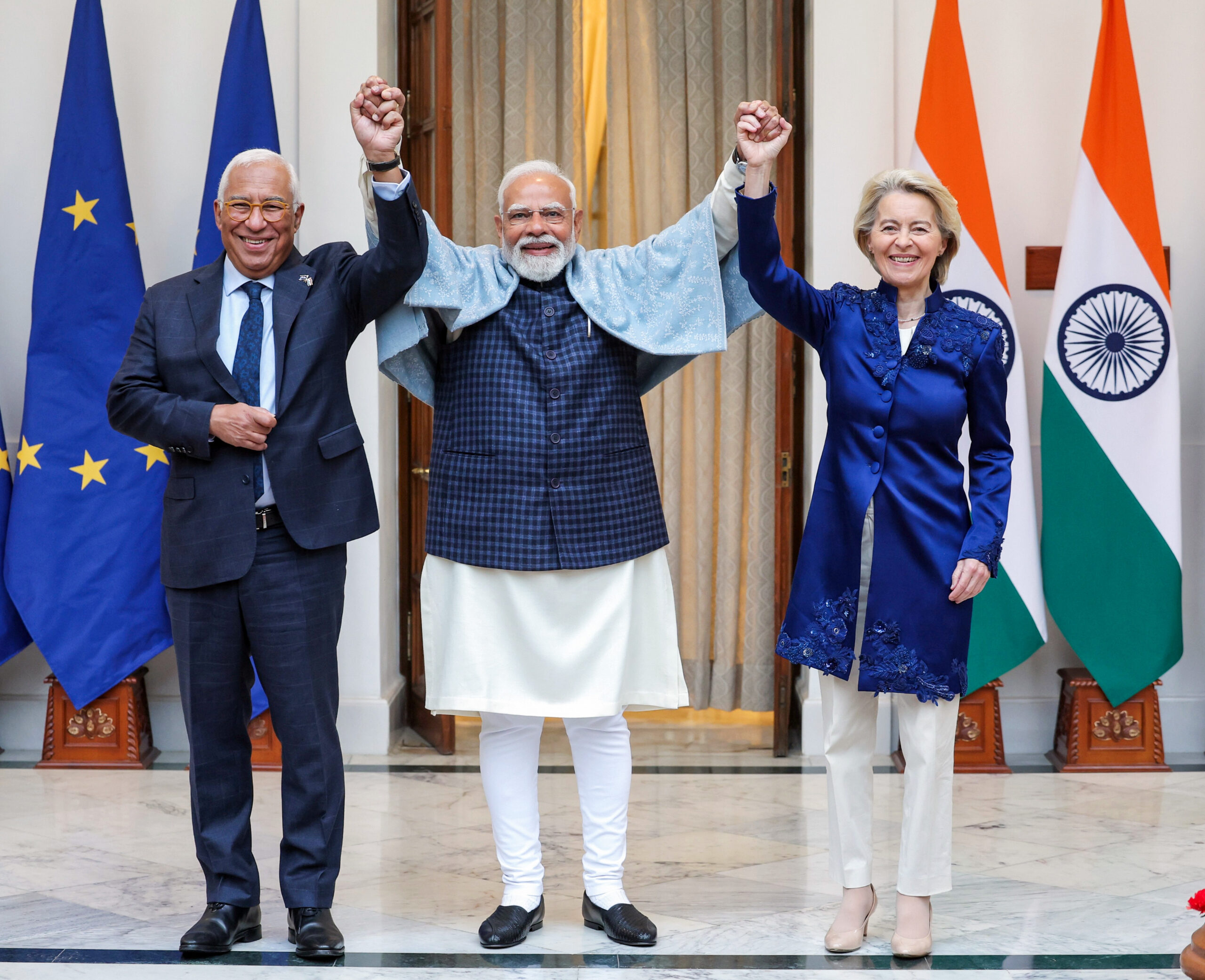
The superlative description—“the mother of all deals”—is unmistakably Trumpian, but it didn’t involve the United States. On Tuesday, Indian and the European Union (EU) leaders announced the completion of a major trade deal. “We have created a free trade zone of two billion people, with both sides set to benefit,” European Commission President Ursula von der Leyen said in a statement that also included the description above. “It represents 25 percent of the global [gross domestic product] and one-third of global trade,” Indian Prime Minister Narendra Modi added. Below, Atlantic Council experts answer five pressing questions about this big agreement.
Why is this deal happening now?
The EU-India trade deal is part of the European Commission’s diversification strategy, which is a direct response to increasing pressures from the United States and China on the global trading system. The turmoil caused by the Trump administration’s tariff policies and China’s unfair trade practices have clearly sharpened minds, increased flexibility, and accelerated both sides’ push to come to a deal after years of stalled negotiations.
—Jörn Fleck is the senior director of the Atlantic Council’s Europe Center. He previously served as chief of staff for a British member of the European Parliament.
***
This deal has been in negotiations, with pauses, for almost twenty years, and there have been several pushes to complete it. So, the agreement is not entirely a response to the Trump administration’s tariffs and trade threats. But clearly, they provided the immediate impetus to get it done now, so that both countries can diversify their trade relationships in response to uncertainty, if not antagonism, from the United States.
The deal will not be entirely easy sledding, since there remain difficult areas to work out, including agricultural market access, geographical indications, and the EU’s Carbon Border Adjustment Mechanism (CBAM). Each side still also has domestic legal processes to complete. Getting major trade deals through the European Parliament has proven challenging, most recently with respect to the bloc’s trade deal with Mercosur. The full story is not yet over.
Still, free trade agreements (FTAs) are difficult to negotiate, and the parties are to be commended for getting this one done.
—L. Daniel Mullaney is a nonresident senior fellow with the Atlantic Council’s Europe Center and GeoEconomics Center. He previously served as assistant US trade representative for Europe and the Middle East in the Office of the United States Trade Representative.
***
The real question is: Why didn’t it happen earlier? The two sides have been at it for roughly two decades, and they’ve seen trade negotiators come and go during that period. The latest sprint to the finish actually started during the Biden administration. My take is that both sides have been motivated at top levels in recent years for a host of geopolitical and economic reasons, and the politicians pushed their negotiators to get it done, even if it meant cutting some corners. In the end, it’s truly a consequential FTA, even if I wouldn’t describe it as the “mother of all deals!”
—Mark Linscott is an Atlantic Council nonresident senior fellow on India. He previously served as the assistant US trade representative for South and Central Asian Affairs.
What impact will this have on Europe?
The EU-India trade is first and foremost a strategic win for both partners, having come under increased US and Chinese pressure. The European Commission can clock another political win in its trade diversification strategy, while the Modi government can add to leverage against the US president’s 50 percent tariff punishment.
Economically, the deal will have a modest impact at first. India accounted for only 2.4 percent of EU total goods trade in 2024, small change compared to the US share of 17.3 percent or China’s 14.6 percent. But Brussels hopes to double that piece of the trade pie over the next seven years of implementation, and India agreed to greater tariff reductions than many expected.
India is not only seen as an important growth market for European sectors from autos to machinery and chemicals. Europe also sees the potential in building the softer connective tissue between the combined markets of two billion consumers. Brussels and Delhi are expected to agree to a framework affording greater access to Indian labor and expertise from healthcare to information technology services. European universities are keen to ride recent trendlines and attract more Indian students in science, technology, engineering, and mathematics. And intensifying defense tech and broader technology cooperation with India could reap not just economic but geopolitical benefits for Europe.
—Jörn Fleck
What impact will this have on India?
The deal highlights two significant recent trends in Indian foreign policy. The first is New Delhi’s ongoing push for more trade deals, as India looks to shed its image as an overly protectionist economy. India has signed a series of trade accords in recent years, including with some non-EU European states.
Second, the deal reflects an Indian inclination—at least for now—to pull back from the United States and push more toward Europe. With all the strain and uncertainty that characterize India’s ties with Washington, the EU is a logical space to embrace. They have a wealth of shared interests—from increasing trade to countering China—and the EU includes some of India’s closest partners, including France and Germany. These strong convergences can overcome areas of divergence—from relations with Russia to differences over intellectual property. In effect, this FTA could constitute the opening salvo of an Indian play to broaden its ties with one of its closest commercial and strategic partners, with the United States left on the outside looking in.
—Michael Kugelman is a resident senior fellow for South Asia at the Atlantic Council.
***
India is likely to benefit more concretely in the immediate term, when it starts to see increases in exports, particularly in labor-intensive industries, which were the Indian priority for cementing this deal. However, India just recently lost certain preferential tariff benefits under the EU’s Generalized System of Preferences (GSP) program, which affected important sectors, such as textiles and apparel. The FTA, then, may just substitute new low tariffs to replace the previous GSP ones.
—Mark Linscott
What additional geopolitical implications are there?
The geopolitical consequences of the EU-India free trade deal extend well past economics. During the Cold War, India led an initiative to create a “nonaligned movement” that refused to choose sides between the United States and the Soviet Union. In Davos last week, Canadian Prime Minister Carney sought to revive a similar coalition of “middle powers” that seek to strike pragmatic economic and political alliances with a range of strategic rivals to the United States, starting with China. The EU-India deal fits well within this geopolitical tradition.
It is not clear whether the strategy will succeed. Whether for climate-related reasons (through the CBAM) or for geopolitical responses (through tightening economic sanctions), Europe will likely be just as dedicated as the United States is to weaning India off of Russian oil purchases. The trade deal announced this week suggests that the EU strategy will be to reward climate-friendly initiatives that increase India’s already significant shift to support rooftop solar and electric vehicles, rather than penalize India as the United States has done.
If the positive economic incentives in the trade deal succeed in reducing India’s dependence on Russian oil, it will likely come at a cost: increased dependence on China to supply solar panels and other renewable energy equipment. Thus, over the medium term, the EU trade deal could benefit China and its export-led economy, potentially at the expense of US strategic interests in the Indo-Pacific region.
—Barbara C. Matthews is a nonresident senior fellow at the GeoEconomics Center. She previously served as the first US Treasury attaché to the European Union.
What should the US take away from this deal?
This deal is very consequential, a meaningful destination after a long road, and it will give both Europe and India confidence in their ability to deepen their trade integration outside of the United States.
The United States should similarly take note of the impact of its policies on trading partners’ willingness and ability to deepen their ties with each other. Long term, this will ultimately reduce their reliance on the United States and diminish US leverage in negotiations. But there are also shorter-term consequences for the United States. This is especially true in some areas, like geographical indications, where EU agreements may have a negative impact on the United States’ ability to sell agricultural products abroad using their common names. Additionally, deals that align regulations, such as the EU’s agreement with the United Kingdom, can effectively export EU regulatory barriers to its trading partners.
—L. Daniel Mullaney
***
The United States should not see this agreement as a threat. It’s consequential but not a dramatic game changer—at least not yet. A more important takeaway is that big deals can be done with India as long as there’s some flexibility to accommodate New Delhi’s political sensitivities. India is a democracy, and what voters think about its trade agreements matters. This deal can also provide new momentum to US and Indian negotiators to get their deal done. They really are very close, and the stakes are high.
—Mark Linscott