
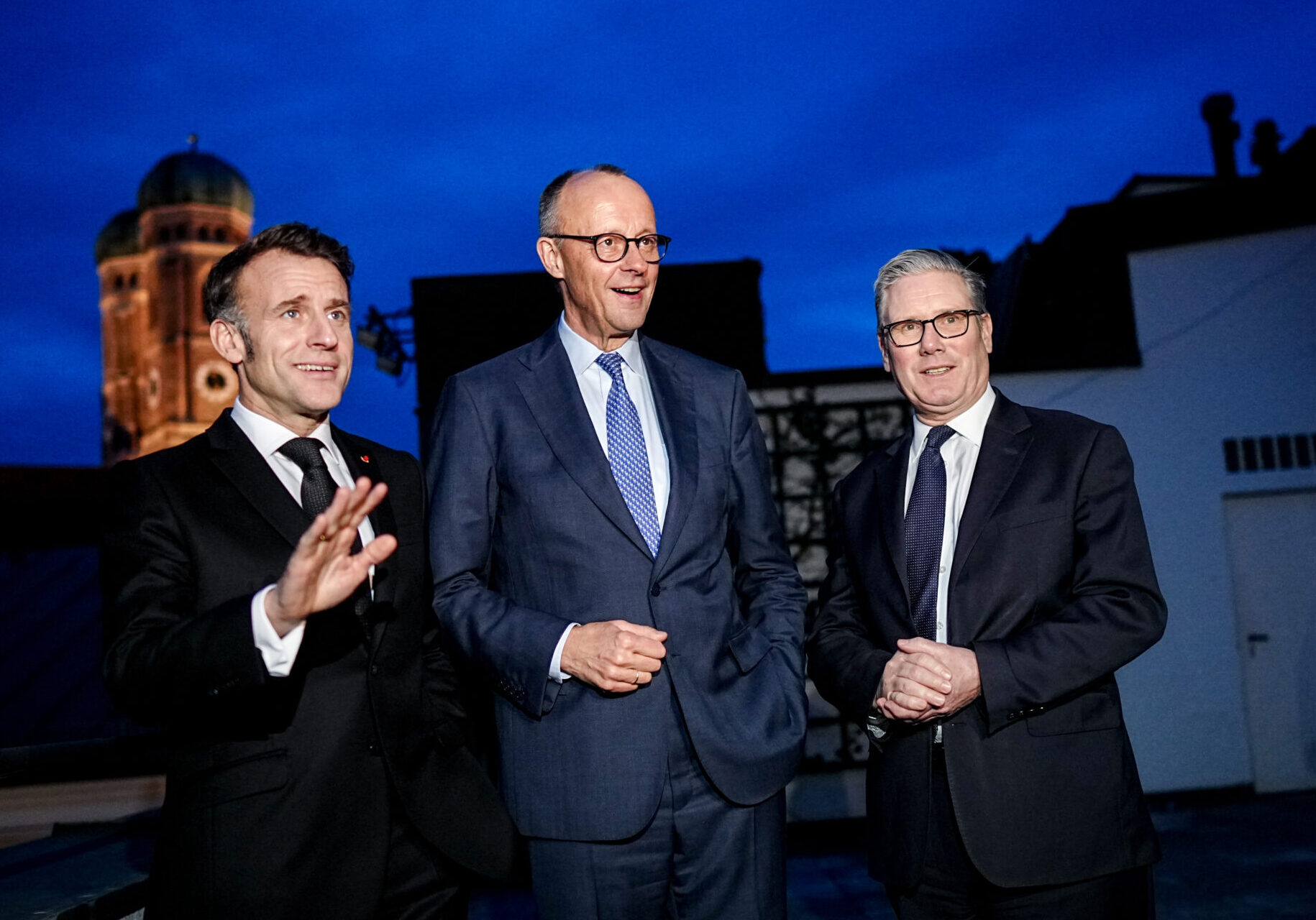
MUNICH—It was a stunning moment at the Munich Security Conference (MSC) this past weekend, when German Chancellor Friedrich Merz, French President Emmanuel Macron, and British Prime Minister Keir Starmer entered the stage side by side to launch the “Global Europe” initiative. Designed for Europe to navigate with confidence and capabilities in an increasingly multipolar world, the initiative contained ground-breaking, action-oriented proposals along four pillars: innovation, energy security, military capabilities, and societal resilience. Gone was the mutual grouchiness of the Brexit years—the leaders of the so-called “E3” now appeared laser focused on bridging difficulties to build joint strength, thereby inspiring others to follow.
Did you miss it? Well, I am sorry to say that you cannot watch it afterwards on YouTube because, alas, it did not happen. But it should have. By now, Europe ought to have left reaction mode behind and taken some bold steps forward. Not individually, but together. It is not as if the Europeans have lacked time to prepare.
Since 2020, I have shared my impressions from the MSC each year. Already in 2022, days before Russia’s full-scale invasion of Ukraine, I noticed “a lot of bold words but little bold action.” In 2024, I reflected upon the “brutal awakening” that Europe was experiencing as it faced both Russia’s threat to Ukraine and the West and its own insufficiency in countering it. In that US election year, fear “even loomed that at the MSC in 2025, Europe would be squeezed between a fascist Russia and an undependable United States—a Europe that would be pretty much on its own.”
In 2025, US Vice President JD Vance delivered a speech that made that prophesy come true. In it, he signaled that from now on the transatlantic relationship as Europe knew it was no more, and Europe should adapt to the new reality.
This year, US Secretary of State Marco Rubio stated that the United States does “not seek to separate but to revitalize an old friendship and renew the greatest civilization in human history.” In part, he aimed at reassuring European allies, but few left without any lingering concerns.
In the corridors of the conference venue of Hotel Bayerischer Hof, a range of interpretations circulated among participants. Some believed that in practice the transatlantic community prevailed, while others saw the decoupling of Europe from the United States as the only realistic way forward.
This lack of congruency among Europeans constitutes a risk that could fragment the continent at a time when unity is its strongest asset. That is why common steps toward greater European independence, while keeping the United States engaged, are so crucial.
The MSC report that preceded the 2026 conference received a lot of attention with its provocative title “Under Destruction,” referring to the “backlash against core values of the post-1945 order evident not only in the US but in many parts of the world.” Consequently, “sweeping destruction rather than careful reforms and policy corrections is the order of the day.”
Given this severe and threatening situation, I had high hopes for the opening session of the MSC. And yes, there was a shift. Merz spoke early on the first day, instead of on the second day as his predecessors had done, presumably to illustrate his will to lead. But my expectations of joint initiatives by Europe’s big powers fell short. From what I heard, Berlin, Paris, and London were not yet ready. Instead, each country presented various components of a stronger Europe.
Merz announced that the European Commission was set to develop ”a joint roadmap” for a strong and sovereign Europe with its own security strategy. He also called for organizing the European Union’s (EU’s) solidarity clause 42.7, as a ”strong, self-sustaining pillar” within NATO—an idea that so far has been a red line for non-EU allies.
Macron has been advocating for European independence for a long time. When I reported on his vision from the MSC in 2020, not many cheered him on. This year, however, it was different. Even if his ideas of European “preference” go too far for some, strategic autonomy now makes sense to many. Macron proposed that Europe should launch “a series of consultations” on a “new architecture of security” for Europe, with the Europeans, for the Europeans.
Starmer called for building a more European NATO—underpinned by deeper links between the United Kingdom and the EU—across defense, industry, tech, politics, and the wider economy. Claiming that the British companies already accounted for over a quarter of the continent’s defense industrial base, he saw the need to integrate capabilities on spending and procurement and build a joint European defense industry.
Taken together, their thoughts largely intertwined and resembled each other, and some were echoed by the European Commission President Ursula von der Leyen, which could possibly lead to a roadmap ahead. As the MSC Chairman Wolfgang Ischinger said at the closing session: “What we need now is a plan.” As I stumbled out of the Bayerischer Hof Hotel on Sunday, sleep-deprived after three intense days, I could not agree more.