
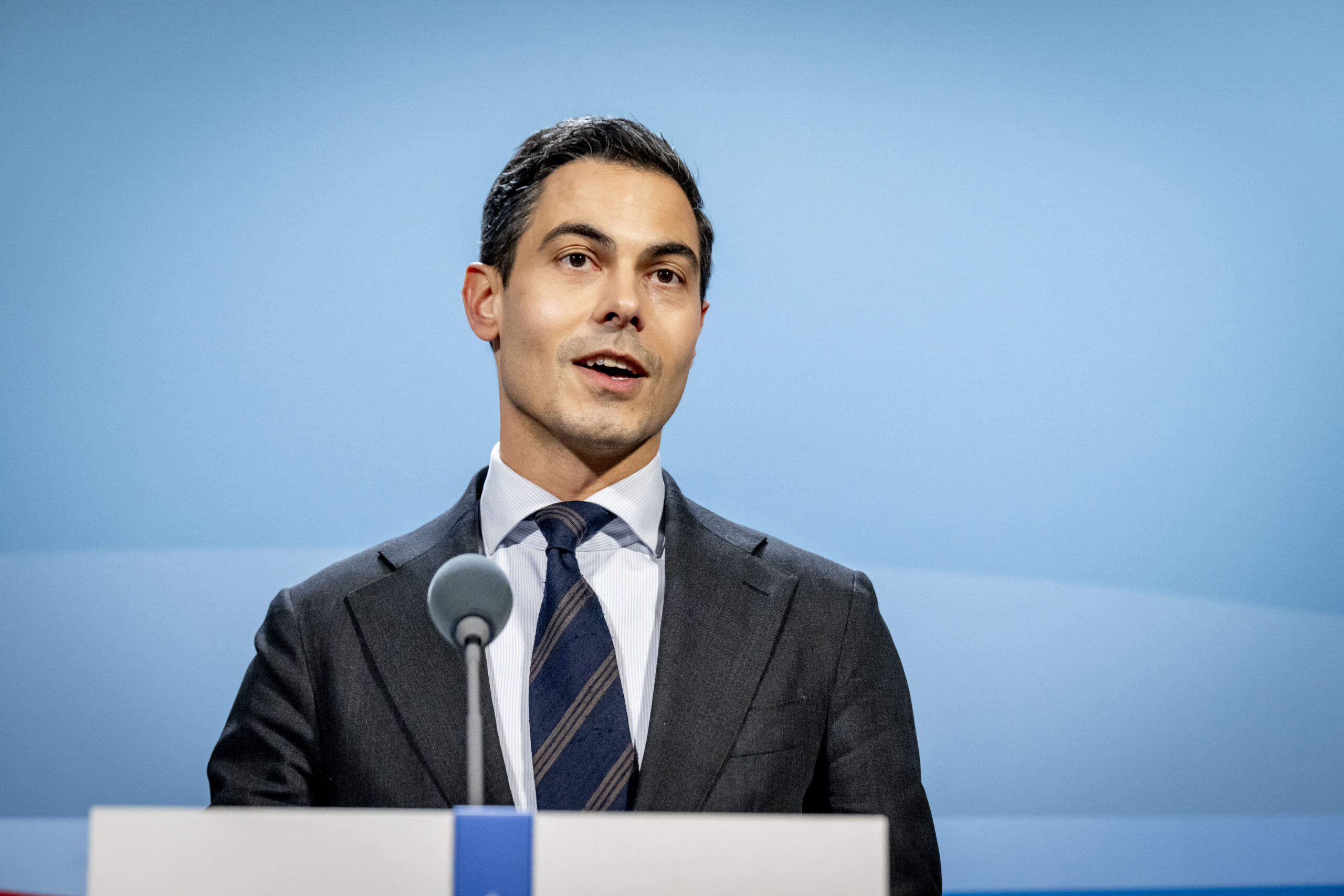
UTRECHT—When you narrowly beat your primary election foe but can’t form a majority coalition to govern, what do you do? Can you still steer your country through some of the most significant geopolitical realignments since 1945 with a minority government? How Rob Jetten, the Netherlands’ youngest-ever prime minister, and his new government coalition answer these questions may serve as an acid test of minority governance in a highly fragmented political environment.
To form the new government, which was sworn in on February 23, three coalition parties negotiated for nearly four months. The result was a document, titled “Getting started,” which outlines the coalition’s agenda. Maintaining this coalition is one challenge; another is advancing the government’s agenda because the coalition lacks a majority in either chamber of parliament. The minority government’s success in implementing its agenda, including its plans for European security and defense, is likely to have implications well beyond the Low Countries.
Putting the coalition together
The new coalition consists of Jetten’s progressive liberal Democrats 66 (D66) party, the Christian Democratic Appeal (CDA), and the centrist-liberal People’s Party for Freedom and Democracy (VVD). Out of 150 seats in parliament, this coalition holds only sixty-six seats, ten short of a majority. Its shortfall is even more pronounced in the Senate, where the coalition holds just twenty-two of the seventy-five seats. To enact any new laws or ratify any new international agreements, therefore, Jetten’s minority coalition will need to find compromises with opposition parties.
The Dutch parliament contains no less than seventeen parties, and the new government will need to be creative in finding ways to assemble assorted groups to pass legislation. The main opposition party is the progressive eco-socialist PvdA-Groenlinks (Labour-Green-Left) with twenty seats. Geert Wilders’ anti-immigrant Freedom Party (PVV) disintegrated after losing the elections and a subsequent internal row; its position has been halved from thirty-seven seats before the election to just nineteen now. On the right flank, Right Answer 21 (JA21) has nine seats, and Forum for Democracy and Group Markuzower (a PVV splinter group) each have seven seats.
European pattern and prospects
As the European Union’s (EU’s) fifth-largest economy and one of NATO’s most capable middle powers, the Netherlands often signals broader trends within Northern Europe. If successful in moving legislation forward in parliament, the new government’s foreign and European policy agenda could contribute to larger shifts in overall Euro-Atlantic diplomatic and security relations. At the top of the new government’s security agenda is the ambition of moving toward a European pillar within NATO. At the same time, the government will need to remain fiscally prudent and avoid proposing radical legislative changes to ensure support.
The relative weakness of the new Dutch government coalition, its minority rule, and the fragmented parliament fit squarely within a wider pattern in European politics. While the constructively pro-European orientation of The Hague may in the short run help support other European centrists, in the longer run, Europe’s structural political problems persist. Together with European partners, the new Jetten government should therefore publicly address the more profound issues facing European liberal democracies, moving beyond the usual technocratic policy analysis. Doing so includes fostering a continental debate about Europe’s future as a civilization underpinning Western values.
In terms of foreign and security policy, the Netherlands under Jetten and his Foreign Minister Tom Berendsen, a former Christian Democrat member of the European Parliament, seek to strengthen European defenses and strategic autonomy while remaining close to the United States. The coalition document spells out this balancing act, explaining that “the Netherlands must pursue a realistic foreign policy in which Dutch and European interests take precedence. NATO constitutes the cornerstone of our collective security. The United States is the global power with which we share the greatest number of interests. At the same time, our future and prosperity are inextricably linked to a strong Europe.”
What this means in practice is the Netherlands taking steps to strengthen the European pillar within NATO. This requires some notable changes, as demonstrated recently when the Dutch government announced that it would join French-led discussions on European nuclear deterrence. Such nuclear diplomacy is a key indicator of The Hague’s strategic realignment. Historically, the Netherlands was highly skeptical about any European nuclear deterrence initiatives, preferring to rely on the US nuclear umbrella. Also notable is the new coalition’s ambition to create a European equivalent to the Five Eyes intelligence partnership.
Defense acquisition is another major aspect. There will also be an effort to set up a “European Defence Mechanism” for the joint European acquisition of military equipment and common military standard setting. The Hague aims to acquire 40 percent of its defense purchases jointly with European partners. And 50 percent should be procured from Dutch and/or European industry.
Notwithstanding these Europeanization efforts in defense policy, the Netherlands remains committed to its ties with the United States, not in the least through the bilateral nuclear sharing agreements and its F-35 air fleet. Toward this end, the coalition government has proposed a law to enshrine a commitment to spending 3.5 percent of gross domestic product on defense, ensuring a long-term, sustained defense effort. The Netherlands also continues to be a major financial contributor to Ukraine’s war efforts, spending 1 percent of Dutch gross domestic product in support of Ukraine.
Geopolitical and financial challenges
In financial and economic policy, it is notable that Finance Minister Eelco Heinen of the VVD party remains in place. Heinen faces a “geofinancial challenge”: to strike the right balance between financial policy and geopolitical exigencies, including the search for greater European strategic autonomy. Under his stewardship, fiscal prudence will remain a key theme. In light of the 3.5 percent defense spending pledge, this prudence is already leading to sharp discussions about social welfare reforms.
In the European context, the Netherlands remains opposed to financing other member states’ national debt, or “eurobonds,” reflecting a longstanding Dutch preference for fiscal discipline in the eurozone. Nonetheless, The Hague looks favorably at common European debt-financed instruments like the Defence Fund, SAFE, and the European Investment Bank. This stance befits a broader trend in the Dutch outlook on European debt mutualization. Furthermore, the new government views implementation of the recommendations of both Enrico Letta’s 2024 report on the future of the European single market and Mario Draghi’s 2025 report on EU competitiveness as crucial. And the Netherlands is a frontrunner in the deepening of Europe’s savings and investment union, previously known as the capital markets union.