
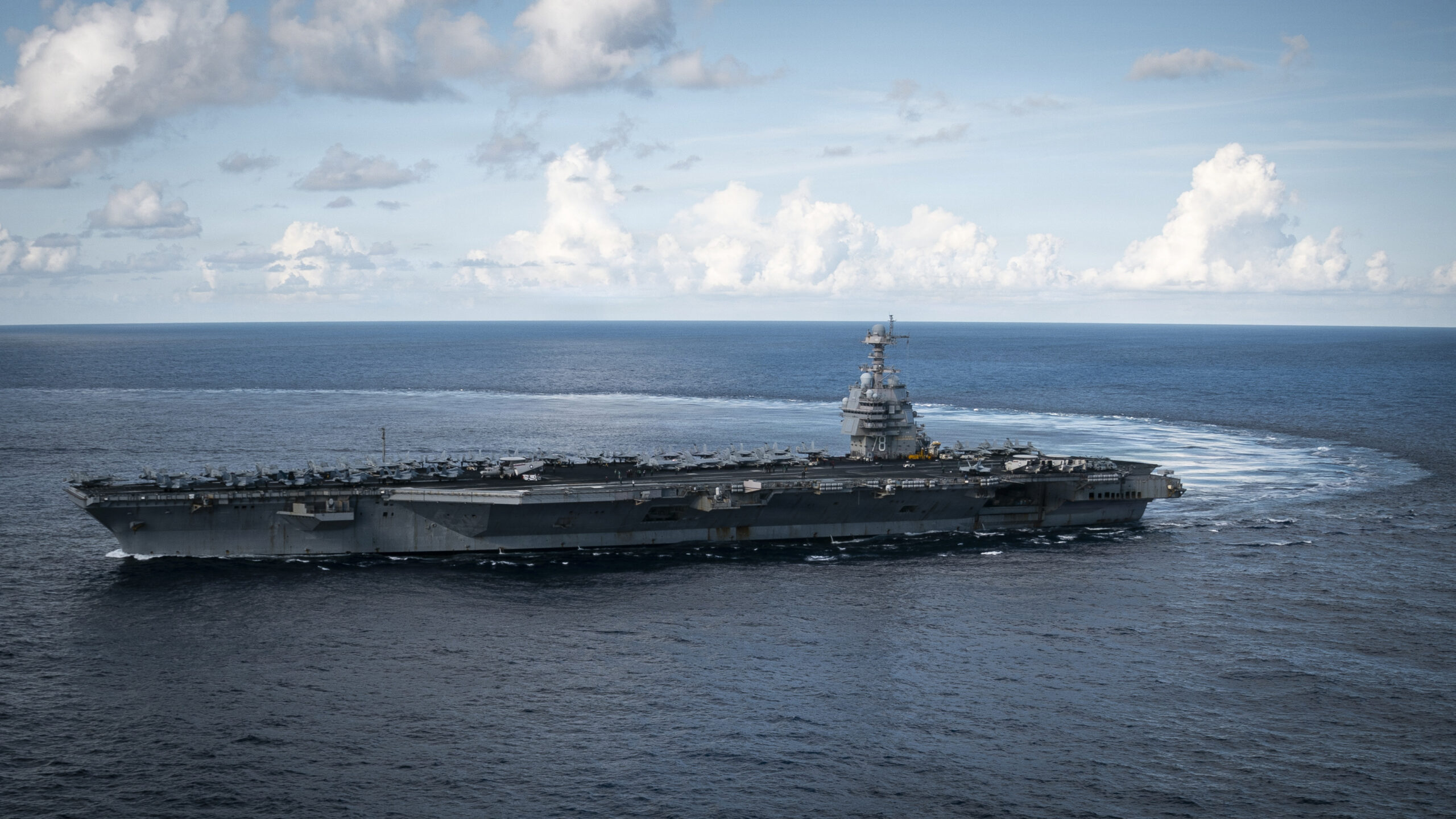
“Venezuela is completely surrounded.” On Tuesday evening, US President Donald Trump announced that the US military would impose a “total and complete” blockade of all sanctioned oil tankers going into or out of Venezuela. The move is targeted at Venezuelan strongman Nicolás Maduro and his regime, but it could also have wider effects. Below, Atlantic Council experts answer four pressing questions.
1. What does this blockade mean for Venezuela?
This blockade adds significant pressure to Maduro’s regime, as these shadow tankers act as a financial lifeline that Maduro relies on to sustain his corrupt patronage system. Sanctioned vessels operate in a global black market, transporting US-sanctioned oil that has been critical over the years to the ability for Maduro to stay in power.
Since the initial US seizure of the Skipper last week, Venezuelan crude exports have fallen sharply, effectively targeting Maduro’s main source of income. Venezuela relies entirely on tankers to export its oil, and disrupting the illegal trade that runs on these sanctioned tankers weakens Maduro’s grip on power. As of last week, more than thirty of the eighty ships in Venezuelan waters were under US sanctions.
Frankly, with the size of the US fleet amassed in the Caribbean, it was only a matter of time before this blockade began. It will be important to see which of these shadow vessels continue to try to reach Venezuelan shores and which vessels the United States determines it has the authority to seize. These ships are part of a large shadow shipping network designed to evade US sanctions and mask the destination of Venezuelan crude. This illegal trade network delivers oil primarily to China, and to a lesser extent Cuba, employing several tactics to disguise the origin, name, and shipping routes to evade US regulations.
The blockade of these sanctioned vessels provides an additional source of leverage for the United States. By cutting off a significant part of the regime’s income, the United States gains an additional chip to put on the table in discussions on ending Maduro’s dictatorship in Venezuela. This move elevates the Caribbean campaign from a counter-drug operation to one that is also cutting off the financial lifelines to Maduro, who the United States has designated as the leader of the Cartel de los Soles.
—Jason Marczak is vice president and senior director at the Atlantic Council’s Adrienne Arsht Latin America Center.
2. What is the likely impact on oil markets in the region and globally?
Venezuela exported a little over 780,000 barrels a day in October of this year, 100,000 of which came to the United States and the rest directly or indirectly going to China. It is highly uncertain whether all or only a portion of those exports will be impacted by the blockade.
The president referred to a blockade of “sanctioned vessels,” which could potentially exclude Chevron’s 100,000 barrels per day. A respected tanker tracking outfit suggested that only 40 percent of the vessels transporting Venezuelan crude are sanctioned.
The president also made reference in social media to Maduro and his government being labeled a foreign terrorist organization. We do not yet have designations or explanations from the Treasury or State Department. It is possible that any person or entity doing business with the Venezuelan government or its national oil company, Petróleos de Venezuela, S.A. (PDVSA), could therefore be exposed to liability. In this case, nearly all of Venezuela’s exports (oil or otherwise) could be impacted.
So far, the oil market has shrugged its shoulders at the blockade. Brent crude was up 2.5 percent overnight, to sixty dollars a barrel, according to Bloomberg. That is a pretty modest impact. This could be the result of the market having already priced in the impact of higher levels of naval interdiction of Venezuelan oil exports, high levels of spare capacity, or weak winter oil demand. Ordinarily, one million barrels a day of displaced oil translates into about ten dollars on the oil price, so a complete blockade of all of Venezuela’s exports, if not replaced by increased by OPEC spare capacity or commercial reserves, would be in the range of five dollars to eight dollars a barrel. Everything will depend on how the blockade is enforced.
—David Goldwyn is president of Goldwyn Global Strategies, LLC, an international energy advisory consultancy, and chairman of the Atlantic Council Global Energy Center’s Energy Advisory Group.
3. What else could the United States do to put pressure on Maduro?
Venezuela relies on revenue from sanctioned oil exports to prop up the regime and the country’s economy. Venezuela continues to sell its sanctioned oil, predominantly to China, while accepting payment in digital assets, namely stablecoins, to circumvent US sanctions. To increase economic pressure on Venezuela, the administration should consider enforcing existing sanctions on Venezuela’s oil sector, including PDVSA. Sanctions enforcement would include seizing crypto wallets and working with stablecoin issuers to seize or burn digital assets held by sanctioned Venezuelan entities. This would have an immediate impact on Maduro by taking out significant financial assets and it would be much more cost-effective for the United States and its naval forces.
Separately, as the United States increases pressure on Venezuela with a blockade, the administration should consider where the vessels will go next. As we have seen, the sanctioned tankers carrying Venezuelan oil have also carried Iranian oil. If ships cannot dock in Venezuelan ports, then the United States should anticipate where they will go instead and whose cargo they will carry, which could be Iran or Russia. The shadow fleet used by Venezuela, Iran, and Russia is a network, and to affect Venezuela, the United States needs to address the entirety of the fleet and its operators.
—Kimberly Donovan is the director of the Economic Statecraft Initiative within the Atlantic Council’s GeoEconomics Center. She previously served as acting associate director of the Financial Crimes Enforcement Network’s (FinCEN) Intelligence Division, in the US Treasury Department.
4. What does the blockade mean for Russia’s shadow fleet?
The US move against Venezuelan oil exports may matter less for Venezuela itself than for Russia’s shadow fleet, because it signals a shift from symbolic sanctions toward more assertive enforcement against maritime sanctions evasion.
Russia today relies on a sprawling shadow fleet—aging tankers, opaque ownership structures, flag-hopping, ship-to-ship transfers, and weak or fictitious insurance—to keep oil flowing despite Western restrictions. What the Venezuela case demonstrates is that Washington is increasingly willing to treat sanctions evasion not just as a financial violation, but as a maritime security problem.
This matters because Russia’s shadow fleet is not isolated. Many of the same vessels, intermediaries, insurers, and ship-management networks service Russian, Iranian, and Venezuelan crude interchangeably. Pressure applied in one region exposes vulnerabilities across the entire system. Even limited interdictions force tankers to go dark longer, take riskier routes, rely on fewer ports, and accept higher freight and insurance costs—raising the overall cost of Russian oil exports.
For Moscow, the immediate risk is not a sudden collapse in exports but growing friction and uncertainty. Each escalation increases the probability of seizures, port refusals, or secondary sanctions on service providers—factors that reduce the efficiency and scalability of Russia’s energy revenues over time.
There is also a deterrent effect. By demonstrating that shadow fleets are visible, traceable, and vulnerable, the United States raises the strategic risk premium for Russia’s oil trade—even if enforcement remains selective.
This dynamic is being reinforced in Washington on the policy front. A bipartisan group of US senators has introduced the Decreasing Russian Oil Profits (DROP) Act of 2025, which would authorize financial sanctions on foreign buyers of Russian petroleum products and seek to choke off a key source of Kremlin revenue. The proposal includes targeted measures to penalize entities anywhere in the world that continue to purchase Russian oil, with narrow exemptions tied to support for Ukraine, underscoring Congress’s intent to close loopholes in the sanctions regime and further isolate Moscow’s energy exports.
The key takeaway is this: Russia’s shadow fleet survives on the assumption of tolerance and ambiguity. The Venezuela action suggests that assumption is weakening. For a war economy dependent on energy revenues, that shift matters.
—Agnia Grigas, PhD, is a nonresident senior fellow at the Atlantic Council’s Eurasia Center working on energy and geopolitical economy.