
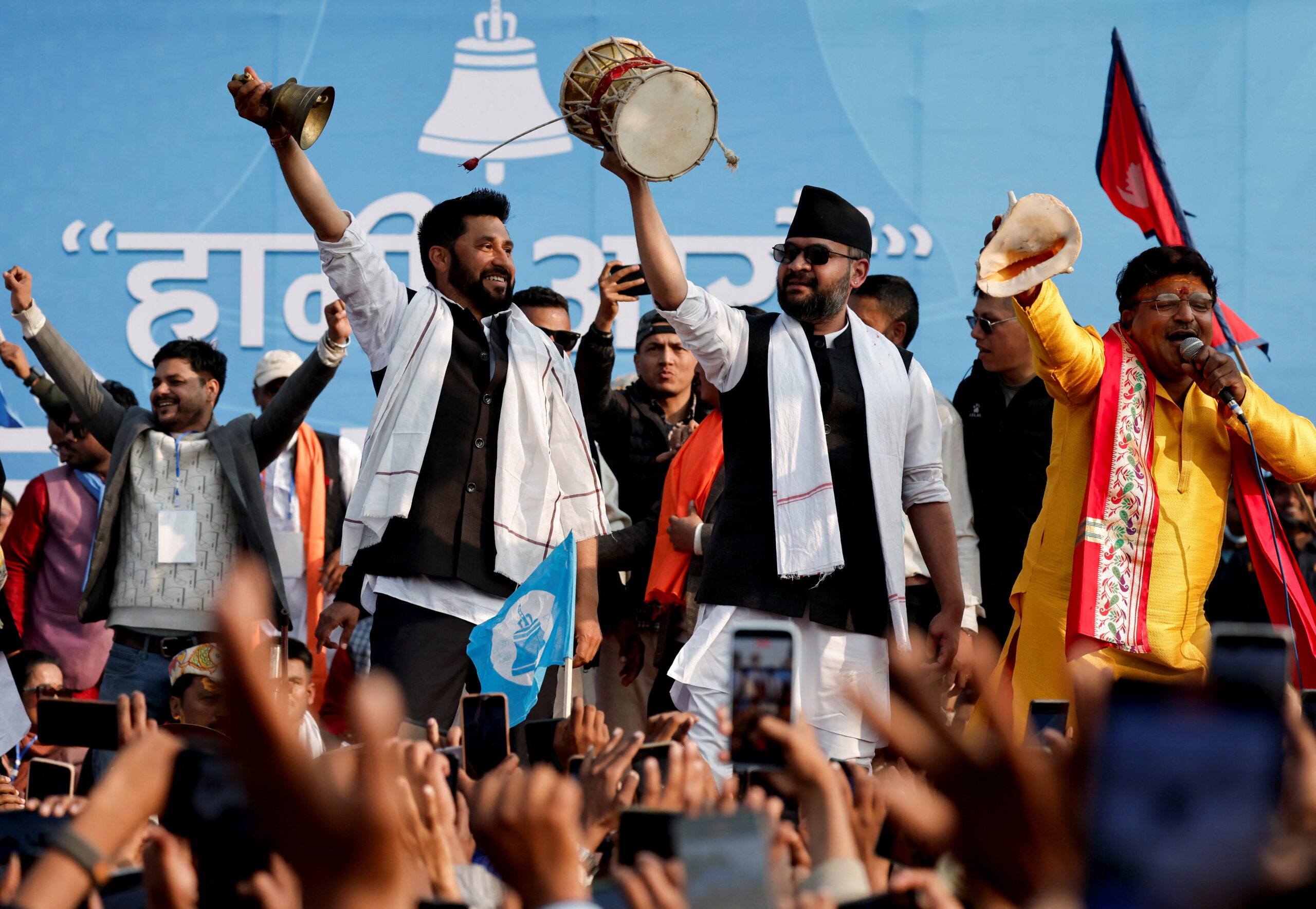
When Nepali students burned their parliament in September 2025, they were demanding jobs, accountability, and an end to a political system that had cycled the same familiar faces through positions of power for the past twenty years. But the protest movement, largely framed in international commentary as a generational revolt, did more than topple the government of the then prime minister, K.P. Sharma Oli: It may have ruptured the equilibrium that had allowed Nepal to navigate between India and China for two generations.
For the past two decades, Nepal’s three dominant political forces—the Maoists, the Communist Party of Nepal – Unified Marxist-Leninist (CPN-UML), and the Nepali Congress—rotated through leadership positions without fundamentally transforming the political system or the country’s foreign policy. The stability that resulted—frustrating domestically but useful geopolitically—is now under serious strain.
As Nepal heads into national elections on March 5 under an interim government, it is not just choosing new leaders. It is choosing who will lead Nepal at a time when the country is navigating both major shocks to domestic legitimacy and intensifying regional competition, and when the institutional architecture that once made geopolitical hedging possible is under strain.
From buffer state to strategic density
For decades, Nepal managed its geopolitical position through calibrated hedging—extracting economic benefits from both India and China while maintaining formal nonalignment. This strategy has deep historical roots. King Mahendra institutionalized the country’s nonalignment in the 1950s and 1960s. Article 51 of Nepal’s Constitution, which was adopted in 2015 and revised in 2016, explicitly anchors its foreign policy in nonalignment, sovereign equality, the Panchsheel principles, and the United Nations Charter—codifying the country’s strategic autonomy as a legal commitment rather than a tactical choice.
As a result, Nepal has had a consistent policy of diversifying external partnerships without surrendering its strategic maneuverability. The country has had close relations with India, signing the 1950 Indo-Nepal Treaty, but it has also managed periodic tensions over Indian interference in its affairs. Nepal has also made parallel efforts to deepen ties with Beijing—including early connectivity projects and later participation in the Belt and Road Initiative. But Nepal has remained autonomous from China as well, including by ratifying a compact with the US Millennium Challenge Corporation (MCC) in 2022 despite Chinese objections.
What distinguishes the current moment from past Nepali policy is not a departure from hedging, but the erosion of the elite consensus that managed it for decades. During past bouts of geopolitical volatility, elite continuity ensured predictability in Nepal’s foreign policy. But today’s political fragmentation could bring to power figures that are less socialized into the country’s diplomatic tradition, raising uncertainty about whether they will maintain this hedging strategy with the same coherence.
Questioning the equilibrium?
In some ways, the September 2025 uprising has already disrupted the country’s long-standing foreign policy equilibrium. Two-thirds of lawmakers from the previous parliament are not running in the upcoming elections. A record 3,484 candidates from 68 political parties are competing.
Major party mergers have reshaped the left, and the generational showdown in this election between Oli and former Kathmandu Mayor Balendra Shah reflects a broader reconfiguration of political authority.
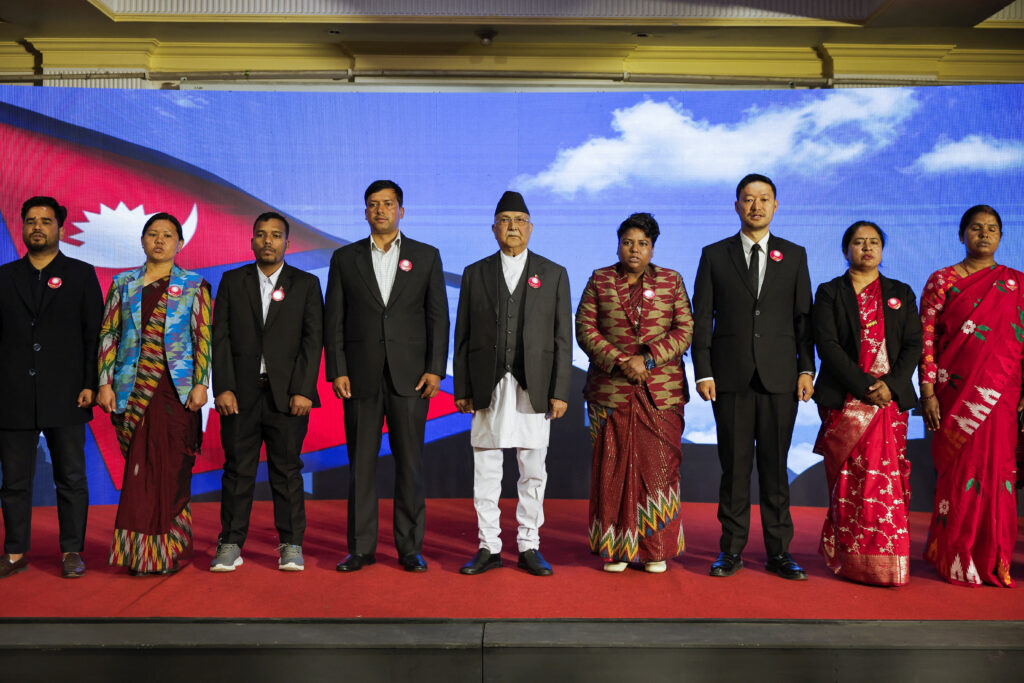
The three most traditionally prominent parties are competing, each carrying distinct geopolitical implications. The Nepali Congress, led by Gagan Thapa, represents the most familiar vector for India and Western partners—a party that has explicitly pledged nonparticipation in great-power strategic competition and whose past governance record offers some predictability. The CPN-UML under Oli, despite being the party that was ousted from power in the September uprising, retains a nationwide organizational base and reaffirms its long-standing “friendship with all, enmity with none” doctrine. Diplomatic observers and regional analysts in India are hoping against a decisive CPN-UML win, wary of Oli’s historically closer ties with Beijing.
Perhaps the most unpredictable party running in the elections is the Rastriya Swatantra Party (RSP), which has named Shah as its prime ministerial candidate and released a manifesto pledging to reposition Nepal from a “buffer state” into a “vibrant bridge” through trilateral economic partnerships with both India and China. The RSP’s foreign policy ambition is rhetorically sophisticated but untested in practice. A party that largely gained prominence from the Gen Z uprising, whose leadership has never governed nationally, would enter office without the institutional socialization that historically made Nepal’s hedging coherent. That is precisely the uncertainty that regional powers are faced with: not that Nepal’s next government will abandon nonalignment, but that it may not yet know how to execute it.
And regardless of which party wins the elections, the country’s political fragmentation will impact its foreign policy. The more fluid and coalition-dependent Nepal’s domestic politics become, the more entry points there are for foreign influence and the more difficult it becomes to achieve the policy coherence necessary for strategic hedging.
Himalayan hedging
For India, a politically stable Nepal provides strategic depth in the Himalayan belt. New Delhi has publicly supported the electoral process and deepened hydropower cooperation, cross-border transmission, and connectivity. Its approach has evolved through a mix of overt political intervention and economic entanglement.
Yet instability in Kathmandu would carry security implications for India. Open borders, cross-border migration, and economic interdependence mean that prolonged volatility reverberates directly into India’s domestic politics. Nepal’s post-uprising uncertainty complicates New Delhi’s calculations. What matters most for India is not merely who wins, but whether the resulting government is durable.
Meanwhile, under Chinese President Xi Jinping, Beijing’s Nepal policy has become more strategic and multidimensional. China’s engagement extends beyond infrastructure and Belt and Road projects to include political party exchanges, security cooperation, and outreach to media and business networks.
China’s interests in Nepal are shaped by concerns over Tibetan activism, Western security penetration, and Indian influence. Political turnover in Kathmandu may alter individual relationships, but Beijing’s diversified channels allow it to adapt. Fragmentation, therefore, does not necessarily weaken China’s influence on Nepal’s politics—it redistributes it.
The economic paradox behind the uprising
The geopolitical stakes are inseparable from Nepal’s economic paradox.
By macroeconomic indicators, Nepal is not in crisis. According to Nepal Rastra Bank data from July 2025 to January 2026, foreign reserves reached a record $22.47 billion in January. Remittances surged by over 32 percent. Foreign assistance now accounts for less than 5 percent of gross domestic product (GDP), and Nepal is set to graduate from the UN Development Programme status of “least developed country” to “developing country” this year. Unlike Bangladesh, which has applied for deferment, Nepal has not—despite the fact that both countries faced regime change due to Gen Z uprisings. Already the United States has committed an additional fifty million dollars in grant financing through the MCC in late 2025.
Yet the September uprising was fueled by economic frustration: unemployment, underemployment, corruption, and a lack of opportunity. The crisis was not one of insolvency but of unmet aspirations. Nepal’s official unemployment rate hovers in the double digits, and youth unemployment is significantly higher, with large numbers of graduates either underemployed or seeking work abroad. For most of the past two decades, overseas migration functioned as a political safety valve, with remittances accounting for roughly a quarter of GDP and sustaining millions of households. Remittances helped cushion social unrest and, for a time, obscured deeper structural weaknesses in domestic job creation.
Yet a generation shaped by global connectivity and constant digital comparison increasingly views migration not as a path to upward mobility but as a necessity. In a country where more than 70 percent of citizens use smartphones, perception management has become a powerful political force multiplier. As a result, stability without meaningful opportunity began to feel less like progress and more like stagnation.
When domestic legitimacy erodes, external economic partnerships become both lifelines and liabilities. Coalition governments reliant on fragile parliamentary majorities are especially sensitive to infrastructure financing, debt exposure, and diplomatic backing—conditions that amplify external leverage.
The United States and strategic bandwidth
Washington views Nepal through the lens of democratic resilience and Indo-Pacific strategy. US officials have emphasized electoral integrity and institutional support, while warning against predatory financing models that compromise sovereignty. The fifty-million-dollar MCC commitment signals sustained US engagement even amid competing global priorities.
The US approach—focused on democratic institutions rather than transactional politics—may prove strategically astute. By supporting governance capacity and economic infrastructure without demanding exclusive alignment, Washington offers Nepal a partnership model that reinforces rather than constrains its autonomy. This creates space for durable engagement that survives political turnover.
The real test
Nepal’s upcoming elections are not simply about whether Gen Z energy can be translated into parliamentary seats. They are about whether a state positioned between major powers and experiencing generational upheaval can rebuild legitimacy quickly enough to preserve strategic agency.
If the next government delivers credible governance and economic reform, Nepal can pursue balanced partnerships—transparent engagement with Western partners and managed cooperation with India and China without surrendering strategic autonomy. Strong institutions enable genuine hedging; weak ones invite the kind of asymmetric relationships that erode sovereignty over time. The distinction matters: countries with robust governance can negotiate from strength. Those without it become arenas of competition rather than actors within it.