
How information and communication technologies can empower women in Senegal
This issue brief is part of the Freedom and Prosperity Center’s “Voices of the Future” series, which highlights how graduate students are using the Freedom and Prosperity Indexes to explore pressing governance and development challenges across the world.
Introduction
The informal sector plays a central role in the economy of sub-Saharan Africa (SSA) and is often linked to poverty, low-skilled jobs, and regulatory challenges. Much research and data highlight these dimensions, but this brief takes a more nuanced approach. In it, we explore how technologies—specifically information and communication technologies (ICTs)—are actively reshaping this sector in the region by creating economic opportunities, especially for women. We first analyze the feminization of informality in SSA. Second, we examine technology’s potential as a game changer for women’s empowerment. Next, we present a case study on Senegal, focusing on the use of social media and mobile payments as business tools. Finally, we provide policy recommendations.
Figure 1. Evolution of the informal sector’s size across regions
This structural picture of the informal economy is reflected in the Atlantic Council’s Freedom Index, which assesses to what extent a country’s economic activity operates under free and competitive market principles. SSA consistently hosts the lowest scores, with an overall Freedom Index score that remained between 51.3 and 55.5, compared with a global average above 60, from 1996 to 2024. A component specific to informality highlights the sector’s magnitude, with SSA recording 62.6 in 2024 against a global average of 71.4.
Figure 2. Freedom Index and informal economy performance in sub-Saharan Africa
Gender adds a critical layer to the picture. A “feminisation of the informal sector” is particularly evident in SSA. Women’s share in nonagricultural informal employment reaches 83 percent, with men’s share at 72 percent, rising to 94 and 89 percent, respectively, when agriculture is included. Though the women’s economic freedom score has consistently improved, it has not translated into equal representation within the sector.
Figure 3. Women’s economic freedom in sub-Saharan Africa
This feminization is driven by several factors, including lower levels of education for women, social norms enforcing traditional gender roles, and legal barriers that constrain their integration into the formal labor market.
Effects of informality on women’s economic freedom and prosperity in SSA: technology as a game changer?
SSA’s high informality correlates with low prosperity scores; the region’s overall prosperity score remained below 50, with an income score of only 40.1, in 2024 (global average: 61.3). This correlation between high informality and low income raises questions about the effect of this informality on women’s income status and ultimately their empowerment.
Figure 4. Prosperity Index in sub-Saharan Africa (1995-2024)
There is a debate on whether informality constrains or empowers women in SSA. Some feminist economists argue it keeps women in low-skilled and low-income jobs, while others see it as a lever for empowerment, allowing them to balance work and household duties.
This brief introduces an additional factor often overlooked in the discussion: technology. It argues that women can be empowered in the informal sector, especially when technology tools are leveraged. Indeed, while acknowledging that structural gender constraints, such as unequal household responsibilities and weak social protection, can remain for women in the informal sector, we argue that they can be alleviated through the leveraging of technology. Here, it is essential to clarify what we mean by “technology.” In this brief, we refer to basic ICTs, namely mobile phones and mobile broadband, which form the infrastructure layer. Building on this, we target an application layer composed of specific digital tools—social media platforms and mobile payment systems—that women use in practice.
ICT development in SSA is significant; mobile internet subscribers reached nearly 320 million in 2020, though internet penetration remains the lowest globally at 22.7 percent due to weak infrastructure and high costs. Research shows ICTs can decrease the spread of informality while reducing costs and increasing growth for informal firms. However, most studies lack a gendered lens and mainly show the existence of a persistent mobile internet adoption gap between men and women. Therefore, whether access to and use of ICTs empowers women in the informal sector or reinforces existing inequalities in SSA remains underexplored.
When ICTs empower women in SSA: Social media and mobile payments
Despite being the second-largest economy in the West African Economic and Monetary Union, Senegal has an economic structure dominated by small and medium enterprises, a high degree of informality, and gender inclusion efforts concentrated in education. While the country’s Freedom Index score exceeded the SSA average in 2024, women’s economic freedom and informality indicators remain below the regional average. This case study introduces ICTs as a new lens through which to analyze how their adoption within the informal sector intersects with gender and women’s economic empowerment.
Figure 5. Freedom Index and women’s economic freedom in Senegal (1995-2024)
Source: Reproduced from A. David et al., “Informality and Inequality: The African Case,” Journal of African Economies 32, Supplement 2 (2023): ii273–ii295. Due to data visualization constraints, the island countries of Cape Verde, Comoros, Mauritius, Sao Tome and Principe, and the Seychelles are not included.
Source: Reproduced from A. David et al., “Informality and Inequality: The African Case,” Journal of African Economies 32, Supplement 2 (2023): ii273–ii295. Due to data visualization constraints, the island countries of Cape Verde, Comoros, Mauritius, Sao Tome and Principe, and the Seychelles are not included.
Figure 6. Informality in Senegal (1995-2024)
According to the ILO, 97 percent of Senegal’s enterprises operate informally. The country’s digital ecosystem remains underdeveloped, ranking 142 out of 176 countries on the 2017 ICT Development Index—the last year this specific index was published by the International Telecommunication Union—because most firms rely on basic technologies and are behind in terms of adopting advanced tools.
As for the SSA region, there is an overrepresentation of women in the informal sector in Senegal. Despite the limited use of advanced technologies in the working industry, as said above, basic ICT tools are increasingly being used in the informal sector. Although few studies specifically examine this usage among women, a 2018 ILO-Orange Lab seminar highlighted how a small women tanners’ cooperative was using mobile phones and mobile money for better market access and financial inclusion in Senegal. Eight years later, one can ask if this trend remains: Do ICTs continue to be used in this way, and to what extent do they empower women?
To answer this question, we conducted thirteen interviews in Dakar. We chose the capital of Senegal for its concentration of the country’s economic activities, better internet coverage and quality, and density of population coming from all over the country, allowing for better heterogeneity.
The participants were diverse in age (twenty-six to mid-forties); marital status; household composition; level of education; and economic activity, which included selling clothes and related items, bedding, hair products, hairdressing services, and halieutic products. The earliest business started in 2017, the most recent in 2022. All the businesses are online; the owners reported using social media, especially WhatsApp and TikTok, to engage with their wholesalers and share their products through online stories and lives; and they use mobile payments for their financial transactions. These elements form a consistent pattern of ICT adoption and allow us to identify four outcomes:
Balance between economic participation and household responsibilities
One of the characteristics common to all interviewees is that they are in charge of domestic chores. However, their businesses being online allows flexibility and balance between their work and household duties. Setting specific times to publish their products online helps them manage their operations without constantly needing to use their phones.
Better safety and reduced physical vulnerability
Many of the interviewees highlighted that having an online business mitigates the risks related to having a physical business. They face fewer threats of robbery or natural hazards, and they do not need to have physical contact with the clients or their home addresses to be known.
Financial and decision-making autonomy
While their earnings remain very modest, often between 30,000 CFA and 50,000 CFA ($50-$83) a month, below the Senegalese minimum wage, they increase women’s financial freedom to some extent. Indeed, they give personal funds, helping to manage household expenditures independently and complement the salaries of those already employed in the formal sector. This strengthens their financial position and decision-making in the household, especially for those married, because they “don’t have to ask for everything” anymore.
Broader household impact
As mentioned above, the income gained through the online business primarily supports household needs, including groceries, bills, and school supplies for the children. While this income itself does not necessarily lead to wealth accumulation and is rarely entirely spent on the women themselves, it has a broader significant household impact by helping improve food security and children’s education.
Recommendations
The interviews show that ICTs are a powerful tool for women’s economic empowerment within the informal sector. However, several challenges remain. Rather than focusing mainly on formalizing the sector, which has limited success in a region where informality keeps growing, this brief proposes investing in improving the conditions within the informal sector by leveraging technology more efficiently. This is not a rejection of formalization but an approach that seeks to build a stronger foundation for a more realistic formalization process in the long term. To do so, a three-pillar strategy can be considered:
- Enhance digital infrastructure and affordability: Fundamental barriers related to poor connectivity and high cost mentioned by the interviewees prevent women from fully leveraging ICTs for their businesses. Therefore, policies should incentivize investment into reliable and affordable mobile internet. This will be essential as studies have shown that mobile internet can increase household consumption by 14 percent and reduce extreme poverty by 10 percent.
- Provide tailored digital and business training: Out of thirteen interviewees, only one mentioned having once received training on how to use social media for business. This suggests that most women using social media as a business platform are self-learners and may lack business and digital knowledge, which limits the growth of their activities. Business incubators that are community based can give valuable training in digital literacy, social media marketing, and financial management. This can allow the women to level up their businesses and move beyond subsistence economic activities.
- Facilitate access to appropriate finance: Beyond the infrastructure and training barriers, access to capital remains a considerable challenge. Solutions must go beyond simple microcredit schemes, which can be insufficient or risky for poor micro-entrepreneurs. Although technology alone cannot overcome the structural barriers, such as legal or socio-cultural constraints, that prevent women from accessing finance facilities, it can be a strong facilitator. Policymakers should promote innovative solutions that aim for more gender inclusivity. An example can be to include the use of mobile money business transaction histories as an alternative to credit scoring. However, this should be tailored to the irregular income flows of the women in the informal sector for better risk mitigation and financial resilience.
Conclusion
While the informal sector constitutes a huge part of sub-Saharan Africa’s economy, it remains a space where women face structural constraints to their economic development. This brief highlights that while informality is often analyzed as a poverty trap, it is being reshaped by technology. The case study in Senegal shows how women are using social media and mobile payments to engage in domestic activities, allowing them to balance household responsibilities, reduce physical and economic vulnerability, gain modest financial autonomy, and help support their families. While these findings suggest that ICTs can be a lever for women’s empowerment in the informal sector, it is essential to invest in better digital infrastructures, training facilities, and sustainable financing mechanisms to better scale the opportunities that technology offers.
about the author
Aminata Niang is a visiting fellow at the Atlantic Council’s Freedom and Prosperity Center and a research assistant at the London School of Economics’ Firoz Lalji Institute for Africa.
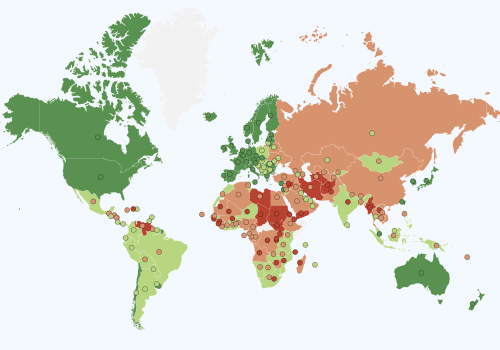
explore the data
stay connected
explore the program
The Freedom and Prosperity Center aims to increase the well-being of people everywhere and especially that of the poor and marginalized in developing countries through unbiased, data-based research on the relationship between prosperity and economic, political, and legal freedoms, in support of sound policy choices.
Image: Women shopping at a market in Senegal, Ziguinchor, Senegal. Jean Papillon, July 11, 2021.
For the latest updates, follow us on social media with #FutureOfDemocracy