When growth outpaces accountability: Political volatility in the Philippines
Bottom lines up front
- Changes in the style and incentives of individual presidents, rather than changes in formal rules, generate large swings in civil liberties and political rights.
- Economic growth has expanded opportunity and resilience, but it has not consistently translated into predictable public services or stable protections of rights.
- Improvements in the information environment allow elections to function more effectively as tools of selection and discipline, even in a system with weak parties and personalized coalitions.
This is the seventh chapter in the Freedom and Prosperity Center’s 2026 Atlas, which analyzes the state of freedom and prosperity in ten countries. Drawing on our thirty-year dataset covering political, economic, and legal developments, this year’s Atlas is the evidence-based guide to better policy in 2026.
Evolution of freedom
The institutional development of the Philippines since the mid-1990s is characterized less by steady consolidation than by sharp swings in the quality of governance and rights. With almost every change in administration, the political climate shifts markedly, producing alternations between more liberal and more illiberal periods rather than a clear linear trend. This volatility is most pronounced in the sphere of politics, while legal and economic institutions tend to evolve more gradually over time. In a very literal sense, the effective scope of rights and freedoms in the Philippines has depended heavily on who happens to be president—a predictable consequence of a highly presidential system, modeled on that of the United States but operating in a context of weak parties and strong political families.
The Freedom Index captures these dynamics well, especially on the political front. In interpreting these patterns, it is important to keep in mind that several components rely on perception-based measures, so the resulting swings can sometimes amplify short-term, highly visible changes relative to slower-moving institutional features. In such a system, shifts in leadership style and rhetoric can rapidly alter perceptions of freedom even when formal rules and organizations remain largely intact.
The basic constitutional architecture has been remarkably stable since the mid-1990s. Elections are held regularly and, since the late 2000s, are administered with reasonably professional procedures and electronic counting. The dramatic swings in the political subindex therefore do not reflect repeated constitutional breakdowns. Instead, it captures how individual leaders use the leeway that this system gives them. In a system designed to concentrate power in the presidency, changes in the character and incentives of presidents—particularly the alternation between more populist or illiberal leaders and more conventional, institutionally minded ones—rather than changes in the formal rules, generate large movements in civil liberties and political rights. If one imagines a sequence of such contrasting presidencies, the resulting time series would look very much like the Philippine political subindex.
To understand why leadership matters so much in the Philippines, it is essential to understand how political power is organized below the level of formal institutions, particularly the central role of families in politics. Political parties exist, but they function less as programmatic organizations than as loose coalitions of clans. My own research shows that political power is deeply embedded in family networks formed through marriage and kinship. Politicians are disproportionately drawn from families that occupy central positions in these networks, and these family ties provide a crucial advantage in coordinating electoral alliances and sustaining clientelistic exchange. Because these alliances are personal rather than institutional, they must be continually renegotiated. While some dynastic ties persist across generations, much of the surrounding coalition is recomposed each electoral cycle, and once the incentives that hold it together weaken, it can unravel quickly. The public rupture between President Ferdinand Marcos Jr. and his former ally, Sara Duterte, is an extreme but revealing illustration of how personal these arrangements are and how little institutional discipline constrains politicians. As a result, leadership changes can produce sharp shifts in how power is exercised, even when the formal rules of the system remain unchanged.
Leadership changes can produce sharp shifts in how power is exercised, even when the formal rules of the system remain unchanged
This family‑based, coalition‑driven politics also helps explain why the Philippines can run elections that are, on paper, reasonably well administered yet still struggle with deep problems of clientelism and accountability. Since the introduction of electronic vote counting around 2010, classic forms of fraud such as ballot‑box stuffing have become much harder. The electoral commission and related institutions are increasingly able to do their jobs without formal interference, and the basic procedures of voting and counting are broadly respected. At the same time, competition within and between dynasties still centers around contingent exchange of jobs, money, and other private benefits. Vote buying is common, and access to public resources is tightly mediated by local brokers, barangay captains, and family heads. This clientelistic equilibrium does not necessarily reduce the formal quality of electoral administration, but it does limit the extent to which elections translate into programmatic policy or consistent protection of rights.
The most visible break in the political series occurs with the election of Rodrigo Duterte as president in 2016. The political subindex shows a sharp drop in the components measuring civil liberties, political rights, and legislative constraints on the executive—a pattern well documented in both journalistic accounts and academic research on the period. Duterte’s “war on drugs” involved large‑scale extrajudicial killings, often carried out by police or quasi‑official actors, and a deliberate strategy of targeting opponents and critics. Media outlets and individual journalists faced harassment, legal cases, and in some instances the withdrawal of broadcast licenses. These pressures are reflected in international press‑freedom assessments: In 2024, Reporters Without Borders ranked the Philippines 134th out of 180 countries in its World Press Freedom Index. At the same time, the Duterte presidency also illustrates how different aspects of the system can move in opposite directions. The election that brought him to power was broadly competitive and credibly run, and the electoral machinery continued to function, so the main tools at his disposal were repression and intimidation rather than the outright manipulation of elections that historically plagued Philippine politics.
The role of institutional checks and balances under these conditions is subtle. Congress in the Philippines does have real power, but in practice it is fragmented and undisciplined, because legislators are themselves embedded in family-based networks and can shift party allegiance easily. They can make and unmake presidents, but they rarely act as a coherent counterweight. The courts, by contrast, are relatively strong. The legal profession is well-trained; the bar system and judicial hierarchy closely follow US models in emphasizing judicial independence. This means that even during periods of political turmoil, formal judicial independence and the clarity of the law remain comparatively robust.
In this context, the decline in the judicial-independence component of the legal subindex around 2016 may partly reflect a misalignment between perception-based indicators and slower-moving institutional realities. Perception-based indicators understandably penalize a judiciary that failed to stop abuses like the drug war, but the core problem in the Philippines was not wholesale judicial capture or corruption. Rather, it was an aggressive president willing to push far beyond legal boundaries in a setting where courts lacked the capacity, speed, and enforcement power to impose meaningful constraints. While the judiciary undoubtedly failed to hold the executive to account, it remained formally independent. This distinction matters: judicial weakness can produce outcomes similar to capture in the short run, but it has very different implications for institutional resilience and the prospects for recovery over time.
An often-overlooked actor in this story is the military. The Philippine armed forces are modeled on the US military and, over time, have become increasingly professionalized and institutionalized. Since the end of the Marcos era, reforms emphasizing civilian supremacy, professional norms, and a clear chain of command have gradually reduced the military’s direct involvement in partisan politics. While the armed forces are not entirely insulated from political pressures, they are far more rule-bound and organizationally coherent than many civilian institutions in the country. It is telling that the military did not play a central operational role in the campaign of killings in Duterte’s drug war, which was instead carried out primarily by the police. This absence matters: It points to limits on the extent to which military power can be readily redirected for personal or partisan purposes, even under an aggressive and illiberal presidency. More broadly, the presence of a professional and institutionalized armed force helps explain why the Philippines can experience sharp swings in its political environment without the coups and sustained civil unrest that characterized the immediate post-Marcos era. In this sense, the military serves as one of several institutions that help the political system absorb even substantial shifts in leadership without collapsing.
The level of corruption in the Philippines appears anomalous when compared to its East and Southeast Asian neighbors, but this divergence is partly a function of the comparison itself. A more appropriate comparison set may be Latin America, given shared features of colonial history, legal traditions, and prolonged US influence on political and administrative institutions. Relative to Latin American countries, the Philippines looks far less exceptional, both in the overall prevalence of corruption and in the way it is organized. As in much of Latin America, corruption in the Philippines is highly personalized and fragmented rather than centralized and predictable. Securing favors or contracts often requires identifying the appropriate political or bureaucratic patron—sometimes a close associate or relative of a top public official—and repeatedly renegotiating terms as coalitions shift. Corruption is never desirable, but this particular structure makes it especially damaging: Instead of functioning as a single, if distortionary, informal tax, it generates pervasive uncertainty and forces firms and citizens to continually reinvest in relationships. This pattern of “inefficient corruption” is closely tied to family-based politics and helps explain why the Philippines has not converged toward the more rule-bound governance models observed elsewhere in East and Southeast Asia.
Informality shows a similar pattern. The Philippines diverges sharply from the East Asia and Pacific average, where informality has declined steadily since the early 2000s, but it aligns much more closely with Latin American trajectories. Informal vendors, markets, and small-scale enterprises remain a defining feature of economic life, reflecting slower progress in building the digital and administrative infrastructure that supports formalization. Only in recent years has the country introduced a national ID and expanded digital finance in ways that could encourage movement into the formal sector, and these changes have not yet fully filtered into the data. Government efforts to promote formalization have been most visible and enforceable in resource-extraction sectors, while progress in formalizing the everyday informality of urban and rural livelihoods has been slower and more uneven.
The economic subindex shows a more familiar pattern for a middle-income, globally integrated economy. Trade and investment freedom have gradually increased since the 1990s, reflecting tariff reductions and openness to foreign capital. At the same time, the property-rights component moves in ways that are not entirely intuitive from a domestic perspective. There is an improvement around the turn of the millennium—likely linked to decentralization and associated legal reforms—and then a later decline that seems more related to changes in the business environment and international perceptions than to any dramatic shift in land rights or enforcement. In practice, because property-rights indicators also respond to legal predictability and enforcement across the economy and not only specific administrative systems like land titling, it is possible for the indicator to move substantially even if the practical challenges of land titling and cadastral fragmentation remain.
The women’s economic freedom component is another area where the legalistic basis of many international indicators underestimates the Philippine reality. Measures based on formal law place the country at the regional average and show gradual improvement, as new legislation on issues such as workplace discrimination is adopted. Yet in terms of everyday economic decision-making, household bargaining power, and attitudes toward female autonomy, the Philippines looks much more like a developed country. Consequently, measures like the World Bank’s Women, Business and the Law Index on which the Freedom Index relies—based on de jure rules—likely understate women’s actual economic freedom. Putting these pieces together, the evolution of freedom in the Philippines since 1995 is best understood as the interaction of three forces. First, a stable but highly presidential constitutional order creates room for large swings in de facto civil liberties and political rights whenever a new leader takes office. Second, a legal system and military that are relatively professional and institutionalized prevent those swings from turning into outright authoritarian breakdown or civil war. Third, a bureaucracy and political system organized around families and clientelism generate persistent problems with corruption and informality and limit the extent to which legal and economic freedoms are translated into predictable, broad-based access to the state. The Freedom Index captures these tensions: Moderate and sometimes improving scores for legal and economic freedom sit alongside sharp, presidency-driven shifts in the political subindex, most dramatically during the Duterte years and, looking ahead, potentially again under Marcos Jr.
From freedom to prosperity
The Prosperity Index for the Philippines tells a more optimistic and smoother story than the Freedom Index. Despite political volatility, overall prosperity has risen steadily since the mid-1990s, with only the COVID-19 shock producing a clear dip. Income has grown and inequality has fallen over the past decade and a half, comparing favorably with several regional peers. In addition, there have been gradual improvements in health, education, and environmental outcomes. At the same time, access for minorities has lagged, and the gains in prosperity remain shaped by the same family-based and clientelistic structures that organize politics.
The evolution of real gross domestic product per capita describes the country’s growth experience: modest but sustained expansion, punctuated by a deeper contraction than many of its peers during the pandemic and a subsequent recovery. The distinctive feature of the Philippine growth model over this period is that much of the engine lies outside the country’s borders. Millions of Overseas Filipino Workers (OFWs) send remittances home, and these flows have grown dramatically. In many towns one can literally see remittances in the landscape: a cluster of simple houses and, in the middle, a large concrete home built with wages earned in Hong Kong, Saudi Arabia, or Italy. These external earnings have supported domestic consumption and smoothed shocks, helping to sustain the upward trend in income per capita even in the face of domestic political instability.
The COVID-19 period is an exception. Here the country suffered a sharper dip than experienced by many regional peers. The government struggled to translate expert advice into effective policy. Vaccine hesitancy was widespread, but unlike in some other countries, this skepticism had a rational basis: a major vaccine controversy in the years just before the COVID-19 pandemic had undermined trust, particularly in poorer communities. Combined with already low trust in government, this made it difficult to achieve high vaccination rates quickly. By contrast, some more authoritarian neighbors relied more heavily on mandates and enforcement, which reduced delays in vaccine rollout.
Just as income per capita reflects the scale of remittances, the inequality component captures their distributional consequences. The data show a relatively strong decline in inequality over the last decade and a half, and I think remittances are central to that story. The families who send workers abroad are not typically those at the very top of the income distribution; they are often lower-middle and working-class households who can finance migration through extended family networks. The jobs they obtain—construction, domestic work, caregiving—are not elite positions, but their wages are high relative to domestic opportunities. When these earnings flow back into sending communities, they raise living standards not only for migrants’ immediate families but, through informal sharing and lending, for neighbors and kin.
Growth driven by overseas workers is, almost by construction, growth from the bottom and middle, not primarily from capital owners or domestic elites.
Remittances in the Philippines likely have measurable spillover effects through social networks: Households linked to migrants are more likely to change their economic behavior and sometimes their political attitudes. This mechanism helps explain why inequality measures improve so markedly relative to other countries. Growth driven by overseas workers is, almost by construction, growth from the bottom and middle, not primarily from capital owners or domestic elites. It is also gendered: Many OFWs are women working as nurses, caregivers, and domestic workers, which reinforces the earlier point that female economic opportunities have expanded even more than legal indicators suggest.
The health component presents a more mixed picture. For its income level, the Philippines has an impressive pool of medical professionals. Filipino doctors and nurses are highly trained and in demand abroad. The constraint is not talent so much as the systems that support it at home: infrastructure and supplies are uneven, and service delivery remains fragmented across local governments. Many facilities lack sufficient resources; operating rooms may lack adequate equipment, and local clinics are often without basic supplies. Despite the significantly higher cost of living in countries like the United States, where expenses can be two to three times higher, income disparities remain a major driver of outmigration, especially for nurses. In Metro Manila, private hospitals pay nurses as little as ₱12,000 a month (about US$203), while those in public hospitals make around ₱35,000 (roughly US$595). In comparison, nurses in the United States earn on average about US$6,417 a month. Decentralization reforms in the late 1990s devolved frontline health provision to municipalities and provinces. This helped bring services closer to remote communities, but also fragmented responsibility and made it difficult to implement consistent national strategies or large-scale efficiency improvements. The COVID-19 pandemic exposed these weaknesses clearly, as local governments struggled with logistics, data management, and public messaging. These realities are only imperfectly captured by the index, which focuses on aggregate outcomes such as life expectancy and mortality, but they help explain why the health component improves only gradually and takes a noticeable hit during the pandemic.
Education follows a similar pattern. Enrollment has expanded and average years of schooling have risen, producing an overall positive trend. Nonetheless, the data show less of a pandemic-related decline than I would have expected. Schools were closed for extended periods, and remote learning was constrained by patchy internet access and limited digital infrastructure. One possibility is that standard indicators based on attainment or enrollment miss much of the learning loss that resulted. In fact, available evidence suggests the country is suffering from acute learning poverty. According to a 2023 report, the share of children under ten unable to read and understand a simple text jumped from 69.5 percent in 2019 to 91 percent in 2021. That makes the Philippines one of the worst-performing countries in East Asia and the Pacific in terms of foundational reading skills. As with health, formal access is easier to measure than quality, and the Prosperity Index, by design, may not fully capture what happens inside classrooms.
The environmental component shows a marked improvement over the past two decades, largely driven by rising access to clean cooking technologies. Around the year 2000, only about 40 percent of the population used relatively clean fuels and stoves; today that figure is closer to 60 percent, which represents a substantial gain in terms of indoor air quality and associated health outcomes. Nevertheless, environmental challenges remain substantial outside those gains. Mismanaged waste is one of the most serious issues. Improperly disposed garbage and plastic refuse pollute waterways, worsen flood risk, and endanger coastal ecosystems. The burden of this waste problem falls heavily on poorer and coastal communities, where sanitation services are often limited or absent. By contrast, other variables captured by the index, such as industrial emissions, have seen comparatively little movement, largely because the Philippines is not a heavy industrial polluter compared with some of its East and Southeast Asian neighbors, so the main environmental challenges are not massive factory emissions but more localized problems linked to energy use, waste management, and resource extraction. The Philippines does not have the sort of racial cleavages that structure politics in some other societies, and it is overwhelmingly Catholic. The meaningful lines of difference are instead linguistic, regional, and between indigenous and nonindigenous populations, as well as between Christians and Muslims in Mindanao. Indigenous communities start from a very vulnerable baseline and tend to fare poorly across a wide range of outcomes; they are hit harder by shocks, such as COVID-19, and benefit less from growth. Muslim populations in conflict-affected areas face their own forms of exclusion. At the same time, women and many linguistic minorities have seen their opportunities improve, particularly as migration and remittance economies open new pathways. My assessment is that these offsetting trends—for some groups moving sharply up, for others stagnating or moving down—are producing a flat or slightly declining aggregate minority component in the Prosperity Index that does not fully reflect the underlying complexity.
The path forward
Economic growth in the Philippines has largely taken place in the absence of sustained political stability. The challenge now is to create conditions in which growth and political accountability reinforce one another, rather than evolve on separate tracks. Over the past three decades, the country has achieved steady gains in income, health, and education, even as its political environment has remained volatile. Living standards have improved for many households, supported by migration, remittances, and gradual human development gains, yet political rights and accountability continue to swing sharply with changes in leadership. This gap between rising prosperity and uneven freedom defines the task ahead: ensuring that economic progress deepens democratic accountability rather than reinforcing personalized and clientelistic politics.
Closing the gap between prosperity and freedom will require not only stronger institutions, but changes in how political accountability operates on the ground.
A realistic path forward must therefore address both sides of this equation. Economic gains have expanded opportunity and resilience, but they have not consistently translated into predictable public services or stable protections of rights. Weak parties, personalized coalitions, and uneven bureaucratic capacity mean that improvements in welfare often flow through private networks rather than public systems. As a result, elections remain competitive, yet leadership changes can still produce large swings in governance outcomes. Closing the gap between prosperity and freedom will require not only stronger institutions, but changes in how political accountability operates on the ground.
A promising source of optimism lies with voters themselves. Our research during the 2016 and 2019 elections shows that citizens are not irreversibly locked into clientelistic modes of politics. Instead, how voters evaluate candidates is highly responsive to the information environment in which electoral choices are made—an especially important dynamic in a system with weak parties and personalized coalitions.
Using field experiments across multiple election cycles, my research shows that providing voters with clear, credible information about candidates’ policy positions and commitments can meaningfully change the basis of electoral choice. Better-informed voters are more likely to support candidates whose policy positions align with their own preferences and less likely to rely on clientelistic considerations such as gifts, favors, or personal ties. While these interventions do not dismantle family-based politics, they weaken its grip at the margin by shifting how candidates are evaluated.
Those marginal shifts matter. When voters reward policy alignment and performance—even imperfectly—they alter the incentives political elites face. This creates a pathway for strengthening democratic accountability without requiring rapid party institutionalization or the dismantling of entrenched family networks. In contexts like the Philippines, where parties are fluid and coalitions are personalized, information allows elections to function more effectively as tools of selection and discipline.
Information, of course, is not a substitute for institutions. Courts, professional bureaucracies, and an increasingly institutionalized military remain essential for preventing political volatility from turning into outright breakdown. But informed voters can complement these constraints by shaping incentives before leaders take office. When candidates expect voters to reward policy alignment and performance, the space for arbitrary or illiberal governance narrows.
In practice, making this mechanism effective requires concrete investments in the information environment. These need not be sweeping or expensive. Standardized disclosure of candidate positions and policy commitments, voter guides that compare candidates on salient local issues, and the dissemination of credible information through trusted intermediaries—such as civil society organizations, local media, schools, and religious institutions—can all improve how voters evaluate their choices. Importantly, information is most powerful when delivered early, before clientelistic exchanges dominate electoral campaigns.
Economic development can reinforce this process. Rising education levels, expanding digital access, and broader media reach increase voters’ capacity to process and act on political information. But without deliberate efforts to improve the quality and credibility of that information, prosperity risks reinforcing clientelism by expanding the resources available for private exchange rather than strengthening public accountability.
At the same time, accountability gains will be limited if improvements in governance remain highly dependent on individual officeholders. Even as household conditions improve, the delivery of public services continues to vary widely across localities. In many areas, progress in health, education, or infrastructure is still disrupted by leadership turnover rather than sustained by durable administrative systems.
Some local governments, however, demonstrate what is possible when incentives align around performance and accountability. Where administrative capacity, leadership, and voter expectations reinforce one another, targeted reforms—such as improvements in frontline health care, streamlined administrative procedures, and investments in school quality—have taken root. These cases remain limited in scale, but they demonstrate that accountability can emerge even within a personalized political system when performance is visible and rewarded.
Extending these gains requires supporting bureaucratic professionalism in practical ways: investing in data systems, standard operating procedures, and career incentives that emphasize reliability and service delivery; insulating frontline functions from political turnover; and reinforcing norms of performance evaluation that are legible to citizens. These do not require grand institutional overhauls, nor do they depend on wishful thinking that the country can immediately transition away from personalistic politics. Rather, they are precisely the kinds of changes that make service delivery more predictable and gain traction when they align with how citizens evaluate government performance.
What is required instead is a realignment of incentives within that system, so that economic progress translates more reliably into political accountability and the protection of rights.
The path forward, then, is not about wholesale constitutional change or institutional redesign. The Philippine political system already provides the formal mechanisms needed for accountability. What is required instead is a realignment of incentives within that system, so that economic progress translates more reliably into political accountability and the protection of rights. Strengthening the information environment and targeted investments in bureaucratic capacity can help ensure that economic growth and political accountability move together rather than on parallel tracks.
When voters reward performance and policy alignment, even at the margins, they reshape the incentives political elites face. These shifts may be gradual, but they are directional, and often self-reinforcing. They expand the space for accountable politics and narrow the appeal of purely transactional ones. The task ahead is not to wait for institutional change, but to meet voters where they already are: ready to choose differently, when given the tools to do so.nt.
about the author
Cesi Cruz is an associate professor of political science and economics at the University of Michigan. Her research examines political accountability and governance, with a focus on how information, institutions, and social networks shape political behavior in developing democracies. She serves on the editorial board of VoxDev, a policy platform that translates academic research into accessible insights for policymakers and practitioners in development. Her work has been published in leading journals in political science and economics.
Explore the data
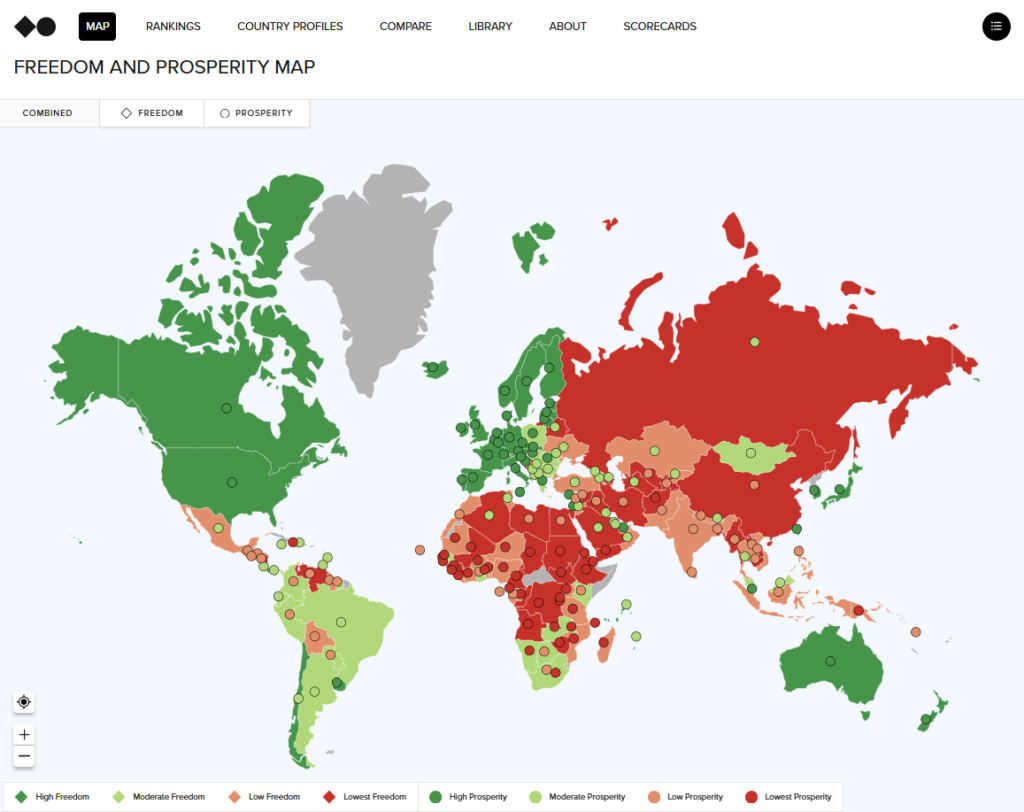
The Indexes rank 164 countries around the world. Use our site to explore thirty years of data, compare countries and regions, and examine the subindexes and indicators that comprise our Indexes.
Stay Updated
Get the Freedom and Prosperity Center’s latest reports, research, and events.
Stay connected
Read all editions
2026 Atlas: Freedom and Prosperity Around the World
Against a global backdrop of uncertainty, fragmentation, and shifting priorities, we invited leading economists and scholars to dive deep into the state of freedom and prosperity in ten countries around the world. Drawing on our thirty-year dataset covering political, economic, and legal developments, this year’s Atlas is the evidence-based guide to better policy in 2026.
2025 Atlas: Freedom and Prosperity Around the World
Twenty leading economists, scholars, and diplomats analyze the state of freedom and prosperity in eighteen countries around the world, looking back not only on a consequential year but across twenty-nine years of data on markets, rights, and the rule of law.
2024 Atlas: Freedom and Prosperity Around the World
Twenty leading economists and government officials from eighteen countries contributed to this comprehensive volume, which serves as a roadmap for navigating the complexities of contemporary governance.
Explore the program
The Freedom and Prosperity Center aims to increase the prosperity of the poor and marginalized in developing countries and to explore the nature of the relationship between freedom and prosperity in both developing and developed nations.
Image: Supporters of Philippine film star and former presidential candidate Fernando Poe Jr wave the Philippine flag as the funeral march passes by a residential district during sunrise in Manila December 22, 2004.
Keep up with the Freedom and Prosperity Center’s work on social media