In-depth research and reports

Our programs and centers deliver relevant, policy-focused research that matters to inform debate and action. Our focus is always on moving debate forward, integrating analysis with active, relevant conclusions throughout our published work.

Report

Nov 21, 2017

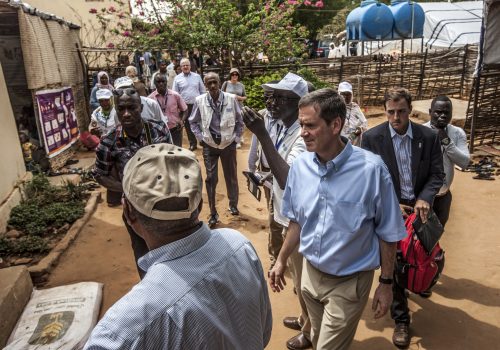
Equipping Africa’s primary school learners for the future

By Constance Berry Newman

Education remains a crucial component of economic development and poverty reduction. Primary education is especially important, as it provides students with the foundational skills necessary to continue with advanced education and participate in local and global economies. Collectively, educational benefits extend beyond individuals to benefit broader communities.   Despite its importance, primary education in Africa […]

Africa East Africa

Issue Brief

Nov 20, 2017

Partners or competitors? The future of the Iran-Russia power tandem in the Middle East

By John Herbst

Ambassador John Herbst, director of the Atlantic Council’s Dinu Patriciu Eurasia Center, writes in a new issue brief entitled Partners or Competitors? The Future of the Iran-Russia Power Tandem in the Middle East that Russia and Iran are currently drawn into partnership over common regional interests and anti-American policies and sentiments despite centuries of historical […]

Iran Politics & Diplomacy

Report

Nov 15, 2017

Asia in the “Second Nuclear Age”

By Gaurav Kampani and Bharath Gopalaswamy

It is now a truism among foreign and defense policy practitioners that the post Cold War nuclear buildup in the India Pacific region constitutes the drawn of the “second nuclear age.” From the 1990s onward, China’s decision to stir out of its strategic languor and modernize its nuclear arsenal, along with the resolve of India […]

Nuclear Deterrence Nuclear Nonproliferation

Diversity, Equity, and Inclusion

Nov 15, 2017

The Kremlin’s Trojan Horses 2.0

By Atlantic Council

Russian influences in Greece, Italy, and Spain “Russia’s interference in the US presidential election in 2016 sent a signal to the West: democratic societies are deeply vulnerable to foreign influence,” writes Dr. Alina Polyakova in The Kremlin’s Trojan Horses 2.0: Russian Influence in Greece, Italy, and Spain, a new report from the Atlantic Council’s Eurasia […]

Issue Brief

Nov 9, 2017

Iran’s bottom line in Afghanistan

By Alex Vatanka

Due to proximity and historical ties, no other country is as well placed as Iran to play a dominant role in Afghan society, as Middle East Institute senior fellow Alex Vatanka shows in his new paper, Iran’s Bottom Line in Afghanistan. However, Tehran is focused on short-term tactical gains at the expense of a sustainable, […]

Afghanistan Iran

Report

Nov 7, 2017

The Sino-Indian clash and the new geopolitics of the Indo-Pacific

By Bharath Gopalaswamy and Robert Manning

On June 18, 2017, an Indian patrol disrupted construction of a Chinese road along the disputed border of Sikkim, a remote state in northeast India, reigniting a border conflict between China and India. This incident rapidly evolved into a standoff, with the apparent threat of militarized escalation between the two countries. The tension dissipated without […]

Indo-Pacific Maritime Security

Report

Nov 7, 2017

Aviation cybersecurity—Finding lift, minimizing drag

By Pete Cooper

The aviation industry is faced with a complex and critical challenge to carefully balance costs with evolving business imperatives, customer demands, and safety standards.

Cybersecurity English

Report

Nov 6, 2017

Asian Water Security

By Peter Engelke

Read the Publication (PDF) Few  security  risks  are  becoming  as  serious  and  far-reaching  as  those  that  fall  under  the  heading  of  “ecological  overshoot”,  i.e.,  the  idea  that  humans  are  stretching  the  planet’s  resources  to  the  breaking  point  and  even  beyond. The  growing  scarcity  of  fresh  water  on  a  rapidly  changing planet is an important example […]

Issue Brief

Nov 2, 2017

Turkey: Managing tensions and options to engage

By Aaron Stein

This new issue brief argues that the United States should craft a realistic Turkey policy, given the current state of tensions over regional policy and the entrenchment of authoritarianism and illiberalism in Turkey.

Politics & Diplomacy Turkey

Issue Brief

Nov 2, 2017

Turkey: Managing tensions and options to engage

By Aaron Stein

This new issue brief argues that the United States should craft a realistic Turkey policy, given the current state of tensions over regional policy and the entrenchment of authoritarianism and illiberalism in Turkey. The piece contends that the trajectory of the relationship between the United States and Turkey suggests a need for the United States […]

Politics & Diplomacy Turkey

Issue Brief

Oct 31, 2017

Tehran stands atop the Syria-Iran alliance

By Danielle Pletka

Syrian President Bashar al-Assad has managed to hold onto power through the civil war and has the determined support of Iran to thank for his position. In Tehran Stands Atop the Syria-Iran Alliance, author Danielle Pletka examines ties between Syria and Iran, the power relationship that has emerged, and the legacy it leaves for the […]

Iran Politics & Diplomacy

Issue Brief

Oct 24, 2017

Managing the Korean conundrum

By Todd Rosenblum

Tensions on the Korean Peninsula have vexed US policy makers for generations. But for American citizens, problems of stability on the peninsula, and North Korean threats to its neighbors were problems over there.

Korea Nuclear Nonproliferation

Issue Brief

Oct 24, 2017

Managing the Korean conundrum

By Todd Rosenblum

Tensions on the Korean Peninsula have vexed US policy makers for generations. But for American citizens, problems of stability on the peninsula, and North Korean threats to its neighbors were problems over there. Not anymore. North Korea’s dual advances in nuclear weapons and intercontinental delivery systems are edging the situation toward profound. Ever since the […]

Korea Nuclear Nonproliferation

Issue Brief

Oct 19, 2017

Aligning economic sanctions

By John Forrer

As part of the Atlantic Council’s “Economic Sanctions Initiative,” the issue brief examines the challenges to aligning economic sanctions, with a focus on the economic sanctions on Russia in response to the annexation of Crimea. The author also explains why achieving well-aligned economic sanctions should be an important foreign policy objective: Well-aligned sanctions are more […]

Financial Sanctions and Economic Coercion

Issue Brief

Oct 19, 2017

Aligning economic sanctions

By John Forrer

John Forrer's issue brief examines the challenges to aligning economic sanctions, with a focus on the economic sanctions on Russia in response to the annexation of Crimea.

Financial Sanctions and Economic Coercion

Atlantic Council Strategy Paper Series

Oct 19, 2017

A strategy for the Trans-Pacific century

By Matthew Kroenig and Miyeon Oh

According to some projections, the majority of all global economic activity could take place within Asia by 2050. Military might often follows economic power, and Asian countries are already spending more than European states on defense. Both of these developments reflect a broader shift in global power from West to East.

Europe & Eurasia Indo-Pacific

Issue Brief

Oct 19, 2017

Iran’s fingerprints in Yemen: real or imagined?

By Elisabeth Kendall

In Iran’s Fingerprints in Yemen: Real or Imagined?, Dr. Elisabeth Kendall, nonresident senior fellow with the Brent Scowcroft Center’s Middle East Peace and Security Initiative and senior research fellow in Arabic and Islamic studies at Pembroke College at Oxford University, investigates the true extent of Iran’s presence in Yemen, including both military and cultural aspects. […]

Iran Security & Defense

Report

Oct 10, 2017

US strategy options for Iran’s regional challenge

By Kenneth M. Pollack and Bilal Y. Saab

In their new paper, entitled US Strategy Options for Iran’s Regional Challenge, Kenneth M. Pollack, resident scholar at the American Enterprise Institute, and Bilal Y. Saab, senior fellow and director for defense and security at the Middle East Institute, present five alternative strategies that the United States could pursue to limit Iran’s destabilizing activities. After […]

Iran Security Partnerships

Report

Oct 5, 2017

What if NAFTA Ended? The Imperative of a Successful Renegotiations

By Adrienne Arsht Latin America Center

In the midst of NAFTA renegotiations, the United States, Canada, and Mexico are discussing changes that could impact millions of jobs, investments, and North America’s stance in the global stage. As negotiators work at breakneck speed, new Atlantic Council findings show what the United States would lose if NAFTA were not in place.What if NAFTA […]

Mexico Trade and tariffs

Atlantic Council Strategy Paper Series

Oct 4, 2017

US strategy toward China’s belt and road initiative

By Gal Luft

The balance in Eurasia is shifting. China’s President Xi Jinping has ambitious visions for Asia, while the rest of the world reshuffles to find its place in the rapidly changing global order. The United States would be better off engaging with the BRI and trying to influence its design and mechanics from within, rather than staying on the sidelines and witnessing its allies gravitating toward China.

Africa China