

Resilience

The growing threats of climate change, migration, natural disasters, and spillover from violent conflict are forcing policy makers to focus on the resilience of their societies and institutions. While not all crises can be avoided, societies can be made more resilient through proper preparation before, during, and after a disaster or shock occurs. 

Programs

The Adrienne Arsht-Rockefeller Foundation Resilience Center will reach one billion people with resilience solutions to climate change, migration, and security challenges by 2030. We will focus our efforts on individuals, communities, and a broad spectrum of governments and institutions to help them, and their constituencies and stakeholders, better prepare for, navigate, and recover from shocks and stresses. We will help build a more resilient world.

Content

Dispatches

Mar 20, 2026

Demand destruction has begun: What Sri Lanka reveals about the global energy crisis

By Phillip Cornell

The disruption to oil and gas flows through the Strait of Hormuz has triggered a systemic shock to energy markets, and Sri Lanka is on the front line.

Conflict Energy & Environment

Issue Brief

Mar 19, 2026

Federal agencies under pressure need smarter systems, not tougher people

By Caitlin Thompson

Resilience is an important trait for national security practitioners, but it is not a solution for problems with agency and department design. Better systems and strategies can ensure that individuals are fully prepared and ready to respond to crises, rather than consistently under strain.

National Security Resilience

Dispatches

Mar 18, 2026

Attacks on desalination plants in the Iran war forecast a dark future

By Ginger Matchett

The attacks on desalination plants in Iran and Bahrain offer a glimpse into the dangers the region would face if water infrastructure is intentionally targeted at scale.

Conflict Energy & Environment

Dispatches

Feb 18, 2026

National preparedness starts at the state level with governors and the National Guard

By Jeanne Thorpe and Sarah Wallace

US state governors must retain meaningful access to the National Guard as a critical, time-sensitive resource for their own populations.

Resilience Resilience & Society

Atlantic Council Strategy Paper Series

Feb 9, 2026

Six ‘snow leopards’ to watch for in the decade ahead

By Uliana Certan, Nikita Shah, Ginger Matchett, Sarah Wallace, Dominique Ramsawak, Tatevik Khachatryan

Our scholars scan the horizon for the underappreciated phenomena that could have outsize impact on the world, driving global change and shaping the future.

Artificial Intelligence Climate Change & Climate Action

UkraineAlert

Jan 15, 2026

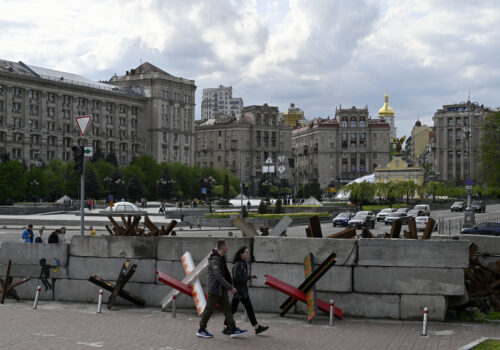
Ukraine’s enhanced fortifications are increasing the cost of Putin’s invasion

By David Kirichenko

As Ukraine focuses on preventing further Russian advances, Kyiv is investing in a major upgrade of the country’s defenses. This has resulted in what The Economist recently described as a “massive fortification system” covering much of the Ukrainian battlefield, writes David Kirichenko.

Conflict Defense Technologies

Report

Jan 2, 2026

The evolution of Latvia’s defense and security policy in resilience building

By Armands Astukevičs and Elīna Vrobļevska

Latvia has embraced a broader concept of national resilience encompassing not only military strength but also the resilience of its society, the continuity of government and essential services during crises, the protection of critical infrastructure, and the cultivation of psychological defense among its populace.

Defense Policy Europe & Eurasia

MENASource

Dec 19, 2025

Employment needs to take center stage in Gaza security plans

By Melanie Robbins 

The best way to undermine Hamas’s power in Gaza is to employ the people Hamas pays today.

Civil Society Economy & Business

New Atlanticist

Dec 1, 2025

How Syria’s grassroots civil peace committees can help prevent intercommunal conflict

By Gregory Waters and Kayla Koontz

Syria’s local civil peace committees offer an important model for dealing with the country’s deeply rooted social divisions.

Civil Society Crisis Management

New Atlanticist

Nov 7, 2025

Hurricane Melissa left $8 billion in damage. Jamaica needs US support to get back on its feet.

By Patricia R. Francis, Maite Gonzalez Latorre

After the devastation caused by Hurricane Melissa, Jamaica needs the United States to invest in the country’s resilience and economic recovery.

Caribbean Climate Change & Climate Action

Experts