Security & Defense

One of the most fundamental responsibilities of governments is to protect their citizens from all threats, internal or foreign. Policy makers must prepare for potential conventional warfare, terrorism and other asymmetrical attacks, and the repercussions of natural disasters and climate change to ensure the safety of their citizens. The motivation to protect against future threats must also be partnered with regular dialogue and partnership with allies and neighbors to prevent the triggering of violent conflict or destabilizing arms races.

Content

New Atlanticist

Nov 7, 2025

With Hezbollah rearming, Israel must heed the lessons of October 7

By Jonathan Rosenstein

Only by combining military strength, diplomatic coordination, and strategic foresight can Israel keep the terrorist group in check.

Israel Lebanon

In the News

Nov 7, 2025

Ruggiero in the Washington Post on Trump’s nuclear testing announcement

On November 6, Forward Defense nonresident senior fellow Anthony Ruggiero was quoted in an a Washington Post article entitled “Trump’s ill-defined nuclear test threat compels a response from Putin,” in which he discussed Trump’s motivation to restart nuclear testing.

Arms Control Nuclear Deterrence

In the News

Nov 6, 2025

Wieslander on Deep Dish on Global Affairs Podcast

Anna Wieslander, Director for Northern Europe, featured on Thursday November 6 in the Deep Dish on Global Affairs Podcast by the Chicago Council on Global Affairs on the Arctic. Wieslander discussed how the Arctic from a European perspective has gone from a non-tension area with essentially no focus on security issues, to an area of increasing tensions […]

Northern Europe Security & Defense

UkraineAlert

Nov 6, 2025

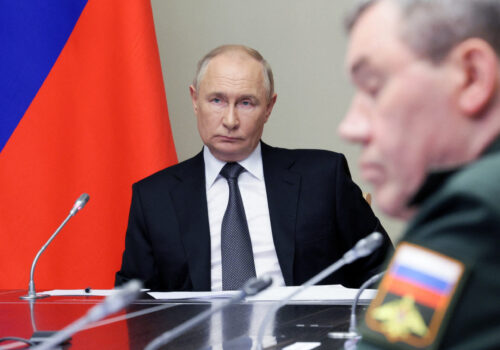
Vladimir Putin’s endless nuclear threats are a sign of Russian weakness

By Stephen Blank

Since 2022, Russian President Vladimir Putin has repeatedly used nuclear threats to deter Western support for Ukraine, but this scare tactic risks exposing Russia's inability to project strength via more conventional means, writes Stephen Blank.

Conflict Disinformation

New Atlanticist

Nov 6, 2025

The expert conversation: What’s Trump’s endgame in Venezuela?

By Matthew Kroenig, Jason Marczak

We spoke to Matthew Kroenig and Jason Marczak to shed light on the US campaign of attacks on alleged drug boats and lay out what's next.

Conflict Human Rights

UkraineAlert

Nov 6, 2025

Ukraine’s youth exodus highlights mounting demographic challenges

By Kateryna Odarchenko, Zoryana Golovata

Thousands of young Ukrainian men have left the country since the relaxation of martial law travel restrictions in August. The exodus has highlighted Ukraine's mounting demographic challenges, write Kateryna Odarchenko, Zoryana Golovata.

Conflict Economy & Business

UkraineAlert

Nov 6, 2025

Learning the lessons from Ukraine’s fight against Russian cyber warfare

By Oleksandr Bakalynskyi, Maggie McDonough

The Russian invasion of Ukraine is among the most technologically advanced wars the world has seen. But while rapid developments in drone warfare tend to attract most attention, the cyber front also offers important lessons for international audiences, write Oleksandr Bakalynskyi and Maggie McDonough.

Conflict Cybersecurity

In the News

Nov 6, 2025

Rich Outzen joins i24 for an interview on US troops in Syria

Defense Policy Middle East

MENASource

Nov 5, 2025

Why China is here to stay in Iraq’s energy sector

By Jared Levy and Ben Van Heuvelen

Regardless of the specific makeup of the next Iraqi government, it is likely that Chinese firms will continue to enjoy an advantage.

Elections Iraq

New Atlanticist

Nov 5, 2025

With Trump’s threats of military intervention in Nigeria, Tinubu faces a delicate balancing act

By Ohimai Amaize

With Nigeria on the brink of a diplomatic crisis with the United States, President Bola Tinubu must confront extremist violence without inflaming sectarian divides and rebuild diplomatic ties with Washington.

Extremism Financial Sanctions and Economic Coercion

Experts

Events