
As the Trump-Xi summit draws closer, trade uncertainty still looms large
Next week, US President Donald Trump and Chinese President Xi Jinping will once again walk the red-carpeted corridors of the Great Hall of the People. In the high-level talks that follow, they will discuss the tense relationship between the world’s two largest economies. And there is plenty to cover, especially on the economic front.
For one, the conflict in the Middle East, which initially prompted the summit’s postponement from early April to mid-May, continues to send shockwaves through global trade and US-China relations. Just last month, the US administration sanctioned five Chinese refineries for purchasing Iranian oil. Over the weekend, Beijing responded by invoking a Chinese law that protects firms across the country that continue to do business with these facilities, effectively defying Washington’s measures.
The issue that remains front and center as the Trump-Xi summit draws closer, however, is trade. Although the US administration is not expected to make any major announcements prior to Trump’s visit to Beijing, it is moving quickly to impose new import duties on Chinese goods. These new tariffs are expected in the second half of the year, and as evidenced by its recent rejection of US sanctions, China will not hesitate to respond in kind to what it sees as an overreach of US economic statecraft. What both sides manage to agree to in Beijing on key export controls or purchase agreements will significantly shape how the White House approaches rebuilding its tariff wall.
From IEEPA tariffs to 301s
Since the Supreme Court struck down IEEPA tariffs in February, the US administration has been leveraging new legal avenues to reimpose its tariff regime. Part of the reason is that China, originally the prime target of Trump’s “Liberation Day” tariffs, has emerged as one of the ruling’s biggest beneficiaries. Originally faced with a 34 percent IEEPA tariff rate, China is now subject only to the 10 percent universal baseline under Section 122—and even this baseline is set to expire in July.
To compensate for the shortfall, the Trump administration has indicated that it will use a combination of Section 301 and Section 232 tariffs to replicate the IEEPA regime. Moreover, there are currently two separate 301 investigations targeting China: one focused on excessive industrial overcapacity and another on alleged forced labor violations.
A closer look at the data shows, however, that recreating last year’s effective tariff rate would require drastic measures, as illustrated in the two scenarios below.
Using 2025 customs data on imports from China, the estimated effective tariff rate on Chinese goods, including Section 232 tariffs and existing Section 301 measures, is around 23.69 percent. These legacy 301s date back to the first US-China trade war and were later expanded during the Biden administration. They cover over 60 percent of Chinese imports, mostly at a 25 percent rate, with notable exceptions, including solar cells at 50 percent and electric vehicles at 100 percent.
Even if the Trump administration were to expand the list of products covered by Section 301 tariffs to 80 percent of Chinese imports, this would raise the effective tariff rate only to 27.63 percent. And that is without accounting for the many products intentionally kept off Section 301 lists and exempted from previous rounds of IEEPA tariffs because of the costs they would impose on US businesses and consumers. These include pharmaceuticals, rare earths, and iPhones.
In an alternative scenario, the administration could raise Section 301 tariff rates from 25 percent to 50 percent. While this would be enough to recreate the effective tariff rate under IEEPA, it would almost certainly trigger an escalatory response from Beijing. And just as in October 2025, when China retaliated against US tariffs, export controls on rare earths minerals could once again become the weapon of choice.
The soybeans and the stick
Although tariffs remain a defining issue in the US-China trade relationship, they may take a backseat in the actual negotiations at the summit in Beijing—the simple reason being that the US administration cannot yet implement new 301s due to the mandatory investigation period. Instead, both sides should use the meeting to review the terms of the “trade truce” from the Trump-Xi talks in Busan last year, assess what progress has been made, decide whether the current pause on export controls should be extended, and maybe even consider the “Board of Trade” idea.
As part of an escalatory cycle in US-China relations between March and October of last year, both sides introduced stricter export controls on top of existing restrictions. As a result of the Trump-Xi talks in South Korea on October 30, however, some of these restrictions were lifted (see the table below).
Now that months have passed and the truce has held, the United States could consider further easing its semiconductor controls in exchange for improved licensing conditions for rare earth metals that remain in place. But national security concerns persist on both sides.
Meanwhile, another key component of the Busan deal may be easier to follow up on: China’s pledge to purchase twelve million metric tons of US soybeans by the end of 2025—and at least twenty-five million metric tons in 2026, 2027, and 2028. So far, reporting suggests China is on track to ramp up imports, although it remains unclear whether it has met the 2025 target. It is likely, however, that Beijing has the flexibility to scale up its purchases of US soybeans to the negotiated quota without significantly increasing US market share or deepening its dependence on US soybean producers—especially given that Brazil remains its largest supplier, providing over eighty million metric tons in 2025.
Détente or escalation?
Will the Trump-Xi summit provide perfect clarity on this broad set of issues, from US tariffs to Chinese export controls to soybean deals? It’s highly unlikely. The meeting will, however, set the tone for the rest of the year.
Given how the summit unfolds, China and the United States could either enter a prolonged period of détente while continuing to decouple in critical chokepoints, or enter a renewed cycle of tit-for-tat trade escalation. What’s true either way is that we have entered an era where friction between the world’s two largest economies has become the baseline, not the exception.
Prior to the first round of 301 tariffs on China in 2018, the notion of tariffing more than half of Chinese imports would have been unimaginable. Today, it’s reality. The question that US-China relations now hinge on is not whether escalation is possible—but how far it will go before it is either contained or settles into a new equilibrium.
Jessie Yin is an assistant director at the Atlantic Council’s GeoEconomics Center.
This post is adapted from the GeoEconomics Center’s weekly Guide to the Global Economy newsletter. If you are interested in receiving the newsletter, email JYin@atlanticcouncil.org.
Related Reading
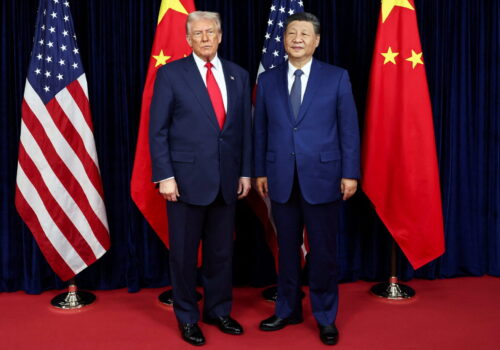

Image: US President Donald Trump and Chinese President Xi Jinping talk as they leave a bilateral meeting in Busan on October 30, 2025. Source: REUTERS/Evelyn Hockstein.