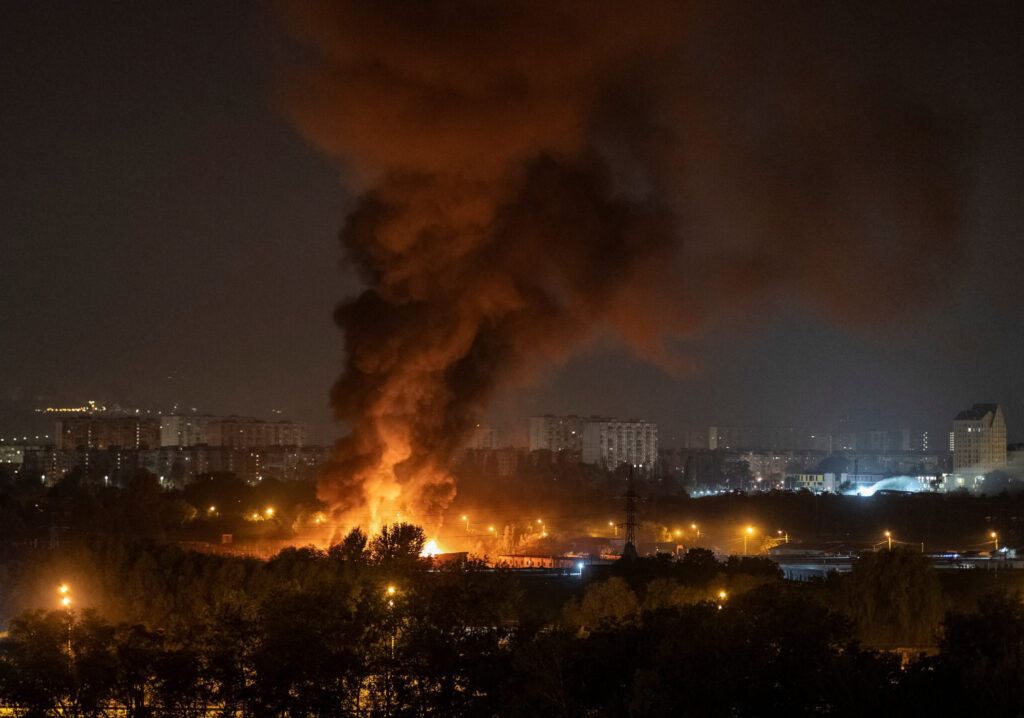
Hours after US President Donald Trump’s surprise Sunday announcement of an energy ceasefire between Kyiv and Moscow, Russia responded by bombing a series of Ukrainian power plants. This very public snub underlines the Kremlin’s lack of interest in US-led peace efforts and confirms Russian dictator Vladimir Putin’s determination to escalate his invasion.
A revised Russian victory plan has been taking shape in recent months that focuses on an expanded air offensive exploiting Ukraine’s depleted defenses. The Kremlin intends to deploy a combination of ballistic missiles, cruise missiles, and increasingly sophisticated strike drones to hit vulnerable civilian sites throughout the country.
This strategic bombing campaign is already well underway and includes round-the-clock attacks on major population centers, along with airstrikes targeting critical civilian infrastructure and key economic sites. Russia’s overall objective is to render much of Ukraine unlivable and cause a humanitarian disaster that will force Kyiv’s capitulation.
Stay updated
As the world watches the Russian invasion of Ukraine unfold, UkraineAlert delivers the best Atlantic Council expert insight and analysis on Ukraine twice a week directly to your inbox.
The current emphasis on air power reflects Russia’s failure to win the war on the battlefield. Despite more than four years of heavy fighting amid enormous human and material costs, the Russian army has been unable to achieve a decisive breakthrough and is currently struggling to make any progress at all.
At the some points of the front, Ukraine has actually managed to advance since the start of 2026. In particular, Ukrainian forces have regained territory in parts of the Donetsk region through the ongoing Operation Vivaldi, which has been credited with stalling Russian efforts to encircle the strategically vital fortress belt of Ukrainian cities in the northern Donbas.
With little current prospect of a decisive military victory in Ukraine, Russia is instead looking to break Ukrainian resistance by undermining the basis for civilian life in the country. Russian attacks on Ukraine’s civilian infrastructure are not new, of course, and have been a key feature of the war since the initial stage of the invasion. Nevertheless, the past six months have witnessed an unprecedented increase in the scale and scope of Russia’s aerial offensive.
There are now concerns in Kyiv and elsewhere that the most intensive phase of Russia’s bombing campaign lies ahead as Putin looks to weaponize the coming seasonal freeze. Speaking in early October, Ukrainian President Volodymyr Zelenskyy warned that Russia has stockpiled as many as seven hundred ballistic missiles for attacks during the winter months.
Ukrainian officials claim to have intercepted Russian documents revealing chilling details of a planned bombardment over the winter period that would leave Kyiv and Ukraine’s other major cities uninhabitable. Reported targets include hydro and thermal power plants, water treatment facilities, EU electricity import routes, and hubs connecting the country’s nuclear plants to the power grid.
In parallel, Russia plans to maintain a pattern of relentless airstrikes on Ukrainian cities using a new generation of jet drones that are far harder to intercept than their propeller-driven predecessors, keeping the remaining civilian population in a state of constant stress and uncertainty. Since the last weeks of the summer season, a surge in jet drone attacks has already disrupted almost every aspect of daily life in Kyiv with schools, businesses, and public transport often unable to operate.
The Kremlin is also attempting to destroy the foundations of the Ukrainian economy. Since the beginning of 2026, Moscow has dramatically expanded attacks on Ukraine’s Black Sea ports, railways, fuel infrastructure, and logistics hubs. Meanwhile, a series of recent missile strikes forced the country’s largest steel plants to shut down. This is hampering maritime exports, creating harsh economic conditions and unemployment across entire regions, and starving the budget of desperately needed revenues.
Eurasia Center events

Russia’s tactics are a recipe for a humanitarian catastrophe that could force millions of Ukrainians to flee their homes and spark a new flood of refugees entering the EU. United Nations officials are already warning that Ukraine faces the most difficult wartime winter since the start of the full-scale invasion. UN development agency head Alexander De Croo stated recently that there was now a “race against the clock” to repair Ukraine’s power network before temperatures plummet.
Many continue to question whether Russia’s bombing campaign will actually work. Skeptics have pointed to numerous historical precedents as proof that the bombardment of civilian populations and critical infrastructure often proves counterproductive and stiffens resistance. Over the past four years, Russia’s winter bombing campaigns have acted as a catalyst for further allied aid, providing Western leaders with the political capital needed to approve additional backing.
Increased international support will now be crucial before the winter season starts in earnest. Ukraine’s partners should prioritize items including additional air defenses, replacement locomotives and repair machinery for the rail network, and industrial-scale power generators for municipalities to maintain critical public services during extended energy blackouts.
Putin believes he can break Ukraine during the coming winter and has no intention of agreeing to any temporary pauses or ceasefire proposals. On the contrary, he is planning what is likely to be the largest bombing campaign of the entire war.
If Putin succeeds in making Europe’s largest country unlivable, the humanitarian and security consequences will reverberate far beyond the borders of Ukraine. Western leaders must act now to strengthen Ukrainian resilience and not wait until the crisis deepens in the months ahead.
Maksym Beznosiuk is an analyst whose work focuses on Russia, Ukraine, and international security. He is an associate fellow at GLOBSEC. William Dixon is a senior associate fellow of the Royal United Services Institute and an associate fellow at GLOBSEC. He specializes in cyber and international security issues.
Further reading


The views expressed in UkraineAlert are solely those of the authors and do not necessarily reflect the views of the Atlantic Council, its staff, or its supporters.


The Eurasia Center’s mission is to enhance transatlantic cooperation in promoting stability, democratic values, and prosperity in Eurasia, from Eastern Europe and Turkey in the West to the Caucasus, Russia, and Central Asia in the East.
Follow us on social media
and support our work
Image: Fire and smoke rise in the city during a Russian missile and drone strike, amid Russia's attack on Ukraine, in Kyiv, Ukraine. October 7, 2026. (REUTERS/Vladyslav Sodel)