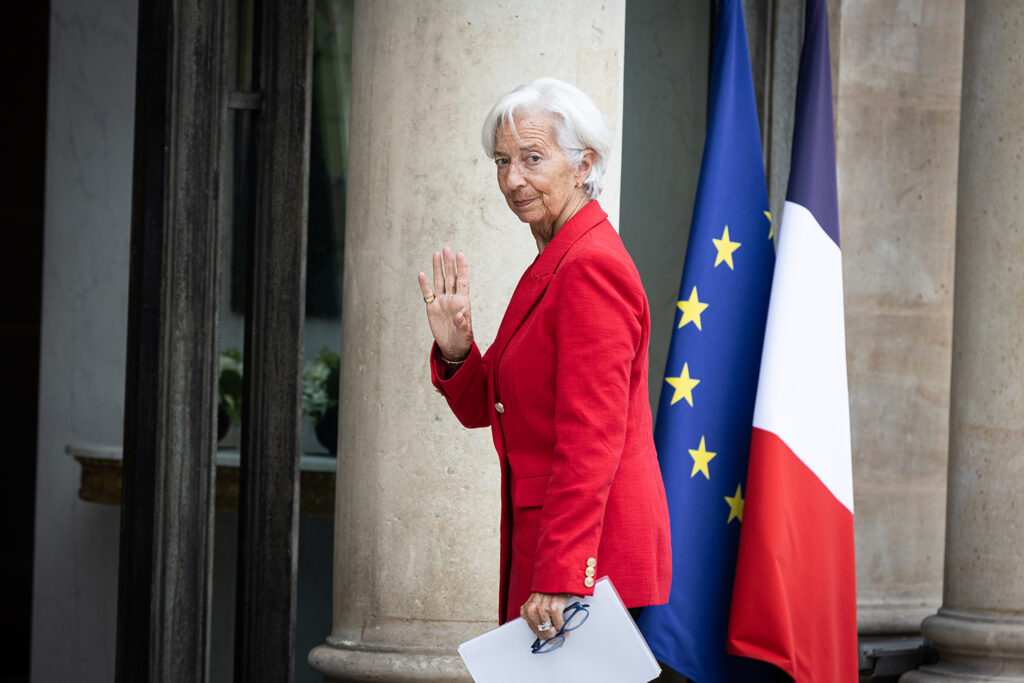
In a wide-ranging interview with the Wall Street Journal published Saturday, European Central Bank (ECB) President Christine Lagarde reflected on her tenure and ambitions. Alongside stating her “mission accomplished” on price stability absent new major shocks, she highlighted another priority: making the euro “fit for the future” by advancing the digital euro. “We have really worked long and hard on our digital central bank currency,” she said, adding that she hoped it would be “a legacy that I will also leave behind.”
Given last week’s reports that Lagarde could step down before her term ends in October 2027, these words take on added significance. They also raise a critical question—one that has received far less attention than speculation about what Lagarde’s early exit could mean for European politics and monetary policy: what will become of the digital euro? As one of the most advanced and closely watched central bank digital currency (CBDC) projects in the world, the initiative has been strongly tied to her tenure.
It was Lagarde who pushed the digital euro from research to a live policy effort, complete with a formal timeline and legislation now moving through Brussels. As she put it last year, “the digital euro is not just a means of payment; it is also a political statement concerning the sovereignty of Europe.”
So far, no final decision to issue the digital currency has been taken. Instead, the project remains in its “preparation phase,” meaning the next ECB president will inherit it midstream. The four rumored candidates for Lagarde’s succession, however, differ sharply in how—or how quickly—they intend to see it through.
Lagarde’s legacy and the current state of the project
The digital euro is a CBDC project pursued by the ECB. Initial research began in 2016, but momentum accelerated in 2019 after Facebook’s proposed Libra stablecoin raised concerns about monetary sovereignty across major central banks. Lagarde inherited the initiative in November 2019. Under her leadership, the ECB launched a formal investigation phase in 2021 and entered a preparation phase in 2023, making it one of the most advanced CBDC efforts among major central banks.
Lagarde consistently framed the digital euro as both a modernization of money project and a sovereignty project. Speaking at the Atlantic Council in 2024, she described it as “a digital backbone”—central bank money adapted for a digital economy. With European payments still fragmented and heavily reliant on Visa, Mastercard, and US-based platforms, she argued a digital euro would offer a fast, low-cost, sovereign alternative. This point has been echoed by others at the ECB, including executive board member Piero Cipollone, who recently warned that “Europe is significantly reliant on non-European payment systems and if we do not do anything this reliance will increase,” adding that payments infrastructure is “critical for the functioning of the economy.”
Over the past few years, the project has made concrete progress on technical and operational design. The ECB has mapped eleven potential use cases, including point-of-sale payments, peer-to-peer transfers, and offline transactions. It is also developing a rulebook to govern how the currency would work across the eurozone, has selected infrastructure providers, and is working with commercial banks and payment service providers that would distribute the currency to users.
Legislation remains the sticking point. The European Commission proposed a digital euro regulation in 2023, but the European Parliament has yet to pass it. Until the legal framework clears—which would establish legal tender status, holding limits, and privacy rules—the ECB cannot take a final issuance decision. Pilots are expected around 2027, with a commercial launch potentially following in 2029.
Whenever a new president does take office, they will inherit a project already at an advanced stage, with significant technical progress and regulatory momentum. Critical decisions on design, scope, and timing, however, remain unresolved.
The candidates
None of the four frontrunners oppose the digital euro. However, their positions differ on pace, framing, and the risks they are most concerned about.
Joachim Nagel (president, German Bundesbank)
- Position: Strategically supportive and sovereignty-focused; presents the digital euro as essential to making the euro “fit for the future,” strengthening European independence, and maintaining resilient payments infrastructure. Skeptical of cryptoassets, describing Bitcoin as a “digital tulip,” while reinforcing a central bank–led digital money model. Emphasizes holding limits, no remuneration, and banking-system safeguards.
- Key quote: “I am convinced that the digital euro will be a success . . . The digital euro is an opportunity for Europe . . . [to] make Europe more independent and resilient.”—Bundesbank speech, January 2026
- If appointed ECB president: The digital euro would likely be elevated as a strategic necessity; one could expect timely implementation by 2029 alongside ambitious EU reform projects, including European joint assets and capital markets, to adapt to a fragmenting global landscape.
Pablo Hernández de Cos (general manager, Bank for International Settlements and former governor, the Banco de España)
- Position: Strong technocratic supporter; frames the digital euro as necessary to preserve the two-tier monetary system and ensure continued public access to central-bank money as cash usage declines. Generally cautious on cryptoassets, emphasizing regulatory oversight and financial stability.
- Key quote: “Without a digital euro, the public could lose access to central bank money as payments digitalise . . . which could weaken the ECB’s ability to deliver on its mandate under stress conditions.”—Bruegel Podcast interview, July 2025
- If appointed ECB president: The digital euro would likely be advanced as a responsibility to ensure the Eurosystem’s future viability, without overstepping established European safeguards and in close coordination with the financial industry.
Klaas Knot (former president, Dutch Central Bank)
- Position: Supportive but pragmatic and sovereignty-focused; emphasizes public access to central bank money and strategic autonomy rather than urgency or rapid adoption.
- Key quote: The digital euro will “provide us with a means of payment that is independent of non-European parties and that will also form a reliable backup in crisis situations. This will be an important addition to our payment infrastructure.”—DNB speech, April 2024
- If appointed ECB president: The digital euro would likely be framed as resilience infrastructure; the rollout would likely be cautious, risk-managed, and use-case driven.
Isabel Schnabel (member, ECB Executive Board)
- Position: Strategically supportive but technocratically cautious; frames the digital euro as part of European sovereignty and euro internationalization, while stressing legislative complexity, privacy safeguards, and infrastructure resilience. Portrays the digital euro as an initiative to counter big tech and stablecoins.
- Key quote: “National sovereignty is also about payment . . . One way to further strengthen the international role of the euro is the digital euro.”—Sciences Po address, April 2025
- If appointed ECB president: The digital euro would likely be supported within the ECB’s mandate, but final responsibility would likely be left to the European Parliament, Eurogroup, and European data protection agencies.
None of the four leading candidates are explicitly “anti-digital euro,” but they diverge in how they view its purpose and urgency. Schnabel and Hernández de Cos present the project as structurally important to Europe’s monetary future: Schnabel emphasizes geopolitical sovereignty and the euro’s international role, while Hernández de Cos focuses on preserving the two-tier monetary system and maintaining public access to central bank money as payments digitalize. Nagel and Knot are broadly supportive but more cautious on pace and design: Nagel foregrounds financial-stability safeguards and banking-system protection, whereas Knot stresses demonstrable added-value use cases and a risk-managed rollout.
All four invoke European sovereignty, but the emphasis varies. For Nagel and Hernández de Cos, sovereignty is largely inward-facing, centered on safeguarding euro-area monetary transmission and the European banking architecture. Schnabel’s framing is more outward-looking and geopolitical, highlighting competition from dollar-backed stablecoins and the growing influence of US technology firms in payments infrastructure.
Whoever the next ECB president may be, they will inherit a project whose significance reaches far beyond Europe’s borders—and face decisions that could set the benchmark for central bank digital currencies worldwide. The path they chart will not only shape the future of the euro and the continent’s payments infrastructure but also decide whether Europe takes the lead in the digital currency revolution.
Alisha Chhangani is the associate director for future of money at the Atlantic Council’s GeoEconomics Center.
Jacopo Pastorelli is a program assistant at the Atlantic Council’s Europe Center.

At the intersection of economics, finance, and foreign policy, the GeoEconomics Center is a translation hub with the goal of helping shape a better global economic future.
Further reading

Thu, Jan 15, 2026
What to watch as China prepares its digital yuan for prime time
Econographics By Alisha Chhangani
The changes China is implementing around the e-CNY signal a more mature phase for the digital yuan—and an overall shift toward a much broader geopolitical ambition.
Wed, Oct 23, 2024
Christine Lagarde on European competitiveness, US tariffs, and creating a digital euro
New Atlanticist By Daniel Hojnacki
The European Central Bank president discussed the European Union’s ambitions for becoming more competitive and modernizing its payments systems.
Mon, Feb 2, 2026
To increase its autonomy, Europe must look to its strengths
Dispatches By
The challenge for Europe in the coming decade is not to imitate the United States and China, but to mobilize its own considerable strengths.
Image: Christine Lagarde, president of the European Central Bank, is seen at the entrance of the Elysee Palace after the Council of Ministers in Paris, France, on July 16, 2025. Photo by Telmo Pinto/NurPhoto/Reuters.