Amid Arab competition, the war in Sudan requires a US balancing act
In the wake of the atrocities carried out by the Rapid Support Forces (RSF) in el-Fasher in late October, Sudan’s devastating conflict has drawn renewed international scrutiny.
In April 2023, this civil war erupted amid escalating tensions between the Sudanese Armed Forces (SAF) and the RSF, stemming from disagreements over the RSF’s integration into the national army. These disputes followed a period of SAF-RSF power-sharing in the wake of former Sudanese President Omar al-Bashir’s ouster in 2019.
Thus far, the conflict has claimed perhaps more than 150,000 lives and displaced more than twelve million people, making it one of the world’s gravest humanitarian crises.
With every diplomatic initiative over the past thirty-three months failing to halt the violence, US President Donald Trump’s administration has recently focused more on Sudan. This month, a US-Saudi cease-fire initiative has been under review by the Security and Defence Council, a body that includes members of the SAF. Whether this initiative can move forward and help reverse the country’s descent into catastrophe remains to be seen.
Nonetheless, the Trump administration’s efforts to play a productive role in winding down the conflict will depend, in no small part, on how Washington chooses to engage—and with whom.
SIGN UP FOR THIS WEEK IN THE MIDEAST NEWSLETTER
Trump, MBS, and the personal diplomacy factor
The landmark visit by Saudi Crown Prince and Prime Minister Mohammed bin Salman (MBS) to the White House in November helped direct Trump’s attention toward Sudan, which he described as the “most violent place on Earth” and the “single biggest humanitarian crisis.” As Trump acknowledged during his meeting with MBS, Sudan was “not on my charts to be involved in that,” adding that he viewed the conflict as “just something that was crazy and out of control.”
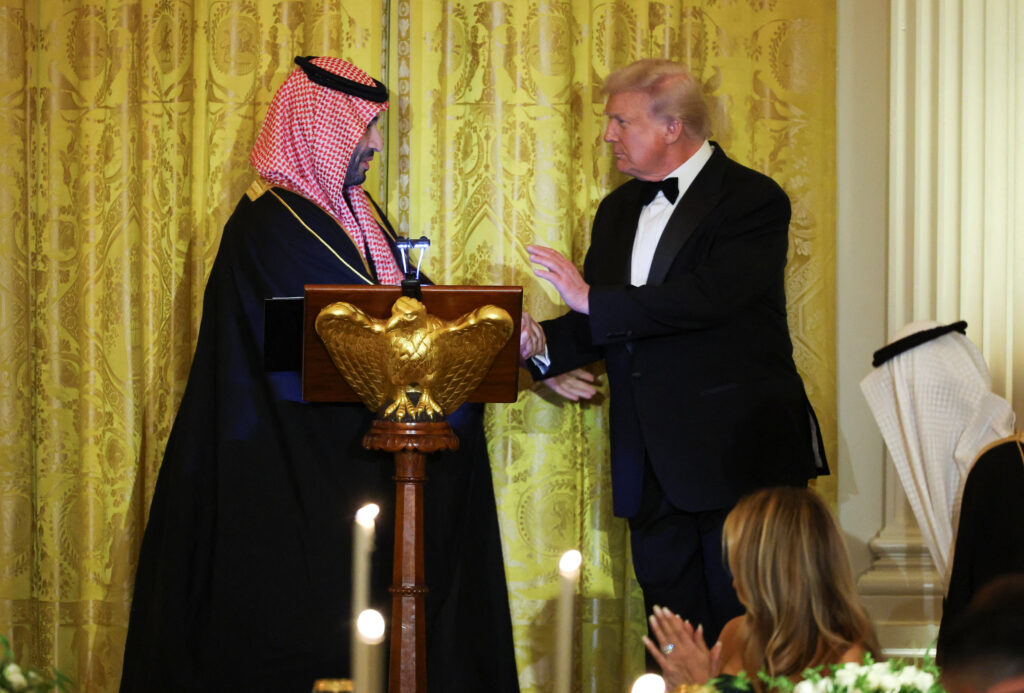
That MBS played a decisive role in bringing Sudan onto Trump’s radar underscores the depth of the US president’s personal ties with key Gulf leaders. In contrast to previous US administrations that relied heavily on institutional channels such as the State Department for Middle East engagement, Trump has consistently favored leader-to-leader relationships as the foundation of his administration’s foreign policy decision-making.
Challenges before the Quad
Trump is determined to work with the so-called Quad—the United States, Egypt, Saudi Arabia, and the United Arab Emirates (UAE)—to bring Sudan’s war to an end. However, this effort will face stiff resistance from both belligerents: the SAF, led by General Abdel Fattah al-Burhan, and the RSF, commanded by General Mohamed Hamdan Dagalo (popularly known as Hemedti).
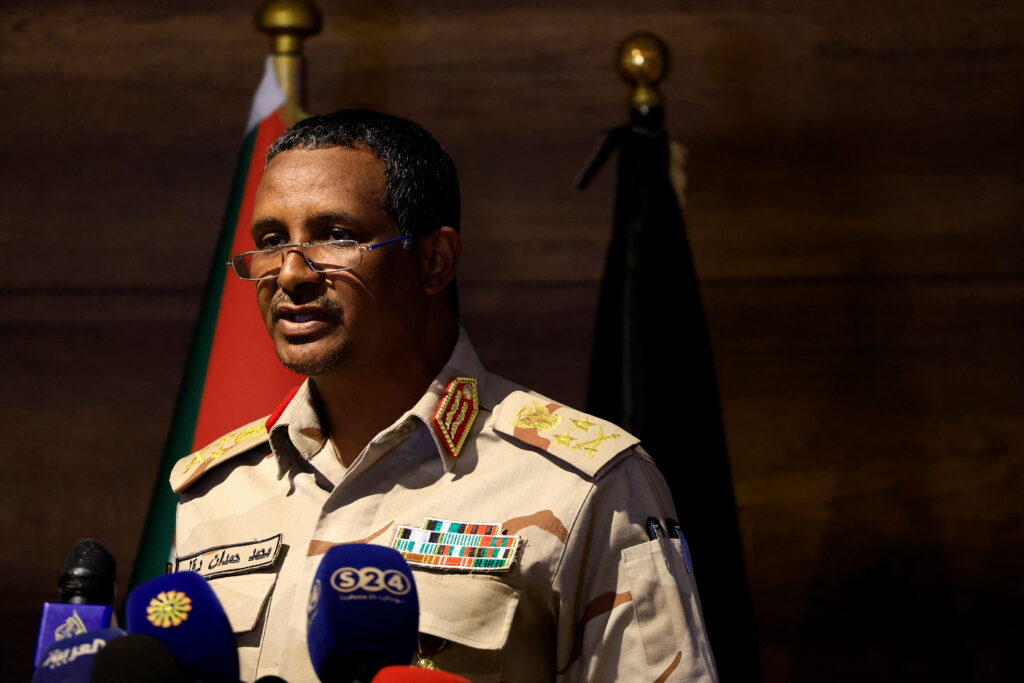
Each side remains unwilling to make painful compromises, instead pursuing maximalist objectives. Their intransigence will complicate efforts by Trump, US Secretary of State Marco Rubio, and Special Envoy Massad Boulos to secure a cease-fire, deliver humanitarian assistance, and launch negotiations under the auspices of a civilian-led government in Khartoum. Within the Quad, however, each regional partner brings distinct priorities shaped by geography, security concerns, and geopolitical pressures.
Egypt has firmly backed the SAF, positioning itself as Burhan’s principal regional supporter while viewing the RSF as a destabilizing force and an immediate security threat. Cairo sees the SAF as possessing the legitimacy of a national institution and the capacity to restore stability. With a shared 793-mile border with Sudan and the arrival of at least 1.5 million Sudanese refugees since April 2023, Egypt has a strong interest in preventing further displacement. This imperative underscores Cairo’s desire to see the conflict end.
Earlier on in this conflict, Saudi Arabia took care to present itself as a relatively neutral mediator between the two sides, yet its posture tilted toward the SAF. Following Saudi Arabia’s reversal of Emirati gains in Yemen in late 2025 and early 2026, Riyadh has grown increasingly determined to leverage its enhanced regional credibility to counter Abu Dhabi’s influence in the Sudanese conflict through multiple channels.
Riyadh’s ambitious Vision 2030 agenda depends on stability along the Red Sea, where major investments, particularly in tourism, are underway. Prolonged fighting in Sudan, and the risk of its escalation into a broader regional crisis, therefore deeply concerns the Saudi leadership. In this context, Saudi officials view a state army such as the SAF as far preferable to a militia such as the RSF, which they regard as unpredictable, institutionally weak, and lacking legitimacy. Ultimately, Riyadh seeks a coherent authority in Sudan capable of effective governance and control over Red Sea ports, which is not a role that Saudi Arabia sees the RSF fulfilling.
The UAE has charted a markedly different course than Egypt and Saudi Arabia. Though Abu Dhabi officially denies it, United Nations experts, human rights organizations, and many media outlets have concluded that the UAE has been arming the RSF, bearing significant responsibility for Hemedti’s rise. However, Abu Dhabi sees the force as a vehicle for projecting Emirati influence in Sudan and, by extension, across parts of Africa. Dependent on external financing and logistics, the RSF has become deeply reliant on financial networks in the UAE, particularly in Dubai. This reliance has substantially expanded Abu Dhabi’s leverage in Sudan. It is notable how Ethiopia, which is under much Emirati influence, has aligned closely with Abu Dhabi in terms of backing the RSF.
Ideologically, the UAE casts Burhan and the SAF as Muslim Brotherhood-aligned, while perceiving the RSF as a dependable anti-Islamist force capable of shaping a post-conflict order consistent with Abu Dhabi’s campaign to marginalize Brotherhood-linked movements across the Arab world.
Emirati support for the RSF reflects a desire to safeguard Abu Dhabi’s interests and preserve the UAE’s autonomy of action in a volatile environment. This approach is occurring within a broader context of intensifying economic and political competition between Riyadh and Abu Dhabi across the Arab world and parts of Africa, amid heavy involvement by multiple regional and extra-regional actors.
Although Saudi Arabia followed the UAE in designating the Muslim Brotherhood as a terrorist organization back in 2014, Riyadh adopts a notably less rigid stance toward the Islamist movement than Abu Dhabi. Collaborating closely with Turkey and Qatar—both known for their Muslim Brotherhood–friendly foreign policies—on a host of regional issues, Saudi Arabia increasingly prioritizes regional stability and the prevention of state collapse in countries such as Sudan and Syria.
In practice, the Quad’s internal contradictions risk undermining its diplomatic effectiveness, while Washington’s engagement risks being somewhat empty and reactive unless the Trump administration develops a comprehensive strategy that applies sustained pressure on both Sudanese and external actors. Yet, given Trump’s close ties to Abu Dhabi’s leadership, there is reason to doubt whether the White House would press the UAE to curtail its support for the RSF. Despite such challenges, there are good reasons to believe that Trump will see it in Washington’s interests to become more involved in Sudan’s civil war, which brings us to Iran.
The Iranian factor in Sudan’s civil war
While Arab states dominate coverage of regional involvement in Sudan, Iran has also intervened in the civil war. Tehran has supplied the SAF with military support, chiefly Mohajer-6 drones, since late 2023. After the setbacks suffered by the “Axis of Resistance” in 2024, Iran’s foreign policy has increasingly focused on exerting influence near two strategic global chokepoints: the Strait of Hormuz and the Bab al-Mandab. Its leverage over the latter is reinforced by Yemen’s Houthi rebels, now the strongest faction in the Iran-led axis. Sudan, for its part, offers Tehran an opportunity to expand influence along the Red Sea through state-level engagement, rather than warfare via surrogates.
With Burhan dependent on external backing, the Sudanese civil war has given Iran a chance to reclaim influence in Khartoum. Iran lost that foothold in the 2010s when Saudi Arabia and the UAE drew Omar al-Bashir’s regime away from Tehran, culminating in Khartoum joining Saudi Arabia and Bahrain in severing diplomatic relations with the Islamic Republic in early 2016.
In this context, the Trump administration is likely concerned that a prolonged conflict in Sudan could advance Iranian interests and undermine the White House’s “maximum pressure 2.0” campaign. Alongside Israel, the Trump team seeks to prevent Sudan from reverting to its former role as an Iran-friendly state along the Red Sea, at the strategic crossroads of the Arab and African worlds.
Navigating Sudan’s geopolitical crossroads
In sum, Sudan’s civil war illustrates how local conflict can become a crucible for regional rivalries. The Trump administration’s new focus on Sudan, spurred by MBS’s November visit to Washington, may place the United States at the center of a complex interplay among competing Arab ambitions, Iranian strategic calculations, and the entrenched divisions between Sudanese actors.
Egypt and Saudi Arabia favor the SAF as the guarantor of stability and state legitimacy, while the UAE’s support for the RSF reflects a broader strategy of influence projection and counterweighting Riyadh. Iran’s involvement further complicates the calculus, presenting both a challenge to the US-Israeli alliance’s desire to counter Iran’s influence near the Red Sea and Bab al-Mandab, and an opportunity for Tehran to regain lost ground in Khartoum.
Actors within Sudan’s rich, complicated, and layered civil society—from established organizations to grassroots resistance committees—have been delivering humanitarian aid, organizing communities, and articulating credible visions for a democratic transition. No sustainable peace process can succeed without the inclusion of these civil society groups, which retain local legitimacy and organizing capacity. As the White House seeks to restore peace, the Trump administration cannot afford to sideline these actors again, because ignoring Sudanese civil society would mean repeating strategies that have already proven ineffective and unstable.
Additionally, there is the African Union (AU), which has sought to serve as the central diplomatic convener on Sudan, advancing a roadmap focused on a cease-fire, civilian protection, humanitarian access, and a Sudanese-led political transition. Through the Peace and Security Council, coordination with the United Nations and regional bodies, and public condemnation of atrocities such as those in el-Fasher, the AU has worked to align international efforts around an African-led approach, even as its limited enforcement capacity has constrained outcomes. Nonetheless, the AU remains the only actor with continent-wide legitimacy, sustained engagement with Sudanese stakeholders, and an existing framework for coordination.
For US policymakers, the path forward demands more than reactive diplomacy. Sustained pressure on Sudanese factions and regional patrons, careful balancing of rival interests, and an emphasis on humanitarian relief and durable governance are all necessary. Ultimately, the outcome in Sudan will not only determine the future of its people, but also serve as a test of how effectively external powers can navigate the overlapping ambitions, alliances, and rivalries that define Sudan’s position in a complicated geopolitical order.
Giorgio Cafiero is the chief executive officer of Gulf State Analytics, a Washington, DC-based geopolitical risk consultancy. He is also an adjunct assistant professor at Georgetown University.
Further reading
Tue, Dec 17, 2024
Sudan is caught in a web of external interference. So why is an international response still lacking?
MENASource By Emadeddin Badi
Sudan needs a unified international strategy, combining economic, political, and diplomatic pressure.
Tue, Nov 18, 2025
Peace, pacts, and recognition: Saudi Arabia at the forefront of a new Middle East
MENASource By R. Clarke Cooper
Trump and other US officials remain eager to add Saudi Arabia to the Abraham Accords rota and to strike a defense pact.
Tue, Dec 16, 2025
What will 2026 bring for the Middle East and North Africa?
MENASource By
As 2025 comes to a close, our senior analysts unpack the most prominent trends and topics they are tracking for the new year.
Image: A displaced boy from al-Fashir gets down from a truck, at a displacement camp in Al-Dabba, Sudan, November 19, 2025. REUTERS/El Tayeb Siddig TPX IMAGES OF THE DAY