
The deadliest single attack on Kurdish security forces since the onset of the war in Iran arrived on March 24, when six Iranian ballistic missiles struck Peshmerga bases in the Soran highlands north of Erbil. The attack resulted in six fatalities and thirty injuries. Kurdistan Region President Nechirvan Barzani described the incident as “direct hostile aggression,” while the Peshmerga ministry condemned it as “a hostile act and treachery.” This event represents the latest escalation in a campaign that has significantly altered regional dynamics.
But it was hardly the first escalation. The day the United States and Israel attacked Iran, February 28, the Islamic Revolutionary Guard Corps (IRGC) and allied Shia militias launched the most sustained barrage of missiles and drones the Kurdistan Region has ever absorbed. In the first seventy-two hours, more than seventy projectiles struck or were intercepted over Erbil. Targets included Erbil International Airport, the newly opened US consulate general (the largest US consulate in the world), Peshmerga headquarters, and the Harir Air Base. On March 12, a Shahed drone killed French Chief Warrant Officer Arnaud Frion and wounded six soldiers at a coalition training base. A separate strike hit an Italian military installation, prompting Rome to temporarily pull its personnel. By late March, over four hundred separate strikes had hit the Kurdistan Region of Iraq (KRI). The Khor Mor gas field preemptively shut down gas supplies, triggering electricity blackouts across multiple governorates.
These incidents are part of an established pattern that predate the current war. Throughout 2025, Iranian-backed militias conducted a sustained drone campaign targeting Kurdish energy infrastructure. In February, a kamikaze drone struck Khor Mor during critical energy negotiations with Baghdad. In July, drones targeted the Sarsang oil field shortly before its American operator was scheduled to finalize a new agreement, resulting in a halt of its production of 30,000 barrels per day. In November, another attack on Khor Mor destroyed a newly completed liquefied natural gas facility and reduced electricity generation by nearly 80 percent. The targeting is systematic and intentional, conveying that Tehran can jeopardize Kurdish economic stability, disrupt Western energy partnerships, and impose costs without facing significant consequences.
The sovereignty that isn’t
Baghdad typically responds to proposals for direct US air defense assistance by asserting that such measures would violate Iraqi sovereignty. However, sovereignty is meaningful only when a government can effectively protect its territory and population. Baghdad lacks sufficient control over its federal territory to prevent Iranian missile strikes on Erbil, ongoing proxy drone campaigns against Kurdish energy infrastructure, or attacks on coalition facilities. The government has not established a monopoly on the use of force, as Iran-aligned militias operate both within and outside formal state structures without restriction. Regardless of these distinctions, the outcome remains unchanged.
Following the February strikes, Kurdish leaders Masoud Barzani and Bafel Talabani urged Baghdad to implement substantive measures to halt militia attacks, emphasizing that their restraint was not unlimited. While Baghdad issued condemnations, it did not intercept any attacks. When a government repeatedly fails to fulfill its duty to protect its territory, the legitimacy of its sovereign veto over external defensive assistance is undermined. The primary violation of Iraqi sovereignty is not the potential deployment of a US-supplied shield in Erbil, but rather Tehran’s accurate assessment that it can strike Iraqi territory without consequence.
The Taiwan precedent
The United States has established a precedent for addressing similar challenges. The Taiwan Relations Act obligates Washington to provide Taiwan with defensive arms and to maintain the capacity to resist coercion. Since the Foreign Relations Authorization Act for Fiscal Year 2003, Taiwan has been treated as a de facto Major Non-NATO Ally (MNNA) for the transfer of defense articles and services. The KRI presents a direct parallel: It is a self-governing entity where the recognized sovereign claims exclusive control over defense, faces a hostile power employing both conventional and proxy tactics, and is unable to acquire necessary defense systems due to its lack of sovereign status. If the United States were to designate the KRI as an MNNA for air defense, it would provide the KRI priority access to foreign military sales, streamline the US review process for arms sales to KRI, and circumvent the bureaucratic obstacles imposed by Baghdad’s procedural veto. This approach would not alter Iraq’s borders but would acknowledge the existing reality.
What the shield looks like
The goal is not to duplicate Israel’s layered air defense architecture, but rather to develop a credible deterrence system tailored to the specific threats faced in northern Iraq: armed drones, loitering munitions, short- and medium-range rockets, and the ballistic missiles deployed by the IRGC in January 2024 and 2026. A US package should include counter-rocket, artillery, and mortar systems, counter-drone platforms, Shahed-type devices, integrated radar, hardened command-and-control infrastructure, and the selective deployment of Patriot batteries at critical locations.
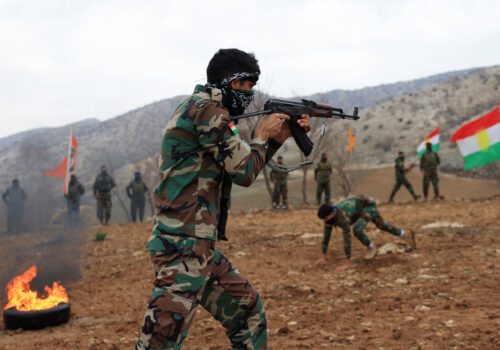
The events of February demonstrated the effectiveness of existing US air defenses in Erbil, which intercepted most incoming projectiles and minimized damage to US facilities. However, these systems do not provide comprehensive coverage for the broader Kurdish population and infrastructure. The fatal March 24 attack highlighted this gap, as Peshmerga bases in Soran remain outside the US defense perimeter. Establishing a Kurdish air defense layer constitutes an extension of force protection, particularly as the KRI now hosts the majority of US forces in Iraq following withdrawals from other Iraqi bases.
How to get there
Legislative mechanisms are available to address these needs. Section 1266 of the fiscal year (FY) 2024 National Defense Authorization Act (NDAA) required the Pentagon to develop a plan to equip and train Peshmerga forces, including air defense provisions, but both deadlines were missed. The FY2026 NDAA, enacted in December 2025, allocates $343 million to the Counter-ISIS Train and Equip Fund for partner forces in Iraq and Syria, which could be adapted to support site defense, radar, and short-range intercept systems for the Peshmerga. The SPEED Act, included in the same legislation, reduces Pentagon acquisition timelines from eight hundred days to approximately five months and facilitates the deployment of commercial and military-off-the-shelf systems. Section 506(a)(1) of the Foreign Assistance Act grants the president drawdown authority for unforeseen emergencies, a mechanism previously used for Ukraine and Taiwan. Congress should establish a KRI-specific air and missile defense line item in the next appropriations package, with notification to Baghdad but without granting Baghdad veto power.
Washington faces a choice: continue to defer to Baghdad’s procedural objections while Iran conducts unimpeded strikes on Kurdish territory or acknowledge the strategic reality and take decisive action. The former approach results in inaction, while the latter helps establish deterrence. The recent missile strike on the Peshmerga’s 7th Division has eliminated any remaining ambiguity. Washington should send a message to Tehran that Erbil is no longer a vulnerable target and to Baghdad that sovereignty entails responsibility rather than an unconditional veto. Where this responsibility has not been met, Washington should be prepared to act.
Yerevan Saeed is a nonresident senior fellow with the Iraq Initiative in the Atlantic Council’s Middle East programs. Saeed is the Barzani scholar-in-residence in the Department of Politics, Governance & Economics at American University’s School of International Service, where he also serves as director of the Global Kurdish Initiative for Peace.
Further reading
Fri, Mar 6, 2026
How would a Kurdish offensive change the war in Iran?
Dispatches By
Our experts explain the goals of the various Kurdish groups the United States is reportedly backing for an attack against Iran and how their involvement could impact the wider war.

Wed, Mar 25, 2026
How ISIS and its affiliates might capitalize on the Iran war
Dispatches By
ISIS is poised to exploit the ongoing regional instability in the Middle East and US policymakers must closely monitor the threats it poses.

Wed, Mar 25, 2026
How the Iran war could change the US relationship with Gulf states
Dispatches By Abram Paley
The war appears to have opened the door to a new wave of uncertainty in the Gulf, which might threaten the very regional stability and economic prosperity it is meant to ensure.
Image: A PAK Peshmerga member holds the Kurdistan flag inside a home destroyed by strikes at the PAKShar camp in Erbil’s Ashkawt Saqa district on March 11, 2026. (Ismael Adnan/dpa via Reuters Connect)