Employment needs to take center stage in Gaza security plans
Employment and economic opportunity are two of the most overlooked areas for strategic development in Gaza. The benefits of focusing on these are rather straightforward: populations stripped of economic opportunity are vulnerable to becoming dependent on armed groups or nonstate actors, especially those that have a monopoly on access to social services and economic opportunity. This means every family in Gaza without an income is an opening for Hamas, militias, or the black-market war economy. Gaza’s economy has long been shaped by coercion, taxation, and armed patronage networks because no legal economic alternative has been built.
Many political and security leaders remain unconvinced that employment should be its own goal or that employment is central to immediate security. While US President Donald Trump’s twenty-point peace plan for Gaza refers to employment in broad terms, it is only referenced as an outcome of investments and large-scale development, but employment is not viewed as a goal in and of itself.
For example, point number ten states that “many thoughtful investment proposals . . . will be considered to synthesize the security and governance frameworks to attract and facilitate these investments that will create jobs, opportunity, and hope for the future of Gaza.”
Gaza cannot function without guaranteed pathways to work. To disarm Hamas, there must be a fiscal strategy alongside effective street-level security. Most critically, the best way to undermine Hamas’s power on the ground is to employ the people Hamas pays today. Security requires a fiscal plan; in Gaza, Hamas controls labor, resources, and opportunity, eliminating competition. To break this chokehold, Gaza requires deliberate intervention to generate employment across sectors.
Hamas and Gaza’s employment crisis
Before the launch of war in 2023, Gaza already faced some of the worst labor conditions in the region. Hamas-led public sector employment accounted for nearly one-third of all those working in the Strip, according to the Ramallah-based Palestinian Central Bureau of Statistics. In 2017, the average monthly household expenditure in Gaza was 934 dinars, or roughly $1,300. Meanwhile, Hamas is paying young fighters up to three hundred dollars per month, according to Wall Street Journal reporting citing Israeli officials—an amount that pays for a crucial portion of those expenses. Additionally, the patronage network system of Hamas meant that those in the militant group’s networks were able to access aid, resources, and other market goods in a way that those unaffiliated could not, something that has continued throughout the war as well.
This meant that the few available jobs or reliable opportunities inside Gaza were disproportionately Hamas-affiliated—whether related to civil service or fighting. Against this backdrop, youth unemployment reached as high as 70 percent in Gaza, and overall unemployment reached 80 percent.
SIGN UP FOR THIS WEEK IN THE MIDEAST NEWSLETTER
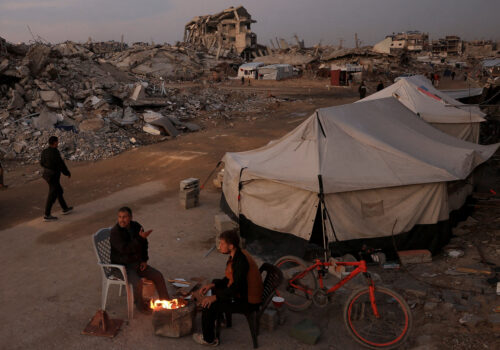
Today, close to 70 percent of Gaza’s population is homeless or displaced, with no clarity on when they will return to stable housing. This has made the need for new employment even more urgent.
When more than a million people have no work, no prospects, and no timeline for rebuilding their lives, the outcome is predictable: Many will return to the only functioning economic structure available, which is dominated by the Hamas-led network. Gaza’s geographic isolation exacerbates this, as the majority of Gazans have never left the Strip. Without jobs, mobility, or legitimate income, dependency becomes permanent.
If Hamas were no longer the leading source of employment, its patronage networks would weaken, reducing its control over communities’ access to salaries, goods, and services. Peacebuilding experience shows that employment changes daily incentives. People with families, stability, and predictable income see militancy as a high-cost and less rational choice.
Ignoring the central variable
The Palestinian Authority’s (PA) belief that it has sufficient institutional capacity to rehabilitate Gaza, as its prime minister wrote recently in its economic plan, is troubling to most long-term analysts of the West Bank and Gaza Strip. Almost every major Arab country and Western ally has made it clear through numerous UN resolutions and diplomatic statements (including most recently in Trump’s twenty-point plan and the New York declaration by Saudi Arabia and France) that the PA requires significant reformation before it can take on control of Gaza.
In the PA’s recently released economic plans, unemployment is treated only as a minor humanitarian issue, rather than a development factor or as a central determinant of whether a cease-fire can hold or Gaza returns to terrorism and war. Specifically, the plan suggests providing $4.2 billion in cash assistance for food, supplies, minor reconstruction, and housing support. Yet, the plan’s development of employment schemes and workforce participation receives only $500 million—far short of what is required for serious job creation.
To underscore just how ill-prepared PA thinking is regarding employment outcomes, to match the current income provided by Hamas employment, the plan would need several billion dollars annually to enable workers to earn the same as they do now from Hamas coffers, as either civil servants or fighters. Yet the PA plan, similar to the Trump plan, does not explicitly focus on the details of making new workforce access available or on pursuing long-term job creation through strategic development, nor does it seek to put significant resources towards the goal of earned income. Instead, it commits Gaza to being an aid-dependent economy, in which international investors are expected to operate without a reliable labor force. This is a direct path back to patronage, dependency, and long-term instability.
Employment as a human rights and security imperative
In my book, What Role for Human Rights in Peacebuilding, I argued that peacebuilding has traditionally overemphasized political rights, institution-building, and security-sector reform while relegating economic, social, and cultural rights to a secondary status. Yet, human rights are interconnected and cannot be pursued as separate goals. Political participation cannot be realized when people are uneducated, unhealthy, unhoused, or unemployed. Civil and political rights must be linked to economic, social, and cultural rights for transitions to be viable.
The models often employed in the Israeli-Palestinian peace process do not address foundational gaps in economic, social, and cultural rights, especially in the area of long-term employment. Unless international leadership takes seriously the central role employment plays in deradicalization and stabilization, Gaza’s reconstruction will replicate past failures. Employment is a framework for disarmament, but only when sustained for the long term—not when limited to temporary per diem labor, food-for-work schemes, or short-term projects.
A sustainable employment paradigm must be put at the center of Gaza’s next phase. Many Gazans will explain, when asked, that many of the flanks of Hamas fighters are not driven by ideology but by predictable payrolls and access to goods for Hamas-affiliated families. Without a competing legal economy, Hamas will always have recruits.
Gaza needs macroeconomic and microeconomic development schemes that create market infrastructure capable of supporting the entire workforce. Education, vocational training, private-sector investment, and targeted upskilling can all generate meaningful employment. In Gaza, ignoring this is not simply poor economics. It is a direct security risk. This requires understanding the actual size of Gaza’s labor force, reasonable income targets, and priority sectors where workers can quickly enter employment with existing or modestly enhanced skills. Both public- and private-sector models will be required, with private-sector growth as the long-term engine of prosperity.
A full-employment-oriented mandate is not extreme government intervention, nor is it a call for the PA to dominate the labor market; rather, it should be defined as a strategy for long-term private-sector growth, carried out in partnership with and supported by public actors.
Impact on Palestinian sovereignty
Palestinian self-sovereignty requires economic independence and access to the world. One of the strongest inoculations against Hamas is broad access to markets and opportunities. Some of this will require long-term planning and sector-specific analysis, but many aspects are straightforward. For example, if private firms and the international community could employ Gazans to rebuild at even a slightly higher wage than Hamas salaries, stable employment could ultimately extend to swaths of the population, with Gazans able to support their families without using dollars tied to the militant group.
Sectors such as environmental rehabilitation, food production, education, medical care, infrastructure, and vocational services all require new labor. If a transitional authority seeks to meet the moment, it should invest heavily in private-sector job creation so that disarmament, deradicalization, and reintegration can begin.
Gaza’s next phase must recognize what weakens Hamas’s grip: economic independence and freedom of movement. Employment severs Hamas’s patronage networks by providing a reliable income not tied to armed actors. It rewires daily incentives, making militancy too costly for most people. The appeal of armed groups declines as economic opportunity expands.
Gaza’s future depends on far more than security forces or humanitarian aid. It depends on whether people see a path out of the rubble that is grounded in economic self-sovereignty, dignity, and the possibility of success. If security and political leaders ignore this reality, they will guarantee that the next war comes even while the debris of this one remains.
Melanie Robbins is the deputy director of the Atlantic Council’s Realign For Palestine project.
Further reading
Mon, Nov 10, 2025
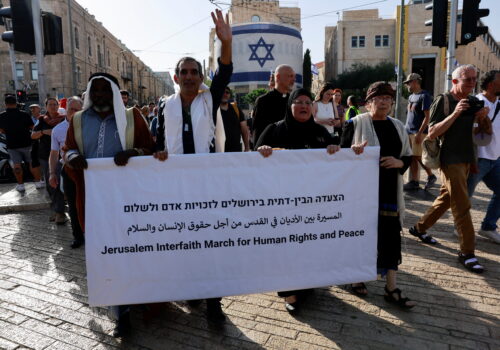
A little-discussed point in Trump’s Gaza plan could be an opportunity to build interfaith understanding
MENASource By Peter Mandaville
Peace efforts don’t need more gleaming Abrahamic baubles, they need a genuine commitment to supporting grassroots religious peacebuilding.

Tue, Jul 29, 2025
‘I can barely stand or make it through the day’: First-hand views of Gaza’s starvation
MENASource By Arwa Damon
Israel has systematically denied aid entry into Gaza, and perpetuated false narratives intended to discredit the humanitarian community.
Tue, Nov 18, 2025
How Trump can leverage the Saudi crown prince’s visit to help secure Gaza’s future
New Atlanticist By Melanie Robbins
Trump should work with Saudi Arabia and the UAE on a Gaza stabilization fund and a more cohesive plan for implementation.
Image: Palestinians fish during a ceasefire between Israel and Hamas, at the seaport of Gaza City, November 19, 2025. REUTERS/Dawoud Abu Alkas TPX IMAGES OF THE DAY