After Maduro
Venezuelan strongman Nicolás Maduro now faces the greatest challenge to his grip on power since he took office over a dozen years ago. A carrier strike group led by the world’s largest aircraft carrier, the USS Gerald R. Ford, arrived in the Caribbean more than two weeks ago along with long-range bombers, Marines, and other US assets deployed to the region as part of a mission officially aimed at combating narcotics trafficking. Previously dormant military bases in the region have been reactivated in a military buildup focused on narcotics, but with Maduro placed at the center of the effort due to his own ties to trafficking.
And the now-released National Security Strategy (NSS) clearly states the United States’ goals for the Western Hemisphere: “Enlist and Expand.” The latter goal includes ridding the hemisphere of a regime that advances priorities clearly in contrast to NSS objectives by providing safe haven for criminal groups, profiting from trafficking, and welcoming the influence of foreign adversaries. And as the United States seeks to secure access to critical supply chains, Venezuela presents an untapped opportunity.
Although US President Donald Trump has been evasive on what exactly his plans are for Maduro, it’s clear that the president is not authorizing the largest US naval deployment in the Caribbean in forty years—dubbed “Operation Southern Spear” by the Pentagon—only to counter small drug boats. It’s part of his NSS. Trump has recently spoken with Maduro, and reports indicate a possible deal being brokered for the dictator’s departure from the country.
But there have been rumors of Maduro’s downfall many times before. Hopefully, this time it comes to pass. Without Maduro, Venezuela and the hemisphere would rid itself of a cancer.
The opposition’s democratic blueprint
A democratic transition in Venezuela must begin with Maduro out of power, but it entails much more than that. It is imperative any opportunity for change is not usurped by many malevolent actors in Venezuela, including Maduro’s generals and high-ranking members of Venezuela’s intelligence agency, the Servicio Bolivariano de Inteligencia Nacional (SEBIN). Drug trafficking guerrilla groups such as the National Liberation Army (ELN) and dissidents of the Revolutionary Armed Forces of Colombia (FARC), as well as armed pro-government paramilitary forces known as colectivos, are also a concern. Corruption lines every inch of Maduro’s regime, so much so that the US Department of State recently designated the Cartel de los Soles as a foreign terrorist organization. The Cartel de los Soles is the term used to describe the de-centralized military structure within Maduro-controlled armed forces that facilitate drug trafficking and other illicit activities for profit.
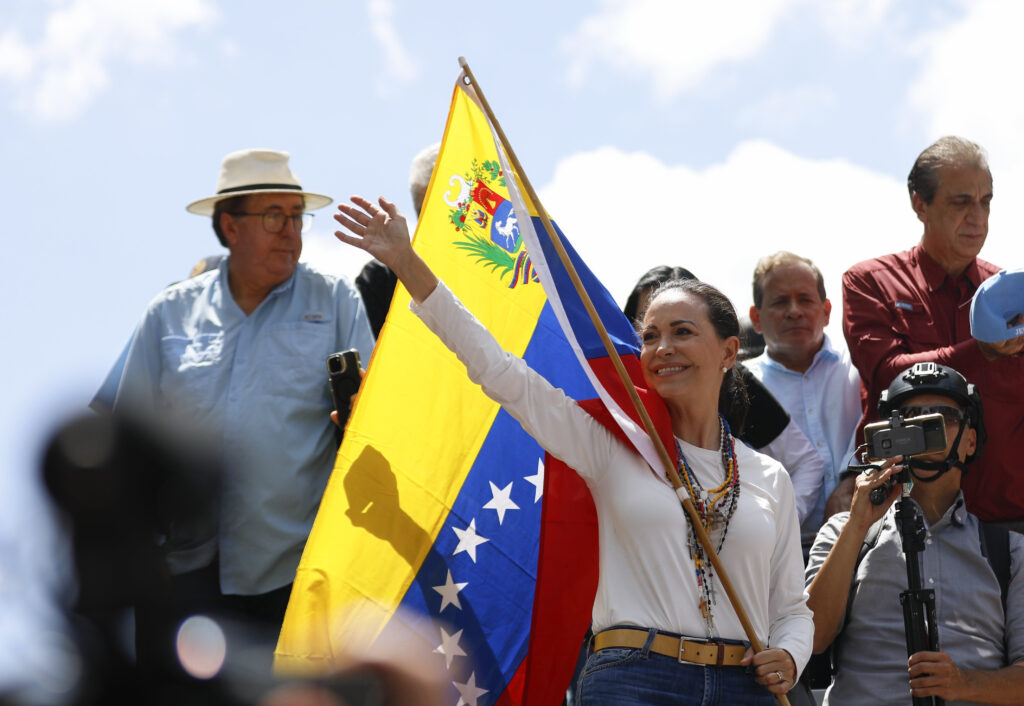
A democratic transition depends not only on the failure of these malign groups to derail the process, but also on the success of democratic forces that share similar interests to those laid out in Trump’s NSS. Here it’s worth looking back to July 28, 2024, the day of the Venezuelan presidential elections. Maduro, backed by friendly electoral authorities, stole the election and declared himself winner. In that election, opposition activists were able to gather more than 83 percent of the voting tallies and electoral records, demonstrating that Edmundo González Urrutia, candidate for the Plataforma Unitaria Democrática, had won around 67 percent of the vote. Since then, González has been forced to flee Venezuela, and opposition leader and 2025 Nobel Peace Prize laureate María Corina Machado remains in hiding from Maduro’s regime in Venezuela.
Critically, opposition leaders still have the weight of their sweeping electoral win behind them. They have reiterated time and again a plan for a democratic transition when Maduro leaves power—a plan that includes economic revitalization and the rapid re-instating of civil liberties and human rights for Venezuelan citizens.
Machado herself has laid out her plans for Venezuela’s first hundred days post-Maduro. She has emphasized that before those hundred days are up, freedom of speech would be restored and new leadership would address the most pressing aspects of the ongoing humanitarian crisis. Further, the opposition has pledged to adopt reforms to curb food insecurity in the country. After immediate social needs are met and processes are in place to continue pulling Venezuelans out of malnutrition and other poor conditions, Machado has said she would enact her plan to begin revitalizing the economy. It’s an ambitious plan—after so many years of corruption and mismanagement under Maduro—but also one that will require continued US support in the days and months following a Maduro exit and a transition that would empower democratic forces.
“A trillion-dollar opportunity”
The Venezuelan opposition’s team of economists have laid out a plan for what Machado’s economic team calls a “trillion-dollar opportunity”—a free-market, liberalized Venezuela open to investors, including the United States.
In her plan, Machado notes Venezuela’s abundance of natural resources, ranging from the world’s largest oil reserves to vast deposits of gold, iron, and other minerals. She argues that a legacy of public investment since before former leader Hugo Chavez came to power and hollowed-out institutions because of Maduro’s dictatorship open a unique path to streamline reforms by removing bureaucratic obstacles and opening Venezuelan goods for international trade with partners around the globe. Machado drives home the point that because so many private-sector opportunities are unexplored in Venezuela, the country is sitting on a gold mine for those who invest in these sectors after Maduro’s grip on the country ends.
The opposition’s main reform programs, which include rule of law, security and defense, and an economic relaunch, provide the United States with a distinct opportunity to create a partnership with one of the most resource-rich and strategically located nations in South America. The positives of Venezuela becoming a friend and an ally of the United States would have been inconceivable in Washington’s policy circles just a few years ago. And such an outcome would significantly advance the NSS’s “expand” goal.
These reforms are an ambitious overhaul of the parasitic political system that has plagued Venezuela for decades. And even though it could take some time for full implementation, it’s an agenda that would amount to a new dawn for Venezuela.
Looking beyond Maduro’s Venezuela
Maduro is noxious—both to the people of Venezuela and the wider Latin American region. In the past decade, almost eight million Venezuelans have fled their homes as Maduro’s parasitic and clientelist regime has enriched itself on the backs of its people. The mass exodus as a result of Maduro’s policies has resulted in a domino effect of instability in the region, notably with the high influx of refugees, who have brought fragile institutions in countries such as Colombia, Peru, Ecuador, and Chile to a near breaking point. Moreover, catastrophic medical and food shortages have jeopardized the lives of millions of Venezuelans, while Maduro’s regime denied the existence of a crisis.
After Maduro stole the election from González in July 2024, his regime carried out a colossal campaign of violence and repression, forcibly disappearing, unlawfully imprisoning, and torturing citizens suspected of supporting the opposition and challenging the regime. Since the election, more than two thousand people have been detained for ties to the opposition, many of them with no contact to the outside world since their imprisonment.
At this pivotal moment for the Venezuelan people and the region, momentum must not be lost for Venezuela’s transition to democracy. Its democratically elected opposition has a plan for the first hundred hours, the first hundred days, the first year, and beyond. It’s time to see that plan in action.
Jason Marczak is vice president and senior director at the Atlantic Council’s Adrienne Arsht Latin America Center.
Further reading
Wed, Sep 10, 2025
What to know about Trump’s war on drug trafficking from Venezuela
New Atlanticist By
The recent US strike on a suspected drug trafficking boat is best understood in the context of the Trump administration’s policies toward Venezuela and the wider Western Hemisphere.
Tue, Nov 25, 2025
How Venezuela uses crypto to sell oil—and what the US should do about it
New Atlanticist By Maia Nikoladze
As US sanctions on Venezuela have intensified, the Maduro regime has grown increasingly interested in leveraging digital assets to facilitate oil transactions.
Wed, Nov 26, 2025
How a Venezuela shock could raise global oil and food prices
New Atlanticist By Joseph Webster, David L. Goldwyn
As US policymakers weigh their options in Venezuela, they should consider the possibility of a long energy recovery and spillover attacks in the region.
Image: President Nicolas Maduro attends, on the day of his inauguration for a third six-year term, at a military academy in Caracas, Venezuela January 10, 2025. REUTERS/Leonardo Fernandez Viloria