
Click on the banner above to explore the Tiger Project.
A troubling gap is emerging between US public opinion and Washington’s cross-strait policy. US public opinion polling shows no consensus on sending troops to defend Taiwan from a possible Chinese invasion or blockade. On the other hand, credible threats of US military force are essential to the current US policy—deterring Chinese attempts to unify Taiwan by force. Allies and competitors alike are taking notice. Credibility, therefore, has become perhaps the weakest link in the United States’ policy on cross-strait relations.
But elected officials have ample opportunity to influence US public opinion. If leaders in the White House and Congress are committed to current US policy, then they must work to close this credibility gap to convince Beijing that Americans would support and even fight for Taiwan.
The public mood
Washington has long maintained a policy of strategic ambiguity, neither committing to defending Taiwan nor promising Beijing to stay out of a conflict. This approach enables the United States to deter Chinese attempts to unify Taiwan by force and to reassure China that the United States does not seek a change in the status quo in the Taiwan Strait.
Today, a number of prominent US policymakers believe that US deterrence toward China is eroding due to changes in Beijing’s military capabilities. China’s growing capabilities have prompted US attempts to increase its own. Deterrence, however, requires both capability and credibility—and, on credibility, the United States risks coming up short.
Americans generally view Taiwan favorably. According to a 2025 survey by the Chicago Council on Global Affairs, 70 percent of Americans believe the US-Taiwan trade relationship strengthens US national security and the number of Americans who would support military action to defend Taiwan has grown over the past year. While some polls even indicate that a majority of Americans support using military action to defend Taiwan from an attack by China, polling that asks respondents about specific actions complicates those findings. For example, the 2025 Chicago Council Survey found broad support for indirect action in the event of a crisis in the strait: 77 percent of respondents said they support military airlifts of supplies to Taiwan, 71 percent said they favor economic or diplomatic sanctions on China, and 63 percent said they support sending military arms to Taiwan. But only 43 percent said they support sending US troops, while 51 percent opposed doing so.
This aversion holds for other types of direct US military action. Only 47 percent of respondents in the same survey supported “using the US Navy to break a Chinese blockade around Taiwan, even if this might trigger a direct conflict between the United States and China.” An equal number were opposed. There is clearly no consensus among the American public on committing US troops to Taiwan’s defense.
Strategic consequences
This hesitation is not new or unique to Taiwan. President Franklin D. Roosevelt faced a public strongly opposed to foreign intervention before World War II. Even President George HW Bush did not have majority US support for the use of troops to liberate Kuwait until days before bombs started falling in Baghdad. Both had the benefit of time—months or even years—and ongoing conflicts to build public support for US intervention.
US leaders may not have that luxury today. Taiwan’s ability to defend itself against China hinges on timely US intervention. There will be immediate strategic pressure to intervene, and public support will be crucial to ensure successful military action. Further, US military intervention will likely result in a protracted conflict with untold casualties, which would test US resolve. China will almost certainly attempt to weaken that resolve, injecting disinformation into the public debate through both overt and covert means.
Beijing is also increasingly exploring military options that do not involve a strike on US forces. This would deny Washington a galvanizing event, such as Pearl Harbor or Sputnik, that would quickly change public opinion. If the public reaction to the war in Ukraine is any indication, Chinese military action alone will not sway a skeptical public. In July 2021, seven months before Russia’s invasion, 50 percent of Americans supported sending US troops to Ukraine “if Russia invades the rest of Ukraine.” By mid-2022, six months after Russia’s invasion, only 38 percent did.
Closing the credibility gap
Public opinion is not fixed. Taiwan certainly has a part to play in convincing the United States of its will and ability to fight. But if elected leaders in the United States want to continue to deter Chinese military action, they must lead the American public by deploying a clear, bipartisan, and principled messaging campaign.
Clear messaging: Americans are getting mixed signals on China and Taiwan. This year alone has seen delays in the implementation of the TikTok ban, the placement of 20 percent tariffs on Taiwanese goods, the loosening of export restrictions on certain advanced semiconductors to China, and a refocusing of the National Security Strategy on the Western Hemisphere. Even if some of these policies are important for executing the broader US foreign policy mission, taken together, they muddle public perceptions of US policy toward China and Taiwan. Meanwhile, some elected officials are also advocating a US global retrenchment. Regardless of the merits of this vision, it weakens the credibility of US threats to use military force over Taiwan.
Admittedly, elected officials have a tough needle to thread: Too much clarity risks undermining strategic ambiguity. But there is a difference between strategic ambiguity and strategic confusion. While deterrence is a careful balance, if elected officials truly believe it is eroding, then there is more upside to a clearer public messaging campaign coordinated between the White House and Congress.
Bipartisan messaging: The war in Ukraine highlights the importance of ensuring that messaging around conflicts remains bipartisan. In March 2022, a month after the start of the war, 79 percent of Americans supported sending US military aid to Ukraine. Three years later, support dropped to 52 percent, driven largely by a fifty-percentage-point decline among Republicans. These swings demonstrate how rapid shifts in partisan framing can influence public opinion.
Elected officials of both parties committed to defending Taiwan must anticipate this if they want to build and maintain support for Taipei among the American public. They must speak strongly, clearly, and consistently about defending Taiwan, and not fall victim to the political winds of the moment. Doing so will not be easy, but overcoming short-term political incentives will be key to convincing China that the United States can maintain the will to fight.
Principled messaging: Much of today’s messaging emphasizes policy-forward arguments: Taiwan’s role in the semiconductor industry, its geostrategic location, and the impact a successful Chinese invasion would have on the US alliance system. While these may be strong arguments in policy circles, they have not resonated with many Americans.
To sway skeptical publics, past presidents appealed to their consciences. In the runup to the Gulf War, Bush did not highlight the value of Kuwaiti oil; he emphasized the fight against aggression and for “a new world order.” Roosevelt did not emphasize the geopolitical risk of a German-dominated Europe; he christened the United States the “arsenal of democracy” and roused the public to action in defense of the “four essential human freedoms.” These were not trite messages. Americans were challenged to fight for a particular vision of the world, and it worked. Bush shifted public opinion by 16 percentage points in a month to favor intervention, and Roosevelt helped shift public opinion by nearly 40 percentage points between 1939 and 1941, well before the attack on Pearl Harbor. Americans step up when inspired by principled goals.
The stakes
Polls cannot perfectly predict how Americans will respond to a Chinese attack on Taiwan, but they can provide clues about the public mood. Polling has shown that Americans are receptive to messages from their leaders. During wars over past century, US public support for the government’s preferred policies depended on how elected leaders communicated with the American public.
Beijing’s leaders know how to read American public opinion polling, too. If they perceive a lack of American public consensus on Taiwan’s defense, the United States’ ability to deter Chinese military action will be undermined. But if American elected leaders can simultaneously improve US military capabilities and rally public support for the defense of Taiwan, they can strengthen the United States’ cross-strait policy for years to come.
Lieutenant Phillip M. Ramirez is a military SkillBridge fellow for Forward Defense in the Scowcroft Center for Strategy and Security at the Atlantic Council.
The views expressed are the author’s own and do not necessarily reflect the views of the Department of the Navy, the Department of Defense, or the US government.
The Tiger Project, an Atlantic Council effort, develops new insights and actionable recommendations for the United States, as well as its allies and partners, to deter and counter aggression in the Indo-Pacific. Explore our collection of work, including expert commentary, multimedia content, and in-depth analysis, on strategic defense and deterrence issues in the region.
Further reading
Fri, Dec 12, 2025
Dispatch from Beijing: Both China and the US think they have the advantage. Only one can be right.
Dispatches By Melanie Hart
US policymakers must understand exactly how the China model is working if the United States is going to compete effectively with it.

Wed, Dec 10, 2025
Why exporting advanced chips to China endangers US AI leadership
Dispatches By Tess deBlanc-Knowles
Allowing Chinese companies to purchase high-end AI chips risks degrading the United States’s current edge in aggregate computing power.
Fri, Dec 5, 2025
The cost of an unjust peace in Ukraine? An emboldened China.
New Atlanticist By Phillip M. Ramirez
A peace deal aimed at ending the war in Ukraine that favors Russia could embolden China to take military action of its own.
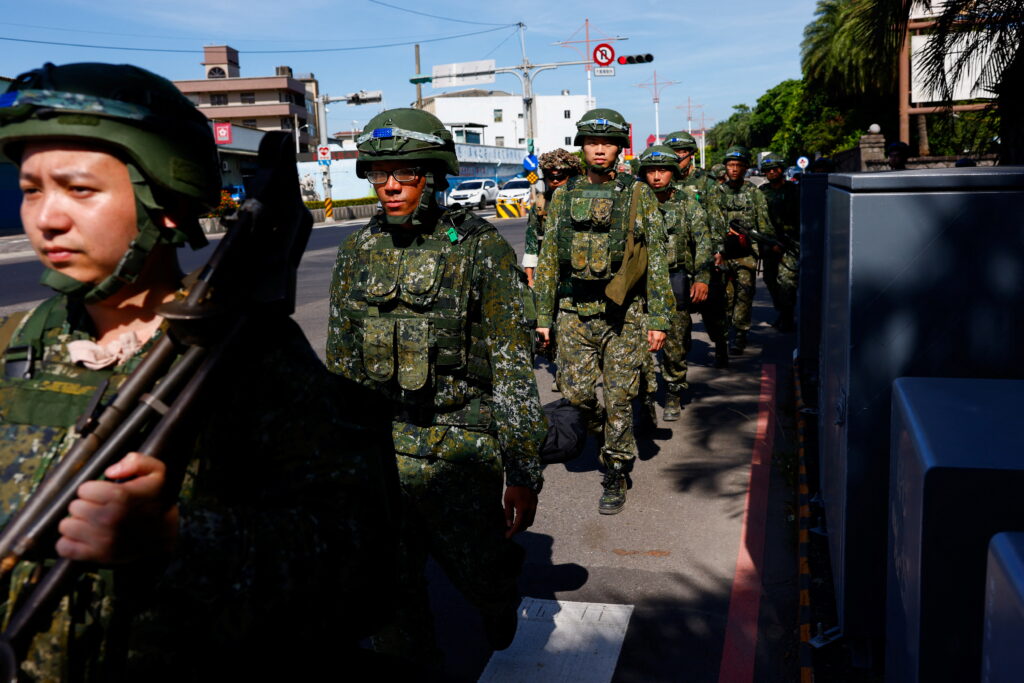
Image: Soldiers take part in the first day of the annual Han Kuang military drills in Taoyuan, Taiwan July 22, 2024. REUTERS/Ann Wang