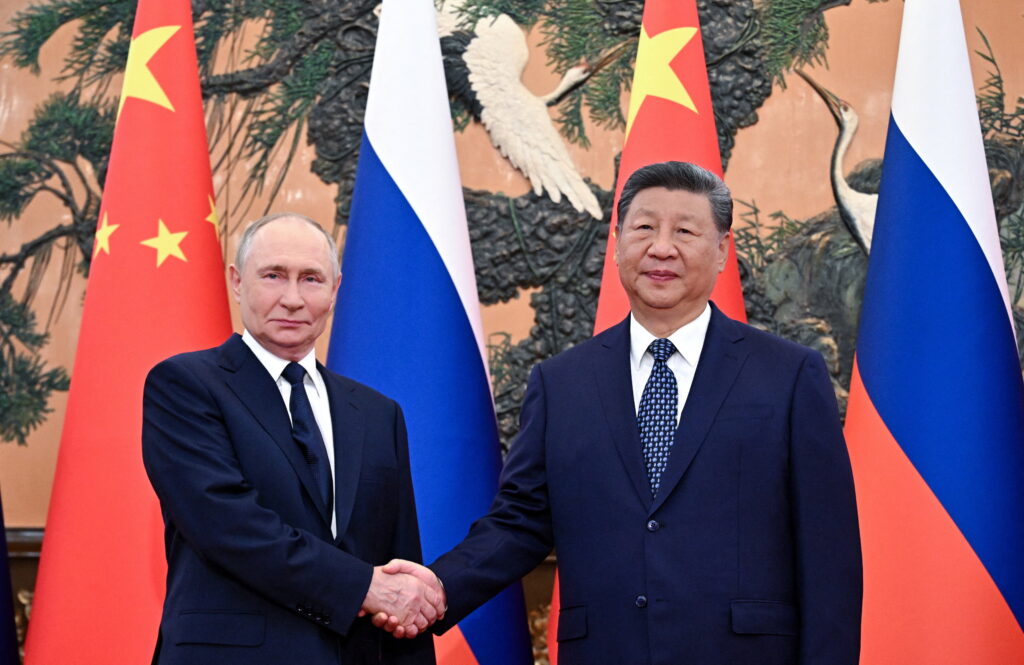
In recent weeks, the Trump administration again engaged in talks aimed at ending Russia’s war in Ukraine. Trump and his envoys should be applauded for attempting to end a conflict that has dragged on for nearly four years at the cost of hundreds of thousands of lives. Unfortunately, given the current realities of the battlefield, any negotiated peace will almost certainly favor Russia. On this, the Trump administration is correct.
However, the administration should consider the consequences of agreeing to a deal that favors the clear aggressor instead of fighting for a more balanced and just peace. The effects of the former would be felt far beyond Ukraine, Russia, and Europe: the very terms that would be agreeable to Russian President Vladimir Putin are exactly the ones that could embolden China to take military action of its own. The United States cannot isolate its actions in one part of the world from its goals in another. China will learn from any peace in Ukraine made under the current situation. The United States will reap the consequences.
Unacceptable terms
The most contentious issue in any peace deal is that of territory. Russia occupies large portions of eastern and southern Ukraine. Putin thinks he can lay claim to what his forces already occupy (and potentially more) in any negotiated settlement, especially because Ukraine has not demonstrated the ability to reclaim that territory. Also concerning are the implications of a potential near-term peace deal on the issues of Ukrainian sovereignty and a renewal of international economic cooperation with Russia. Putin wants limits on Ukraine’s military and its ability to join NATO. He also wants a cessation of sanctions against Russia, Moscow’s readmittance to the Group of Eight (G8), and the restoration of frozen Russian assets. Instead of a pariah, Putin wants Russia to be a respected member of the international community—the status quo ante but better.
China will learn from the outcome of Putin’s bid to secure these terms, just as Beijing has learned from the rest of the war. If Putin can secure vast amounts of territory through military force, then so can China. If Putin can restrict Ukrainian sovereignty via an invasion, then China can secure similar limitations on Taiwan. Given that Beijing’s greatest concerns vis-à-vis Taiwan revolve around questions of the island’s sovereignty, such peace terms for Russia would be a veritable coup for China.
Similarly, if Putin can forestall any permanent economic consequences for his invasion, China will learn it can do the same. The economic consequences China would face as a result of an invasion of Taiwan are some of the most important deterrents to a possible conflict. If China is led to believe it can return to its place in the global economic community—or even improve on it—after the short-term pain of a conflict, the deterrent value of these tools will be reduced.
Questions of resolve
The Trump administration seems prepared to give Russia what it wants because it assesses that Russia is winning, and winners dictate the terms. Underlying the urgency to actually end the conflict, however, is a desire by some in the Trump administration to shift resources away from Europe and to the Indo-Pacific to better deter conflict there. However, the actual amount of blood and treasure the United States has spent on Ukraine, while significant for the Ukrainians, is relatively small for the United States. The United States has no direct military involvement in the war in Ukraine, has not lost a single service member, and has deeply degraded the Russian military with relatively little cost to itself, all while spurring increased competition and growth in the US defense industrial base.
Therefore, ending the war in Ukraine under these conditions will not strengthen the United States’ hand in the Indo-Pacific. It will do the opposite. Peace under these terms will teach China what it stands to gain from military action and demonstrate the limits of US resolve. Deterring a conflict over Taiwan or elsewhere in the Indo-Pacific is as much about having the proper capabilities to fight a war as it is about having the will to see it through. If Beijing’s leaders are led to believe that US resolve over the Taiwan issue will dissipate before their own, deterrence will fail regardless of how many US ships, missiles, and aircraft are in the theater.
Changing the calculus
Given his current calculus, any peace that Putin will sign will send the wrong messages to Beijing. Thus, the United States must change Putin’s calculus. To do so, and thereby strengthen the Washington’s hand vis-à-vis Beijing, the United States and its allies and partners should make Putin question the idea that a Russian victory is assured. They must demonstrate the will and resolve to outlast him in Ukraine. Only then will Putin sign a peace that does not teach the wrong lessons to China. Anything less, and the administration may find the peace it has brokered to be fleeting.
Lieutenant Phillip M. Ramirez is a military SkillBridge fellow for Forward Defense in the Scowcroft Center for Strategy and Security at the Atlantic Council.
The views expressed are the author’s own and do not necessarily reflect the views of the Department of the Navy, the Department of Defense, or the US government.
Further reading
Thu, Nov 20, 2025
China’s new five-year plan should be a wake-up call for the United States
New Atlanticist By
The United States now faces the most formidable economic and technology competitor it has encountered in nearly a hundred years.
Thu, Dec 4, 2025
Ukraine’s warning to the West: A bad peace will lead to a bigger war
UkraineAlert By Myroslava Gongadze
It is delusional to think that sacrificing Ukraine will satisfy Russia. Instead, a bad peace will only lead to a bigger war, while the price of today's hesitation will ultimately be far higher than the cost of action, writes Myroslava Gongadze.
Thu, Nov 27, 2025
While Trump talks peace, Putin is escalating efforts to erase Ukraine
UkraineAlert By Peter Dickinson
Russian President Vladimir Putin has issued a decree this week calling for an escalation in efforts to erase all traces of Ukrainian identity from the approximately 20 percent of Ukraine currently under Kremlin control, writes Peter Dickinson.
Image: Russian President Vladimir Putin and Chinese President Xi Jinping pose for photos before their meeting in Beijing, China September 2, 2025. Sputnik/Sergey Bobylev/Pool via Reuters.