Late last month, following two mass abductions of schoolchildren by armed groups, Nigerian President Bola Tinubu declared a nationwide state of emergency. He also launched a working group to coordinate and deepen security cooperation with the United States. These moves came after US President Donald Trump’s redesignation of Nigeria as a “country of particular concern” on October 31, reportedly in response to a Fox News report on the killings of Christians in the West African nation. Trump went so far as to instruct the US military to prepare for “action” against Islamist groups and other insurgents targeting Christian populations in Nigeria. Nearly a month after Trump’s redesignation, Reuters reported that the United States was still considering sanctions and military action to jolt Nigeria’s government into better protecting Christians.
There are compelling reasons for the United States to increase its footprint in Nigeria, but fears of a genocide against Nigeria’s Christian population are unfounded. In fact, both Christians and Muslims are victims of violence and terrorism in Nigeria, as Trump’s own senior advisor for Arab and African affairs, Massad Boulos, has noted. If the United States is genuinely interested in helping the Nigerian government address violence and terrorism, then it must change course. After all, applying pressure on Nigeria risks driving it toward greater economic dependence on China or deeper military reliance on Russia, as has occurred with some of Nigeria’s Sahelian neighbors in recent years.
Why Nigeria matters
Nigeria is Africa’s most populous country, is a major oil producer, and has the potential to become an African superpower. Contrary to the trajectory of many Sahel states in recent years, Abuja stands as a bulwark against further destabilization in West Africa and is a leader within the Economic Community of West African States. Though the country experienced democratic backsliding under former President Muhammadu Buhari from 2015 to 2023, Nigeria has been an electoral democracy since 1999—and it remains politically stable despite last month’s unconfirmed coup plot and military reshuffle.
Among African countries, Nigeria had the most favorable view of the United States in 2025, according to surveys by the Pew Research Center. While US favorability ratings in Kenya have dropped by double digits over the past year, Nigerian favorability ratings have remained relatively stable. Last year, two-thirds of Nigerians expressed confidence that Trump would do the right thing in world affairs, putting him three points ahead of former US President Joe Biden. By applying overt pressure in dealing with Nigeria, the United States would risk alienating a key regional partner whose population still expresses confidence in US leadership.
Moreover, if US ties with Nigeria were to deteriorate, this could provide an opening for China or Russia to gain influence. The Formal Bilateral Influence Capacity Index shows a steep rise in Chinese influence in Nigeria over the past decade and a half. China has become Nigeria’s largest trading partner, and Nigeria is one of the most active participants in China’s Belt and Road Initiative. Last September, Tinubu met with Chinese President Xi Jinping in Beijing, where the two leaders formally elevated China-Nigeria relations to a “comprehensive strategic partnership.”
Russia, too, has increased its influence over Nigeria in the past decade, signing a military cooperation agreement with Abuja in late 2021. In May 2025, the head of Nigeria’s military visited Moscow for discussions with top Russian military officials. Russia offered additional weaponry and training, which the Nigerian military saw as a reaffirmation of Russian support. Following Trump’s comments about potential US military action in Nigeria, Russia warned that such a step could escalate global tensions.
Given these dynamics, US pressure on Nigeria could backfire, inadvertently driving the country into the arms of Russia and China. This would ultimately weaken US influence in a strategically vital region and mirror the path of some members of the Alliance of Sahel States—a bloc comprising Mali, Niger, and Burkina Faso—that have come to depend on Moscow for security and on Beijing for economic support.
Surveying political violence in Nigeria
Violence is a big problem in Nigeria, but it’s also a complex one. It’s local and it’s regional, occurring both between groups and within them. To shape effective US policy, it is important to understand the country’s complex landscape of political violence.
Nigeria ranks sixth among countries most afflicted by terrorism, according to the 2025 Global Terrorism Index. The Armed Conflict Location and Event Data Project lists Nigeria as one of ten countries globally—and three in Africa—experiencing “extreme” levels of conflict. As the charts below show, political violence in Nigeria has grown significantly since 2020, reaching all-time highs in 2025, though fatalities have not increased proportionally.
Political violence in Nigeria has risen—though fatalities have not grown at the same rate
 Political violence in Nigeria
  Demonstrations in Nigeria
  Fatalities in Nigeria
Source: ACLED, accessed November 1, 2025
Terrorism in the northeast
The terrorist group Boko Haram has been militarily active in Nigeria’s northeastern states since 2009. The group’s violent attacks surged in 2014 and 2015, after it infamously abducted 276 schoolgirls in the town of Chibok and pledged allegiance to the Islamic State and Iraq and al-Sham (ISIS). However, internal disputes prompted the Islamic State West African Province (ISWAP) to split from Boko Haram by 2016. Since then, an inter-jihadist turf war has been waged, leaving Boko Haram leader Abubakar Shekau dead in 2021. In 2024, armed conflict involving the two groups killed nearly 1,400 people, according to the Uppsala Conflict Data Program (UCDP)—and in 2025, they attempted at least twenty ambushes on military positions in Nigeria’s northeastern Borno State. On November 17, ISWAP militants claimed to have captured and killed a Nigerian brigadier general.
Banditry and kidnappings in the northwest
Nigeria’s northwest is a hub for criminal violence. Kidnappings in this region and throughout Nigeria are generally carried out by criminal gangs rather than ideologically motivated groups. In November, twenty-five schoolchildren were kidnapped in Kebbi State in northwest Nigeria and fifty-two more in Niger State in the country’s Middle Belt region. In March 2024, militants kidnapped 280 schoolchildren in the northwest state of Kaduna. Ansaru, a Boko Haram offshoot, is also active in this region. It is responsible for a series of kidnappings for ransoms and attacks against the Nigerian government.
Middle Belt violence
The crisis in Nigeria’s Middle Belt, one of the country’s most ethnically diverse regions, is mostly driven by farmer-herder conflicts. Violence in the Middle Belt occurs primarily between ethno-religious groups amid disputes over resources and land. These conflicts have long and complex roots, exacerbated by climate change and desertification. However, conflating violence by primarily Muslim Fulani herders against mostly Christian farmers with jihadist violence has, in part, led to misconceptions of a “Christian genocide” in the country. In some years, pastoral violence has indeed resulted in more fatalities than Boko Haram-ISWAP insurgencies—for instance, in 2018. However, this was not the case in 2025.
Oil militancy and piracy
Decentralized networks of oil militants, such as the Movement for the Emancipation of the Niger Delta (MEND), have attacked oil infrastructure and kidnapped oil workers in Nigeria’s southeast for two decades. While less threatening than in the 2000s, oil militants remain active, as evidenced by a MEND attack on an oil facility earlier this year. Piracy off Nigeria’s coast, once more severe than Somali piracy, has declined due to shipping security measures, but both pirates and militants continue to evolve and collaborate whenever opportunities arise.
Separatist troubles
Aiming to restore the short-lived Republic of Biafra, the Indigenous People of Biafra (IPOB) was established in 2014. Protesting the marginalization of the Igbo people, IPOB’s militant wing, the Eastern Security Network (ESN), has waged a low-level insurgency against the Nigerian government. In 2024, this conflict caused about two hundred fatalities, according to UCDP data. On November 6, just days after Trump’s statements about Nigeria, IPOB leader Nnamdi Kanu appealed to the US president to investigate state-sponsored killings of Christians in eastern Nigeria. On November 20, Kanu was sentenced to life in prison for terrorism, raising the risk of further clashes between the ESN and security forces.
Neighboring problems
In neighboring Mali, the deadliest Salafi jihadist terrorist group, Jama’at Nasr al-Islam wal-Muslimin (JNIM), continues to expand its influence. JNIM launched its first attack in Nigeria’s Kwara State on October 28, killing one soldier. Of additional concern are potential links between JNIM and Ansaru. In late August, Nigerian security officials arrested two Ansaru leaders who allegedly underwent substantial training from al-Qaeda in the Islamic Maghreb, now a part of JNIM. Boko Haram also operates in Cameroon’s Far North region.
How the United States can support Nigeria
Nigeria faces major security challenges, but carrots, rather than sticks, are more likely to succeed when it comes to US-Nigeria security cooperation. Two primary areas for strategic cooperation should be prioritized:
First, help professionalize Nigeria’s security services. A new US-supported working group presents opportunities for increased engagement with Nigerian military and security forces. This can help Nigeria build a force that appreciates the importance of professionalization, training, and respect for human rights. In late November, Nigeria’s national security advisor met with US Secretary of War Pete Hegseth in Washington. According to a State Department official, the United States is considering an “expansive” engagement plan, including intelligence sharing. Given Nigeria’s record of operational mishaps—including incidents that have killed civilians—this is an opportunity for the United States to help train the Nigerian military on intelligence analysis and mission planning.
Similarly, the United States can support Nigeria as it incorporates advanced technology into its military. In recent years, the country has expanded its fleet of unmanned aerial vehicles (UAVs), but there are risks to such rapid UAV adoption. In fact, the proliferation of drone technology can exacerbate domestic conflicts—and Nigeria is no exception. Between 2017 and 2023, at least three hundred Nigerian civilians were killed in Nigerian air force strikes. Extensive training and engagement, potentially including better communication systems and intelligence integration, could reduce casualties.
In addition to broader military engagement, the United States has pursued specialized partnerships with Nigerian forces. Last year, for instance, the US Coast Guard proposed a partnership with the Nigerian Maritime Administration and Safety Agency, and in the past, US special forces have trained the so-called Special Boat Service, a special forces unit of the Nigerian Navy—though this hasn’t occurred since 2021. Such efforts can both strengthen the integrity of the bilateral relationship and professionalize Nigerian forces. This cooperation can also help shape the force into a pro-Western military and build relationships between Nigerian and US soldiers that could foster future collaboration.
Second, support anti-corruption efforts. Nigeria’s security challenges exist within a context of widespread government corruption, which fuels the grievances of various rebel groups. In Transparency International’s 2024 Corruption Perceptions Index, Nigeria ranks 140 out of 180 countries, with 180 indicating the highest level of perceived corruption. For many Nigerians, working toward changing this status quo is a priority—and both the US administration and the Nigerian government should keep that in mind. Security cooperation alone isn’t enough. There must also be political action that improves government performance and accountability more broadly—something the United States could assist with. Recently, the Nigerian president warned public officials about corruption and government theft, opening the door for the United States to offer support for and encourage anti-corruption programs.
Despite its myriad security challenges, Nigeria remains a major regional power. Trump is not wrong to focus on the country, but a punitive approach or unauthorized military action risks missing key opportunities to deepen engagement. If the United States relies solely on sanctions and threats, then it may find itself on the outside looking in. A more effective strategy is to engage Nigeria from within—offering carrots rather than sticks.
Haleigh Bartos is an associate professor of the practice in the Carnegie Mellon Institute for Strategy and Technology at Carnegie Mellon University. She teaches courses on policy writing and national security at Carnegie Mellon University.
John Chin is an assistant teaching professor of political science in the Carnegie Mellon Institute for Strategy and Technology at Carnegie Mellon University. He is the lead author of the Historical Dictionary of Modern Coups D’état, which was named one of the best historical materials published in 2022-2023 by the American Library Association.
Julien Derroitte is completing a BA in architecture with dual minors in international relations and political science and in American politics and law at Carnegie Mellon University.
Further reading
Wed, Nov 5, 2025
With Trump’s threats of military intervention in Nigeria, Tinubu faces a delicate balancing act
New Atlanticist By Ohimai Amaize
With Nigeria on the brink of a diplomatic crisis with the United States, President Bola Tinubu must confront extremist violence without inflaming sectarian divides and rebuild diplomatic ties with Washington.

Tue, Feb 11, 2025
More stable trade and investment policies can bolster the Nigerian economy
Freedom and Prosperity Around the World By
Nigeria’s political and economic trajectory has been marked by democratic breakthroughs as well as electoral setbacks, insurgent conflicts, and volatile reforms. While the country has made notable strides in reducing poverty and lowering inequality, continued efforts to address insecurity, poor health standards, and pervasive corruption are needed to enhance national freedom and prosperity.
Tue, Aug 1, 2023
There are high expectations for Nigeria’s new president. Here’s how he can fulfill them.
AfricaSource By
Bola Ahmed Tinubu does have an opportunity to set up Nigeria as an economic powerhouse and African superpower. Here's how he can seize it.
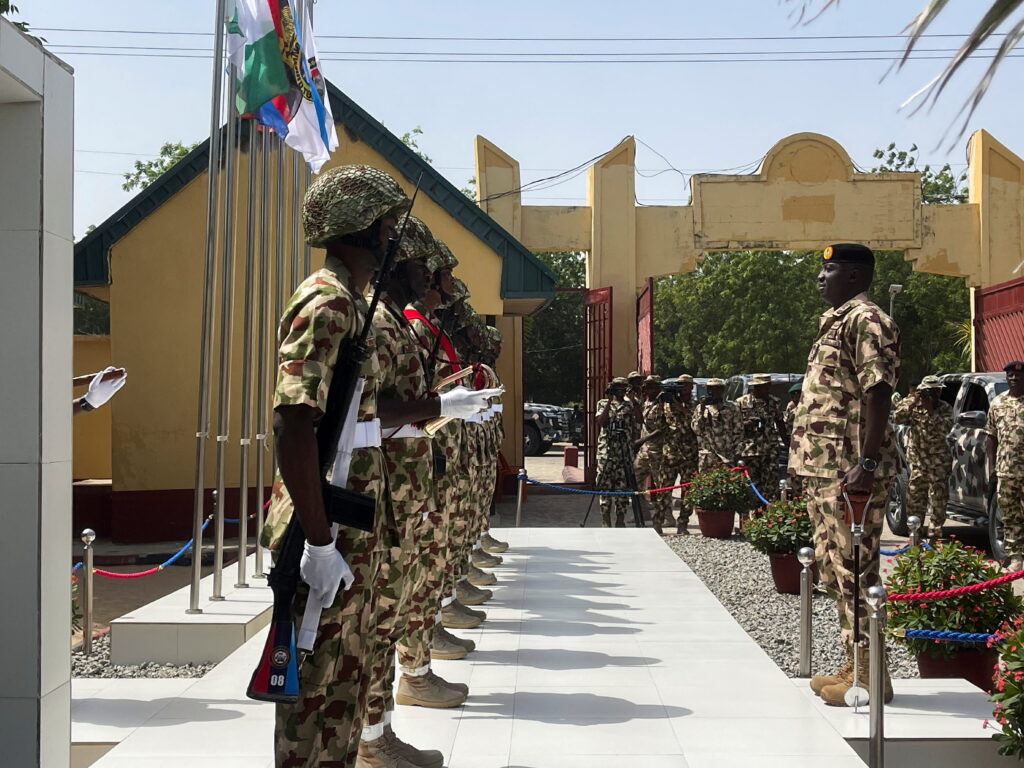
Image: Nigeria's Chief of Army Staff, Lieutenat-General Waidi Shaibu inspects troops, during the tour of Theatre Command Operation Lafiya Dole, in Maiduguri, Borno, Nigeria, November 6, 2025. REUTERS/Ahmed Kingimi