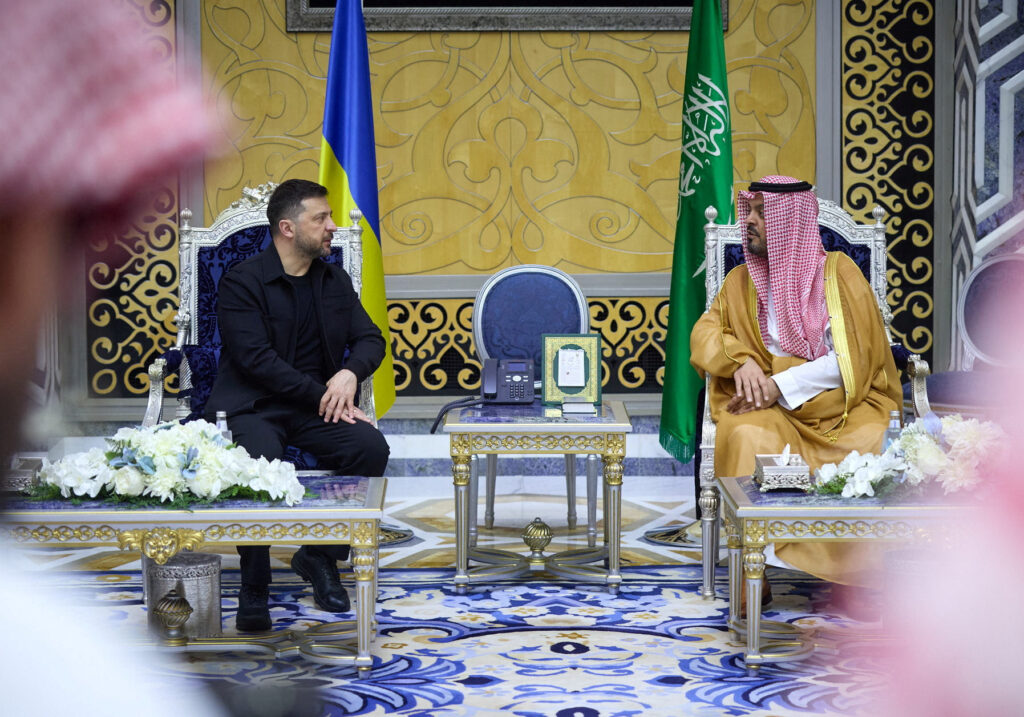
In recent weeks, the Iran war has shone a spotlight on Ukraine’s emergence as a drone superpower. Kyiv’s decision to help defend the Gulf states against Iranian attack drones by deploying teams of Ukrainian specialists is now highlighting the scope for broader tech sector cooperation between Ukraine and the region. This potential for partnership was underlined by Ukrainian President Volodymyr Zelenskyy’s visit to Saudi Arabia on March 26.
When Russia launched its full-scale invasion of Ukraine in February 2022, few analysts predicted that the outgunned Ukrainians would soon fundamentally alter the global understanding of unmanned systems warfare. Yet that is precisely what has happened. From improvised FPV drones strapped with grenades to the long-range naval strike drones that have forced Russia’s Black Sea Fleet to retreat, Ukraine has demonstrated that asymmetric drone warfare can neutralize conventional military advantages in ways that expensive Western defense systems never quite anticipated.
What distinguishes Ukraine’s drone program is not simply its scale, but also the speed and adaptability of its development cycles. Ukrainian engineers, often operating in basements and converted workshops, upgrade drone designs in a matter of days rather than the year-long processes typical of conventional defense procurement. Software updates are pushed out overnight. Lessons from the morning’s combat inform the afternoon’s engineering innovations. The Ukrainian battlefield has become the most demanding product testing environment in the world.
This lean, decentralized, and ruthlessly practical model has not gone unnoticed in Saudi Arabia, the United Arab Emirates, Qatar, and their Gulf region neighbors. All have been studying the Ukrainian experience carefully. For countries that have invested hundreds of billions of dollars in conventional military hardware only to find themselves operating in a world where a commercially available drone can threaten a warship, the Ukrainian approach represents both a warning and an opportunity.
Stay updated
As the world watches the Russian invasion of Ukraine unfold, UkraineAlert delivers the best Atlantic Council expert insight and analysis on Ukraine twice a week directly to your inbox.
The Gulf states are not passive observers of technological change. The UAE’s Vision 2071, Saudi Arabia’s Vision 2030, and Qatar’s National Vision 2030 all share a common ambition to transform their economies from hydrocarbon dependency into diversified, knowledge-based societies where technology plays a central role.
Defense and security technology, long imported wholesale from the United States, United Kingdom, and France, is increasingly identified as a sector where these nations want enhanced domestic capacity. This is not merely a matter of patriotic pride; it is increasingly recognized as a strategic necessity.
For now, ambition and execution remain some distance apart. The Gulf states have capital in abundance and a genuine appetite for technology transfer. What they have found harder to cultivate organically is the specific combination of engineering talent, risk tolerance, regulatory flexibility, and competitive urgency that drives genuine innovation. This is precisely where Ukraine’s wartime technology ecosystem presents an intriguing counterpart.
The case for deeper Ukraine-Gulf technology cooperation rests on synergies that are easy to overlook amid the noise of geopolitics. Ukraine possesses what the Gulf states most covet: Battle-proven engineering expertise; a deep talent pool in software, electronics, and materials science; and a development culture forged under conditions of extreme pressure.
Meanwhile, the Gulf states can offer what Ukraine most urgently needs: Capital, global commercial networks, and the ability to provide a stable platform for technology commercialization at a time when much of Ukraine’s civilian infrastructure and economic base remain under threat.
Drone technology sits at the most visible intersection of these complementary strengths, but it is far from the only area for potential cooperation. The ecosystem that has made Ukraine’s drone program so formidable is built on broad technical foundations including robust software engineering, AI-assisted target recognition, electronic warfare countermeasures, and sophisticated logistics platforms. Each of these capabilities has substantial civilian and commercial applications in areas that match the priorities of the Gulf states.
Eurasia Center events

Any deepening of Ukraine-Gulf technology ties must navigate a complex geopolitical landscape. The Gulf states have, with varying degrees of success, sought to maintain working relationships with both Russia and Ukraine throughout the current war.
This studied neutrality is a potentially valuable asset in fostering Ukraine-related technology cooperation. Some Ukrainian companies might prefer partners who can operate without the political complications of deeper NATO engagement, while Gulf-based joint ventures offer a flexibility that Western partners often cannot.
At the same time, the Gulf states maintain active ties with both Russia and China, creating potential risks for Ukraine’s battle-tested tech to travel further than intended. EU and US sanctions packages have repeatedly flagged UAE-based entities for supplying military and dual-use goods to Russia, including microelectronics and UAV components. The threat of Ukrainian defense IP migrating toward Beijing or Moscow through a Gulf intermediary is not theoretical. It is a structural problem that any co-production framework would need to resolve before NATO partners could endorse it.
Western governments are watching these dynamics carefully. There is a legitimate concern in Washington and Brussels about the dual-use nature of drone and AI technologies amid alarm that capabilities developed by Ukraine could, if commercialized through Gulf intermediaries, find their way into the hands of hostile actors.
These concerns will require careful management. But they should not obscure the more fundamental point that technology partnerships between Ukraine and the Gulf, conducted transparently and within a clear governance framework, could potentially serve the strategic interests of both parties and of the broader rules-based international order.
Ukraine’s drone program is the most dramatic expression of a broader technological transformation that the country has undergone since the Euromaidan Revolution of 2014 and, with accelerating urgency, since 2022. The war with Russia has in many ways turbo-charged Ukraine’s tech sector, driving engineers toward defense applications with the same creative energy previously directed at consumer software.
For the Gulf states, engaging with this ecosystem means potentially accessing not just drone know-how but a broader pipeline of technology talent and startup energy. A deliberate focus on Ukrainian technology companies, whether through direct investment, co-investment structures with Ukrainian state entities, or technology accelerator partnerships, would represent a logical extension of existing Gulf region investment strategies.
Transforming this potential into reality requires deliberate institutional architecture. At the governmental level, the frameworks for technology and investment cooperation between Ukraine and the Gulf states remain underdeveloped compared to those with EU member states or the United States. Bilateral investment treaties, technology transfer agreements, and joint venture frameworks need to be negotiated, or existing agreements updated, to reflect the current reality of Ukraine’s technological capabilities and the investment priorities of individual Gulf states.
At the industry level, dedicated platforms for technology matchmaking are needed. Existing tech sector events are useful, but a more targeted mechanism such as an annual Ukraine-Gulf technology forum could provide the sustained attention that one-off exhibitions cannot. Ukraine’s Ministry of Digital Transformation and the country’s tech industry associations have the institutional capacity to anchor such an initiative from the Ukrainian side.
At the financial level, the structure of Gulf investment in Ukrainian technology will need to be carefully designed to account for the realities of war, reconstruction, and regulatory complexity. Special purpose vehicles, escrow arrangements, and the use of third-country holding structures may be necessary to provide Gulf investors with the governance certainty they require.
The interest that Gulf region governments and investors are showing in Ukraine’s drone capabilities is, at one level, simply pragmatic. But this interest, if properly cultivated, could serve as the entry point for a much broader and more consequential relationship.
Ukraine needs to rebuild its economy, attract sustainable foreign investment, and establish itself as a technology hub that can thrive in the postwar era. The Gulf states need to accelerate their technology transitions, diversify their strategic partnerships, and develop genuine domestic innovation capacity rather than simply buying capabilities off the shelf from Western defense contractors. These are not competing objectives. They are, in important respects, the same objective approached from different directions.
The drones are the headline. But behind the headline lies the possibility of a durable, mutually beneficial technology partnership between two of the world’s most dynamic and consequential technology stories of the current decade. Whether that possibility is realized will depend on the vision and initiative of policymakers, investors, and entrepreneurs on both sides. The ingredients for something significant are present. The question is whether those involved will have the strategic clarity to combine them.
Anatoly Motkin is president of the StrategEast Center for a New Economy, a non-profit organisation with offices in the United States, Ukraine, Azerbaijan, Georgia, and Kyrgyzstan, developing the knowledge driven economy in the Eurasian region.
Further reading


The views expressed in UkraineAlert are solely those of the authors and do not necessarily reflect the views of the Atlantic Council, its staff, or its supporters.


The Eurasia Center’s mission is to enhance transatlantic cooperation in promoting stability, democratic values, and prosperity in Eurasia, from Eastern Europe and Turkey in the West to the Caucasus, Russia, and Central Asia in the East.
Follow us on social media
and support our work
Image: Ukraine's President Volodymyr Zelenskyy meets Deputy Governor of Makkah Region Prince Saud bin Mishaal bin Abdulaziz during his visit to Jeddah, Saudi Arabia. March 26, 2026. (Ukrainian Presidential Press Service/Handout via REUTERS)