The Hungarian parliamentary elections on April 12 are being billed as the most important in the country’s modern history. With Hungary a key focus in the escalating confrontation between Russia and the West, this weekend’s vote could also have geopolitical implications that will be felt in Kyiv, Moscow, Brussels, and Washington.
Current Hungarian Prime Minister Viktor Orbán has been in office for the past sixteen years, making him the European Union’s longest-serving leader. This dominance is now thought to be under threat, with polls showing opposition leader Péter Magyar and his Tisza Party leading Orbán by a significant margin.
Critics accuse Orbán of undermining democratic institutions at home while fostering close ties with Moscow, leading to widespread claims that Hungary unofficially represents Russian interests in Brussels. As key EU decisions require unanimous consent from all member states, Orbán has used his veto power to undermine support for Ukraine. Hungary has consistently opposed Ukraine’s EU accession, refused to phase out Russian oil and gas imports, and repeatedly delayed aid packages for Ukraine.
Budapest currently stands in the way of a €90 billion EU loan to Kyiv. In exchange for dropping his objections to this loan, Orbán has demanded the resumption of oil deliveries via the Druzhba pipeline, which transports Russian oil to Hungary through Ukraine but was reportedly damaged during a Russian attack in January 2026.
Stay updated
As the world watches the Russian invasion of Ukraine unfold, UkraineAlert delivers the best Atlantic Council expert insight and analysis on Ukraine twice a week directly to your inbox.
Orbán’s election strategy has relied heavily on anti-Ukrainian rhetoric. Campaign billboards for his political party, Fidesz, have featured portraits of Ukrainian President Volodymyr Zelenskyy alongside negative slogans including narratives of the Ukrainian leader begging for money or representing the so-called “pro-war lobby” in Brussels. Hungarian officials have claimed that Ukraine “will stop at nothing” to prevent Orbán’s re-election.
The election campaign has also been marred by allegations of disinformation operations, such as the circulation of fake news reports linked to Russia. Much of this so-called “doppelganger” content, which is designed to look indistinguishable from genuine news coverage produced by reputable sources, has been intended to tarnish the reputation of the Hungarian opposition and damage relations with international partners.
Concerns over Russian influence in Hungarian politics have loomed large over the current election campaign. Leaked phone calls between Hungary’s top diplomat Péter Szijjártó and Russian Foreign Minister Sergey Lavrov have emerged in recent weeks showing the Hungarian official coordinating actions with his Kremlin counterpart. Several EU leaders including Polish Prime Minister Donald Tusk and Irish Prime Minister Micheál Martin have condemned these calls as “deeply disturbing” and “sinister.”
Eurasia Center events

Opposition leader Péter Magyar is proposing to transform Hungary’s geopolitical posture. Though relatively cautious in his public statements on Ukraine, Magyar’s platform favors improved ties with NATO and the EU. Crucially, he has also vowed to end to what he terms as the “betrayal” of Hungarian and European interests through collusion with Russia. Magyar has framed the election as a “referendum” on Hungary’s place in the world and an opportunity for Hungarians to decide whether they favor closer ties with Moscow or Brussels.
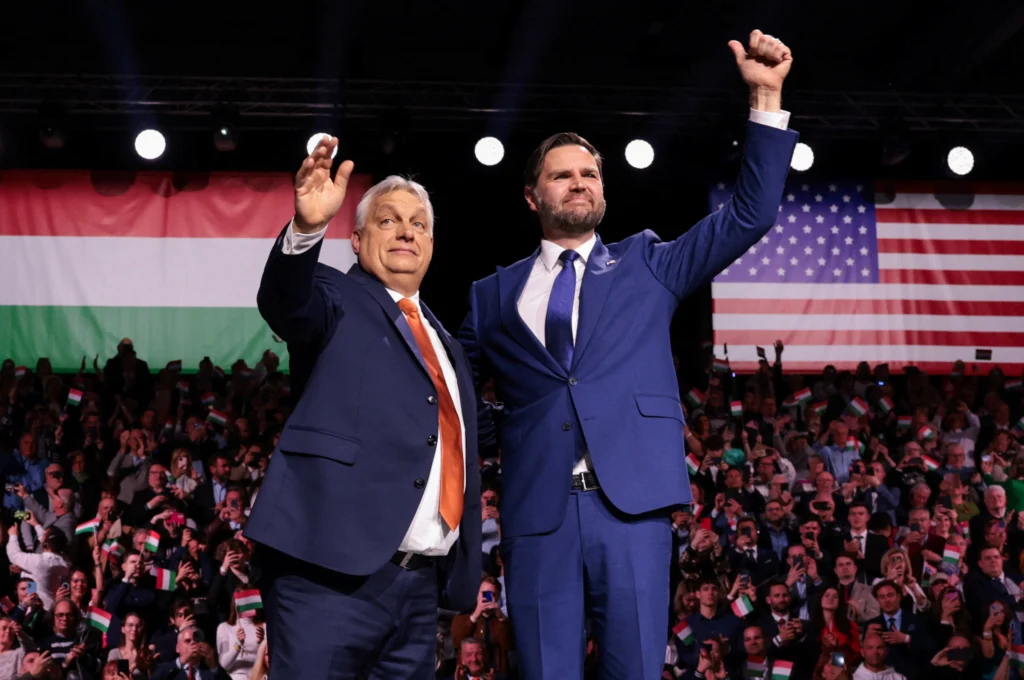
Orbán’s spoiling tactics have made him unpopular in many EU capitals. In contrast, the Hungarian leader can count on vocal support across the Atlantic. US President Donald Trump has publicly endorsed Orbán, While US Vice President JD Vance opted to demonstrate his backing by visiting Budapest on the eve of the election.
Not everyone in Washington favors Orbán, however. A bipartisan group of US Senators recently introduced sanctions legislation aimed at encouraging Hungary to end its reliance on Russian energy and addressing Orbán’s obstruction to aid for Ukraine.
While polling data suggests a likely opposition victory, the outcome of Hungary’s coming election is expected to be close, as the Hungarian electoral system is seen as favoring the ruling party. There are also concerns over possible irregularities including vote buying, voter fraud, and election day intimidation. In the event of a close result, the current authorities may contest the outcome.
For Viktor Orbán, the stakes could hardly be higher. If he loses Sunday’s election, the veteran Hungarian politician will likely face investigation for his actions over the past sixteen years, along with uncomfortable questions about the nature of his ties to the Kremlin.
Internationally, the coming vote could have equally significant repercussions. The fall of the Orbán government would leave Putin without his most important EU ally, making it far more difficult for Moscow to influence European politics. Trump would also lose a key European partner at a time when transatlantic relations are becoming increasingly strained. For Brussels and Kyiv, meanwhile, a change in Budapest would be viewed far more favorably as a step toward easing Ukraine’s integration and removing a major obstacle to European support for the Ukrainian war effort.
Marc Goedemans is a Young Global Professional at the Atlantic Council’s Eurasia Center.
Further reading

The views expressed in UkraineAlert are solely those of the authors and do not necessarily reflect the views of the Atlantic Council, its staff, or its supporters.

The Eurasia Center’s mission is to enhance transatlantic cooperation in promoting stability, democratic values, and prosperity in Eurasia, from Eastern Europe and Turkey in the West to the Caucasus, Russia, and Central Asia in the East.
Follow us on social media
and support our work
Image: US Vice President JD Vance and Hungarian Prime Minister Viktor Orban appear on stage together during Day of Friendship event at MTK Sportpark in Budapest, Hungary, April 7, 2026. (REUTERS/Jonathan Ernst/Pool)