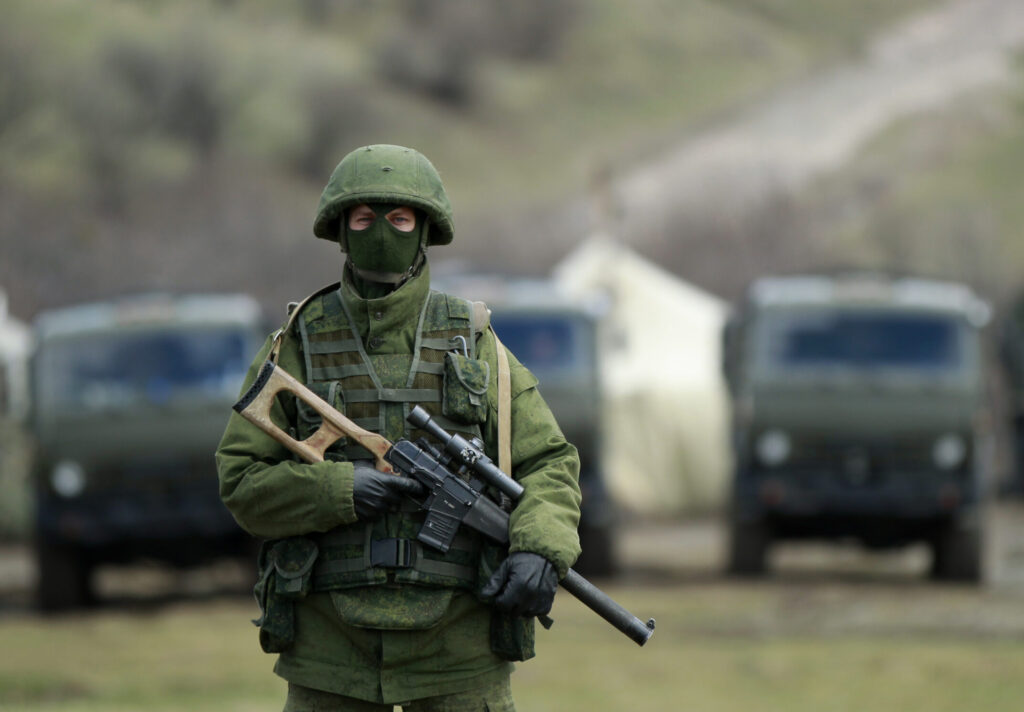
As Russia’s full-scale invasion of Ukraine approached the four-year mark in early 2026, the international media widely reported that the war had now lasted longer than the Soviet fight against Nazi Germany during World War II. This historical comparison made for attention-grabbing headlines, but it was not entirely accurate. In fact, the Russia-Ukraine War did not begin in 2022; it started eight years earlier in 2014. Efforts to end the war must reflect this reality.
Despite extensive coverage and analysis over the past four years addressing Russia’s full-scale invasion of Ukraine, there remains an alarming lack of clarity over the earlier stages of the war. Ukrainian President Volodymyr Zelenskyy clearly recognizes this problem, and was at pains during a recent interview with Britain’s Alastair Campbell to point out that the invasion actually began twelve years ago.
This is not merely a matter of getting the historical record right. It is about framing the current full-scale war correctly as the latest phase in a far longer campaign of escalating Russian aggression. It is also about debunking Kremlin disinformation. Russian President Vladimir Putin has attempted to justify the invasion of 2022 by framing it as a response to Ukrainian military operations in the east of the country, but the fighting in eastern Ukraine was itself the product of Russia’s own military intervention.
Stay updated
As the world watches the Russian invasion of Ukraine unfold, UkraineAlert delivers the best Atlantic Council expert insight and analysis on Ukraine twice a week directly to your inbox.
The Russian invasion of Ukraine began in February 2014 with the takeover of Crimea. While Moscow initially sought to disguise this as a local uprising, Putin subsequently admitted that he personally gave the order for the Russian army to occupy the Ukrainian peninsula. Buoyed by the success of this operation, Putin then initiated a campaign to destabilize and partition mainland Ukraine via the creation of Kremlin-led “people’s republics” throughout the south and east of the country.
While these efforts were thwarted in most regions by local resistance, Kremlin forces were able to gain a foothold in eastern Ukraine’s Donetsk and Luhansk provinces. They were soon reinforced by regular Russian army units operating without insignia and accompanied by blanket denials. This obvious ruse was enough to muddy the waters for some international correspondents, who chose to amplify rather than exposing the Kremlin’s transparent lies about local militias and oppressed Russian-speaking Ukrainians.
Thankfully, many of the leading figures who took part in the Kremlin campaign to seize eastern Ukraine have themselves since acknowledged that the entire operation was led by Moscow and could not have succeeded without the participation of the Russian military. Nevertheless, the veil of deceit that shrouded Russia’s 2014 invasion continues to obstruct understanding of today’s war.
The extent of the fighting during this initial eight-year phase of hostilities between Russia and Ukraine should not be underestimated. From 2014 until the full-scale invasion in February 2022, Russia’s undeclared war in Ukraine’s eastern provinces killed over 14,000 Ukrainians, including approximately 3,400 civilians and 11,000 military personnel, according to United Nations data. In that period, at least 200,000 Ukrainians saw active military service amid sporadic fighting along the front lines in the country’s two easternmost regions.
This death toll of 14,000 meant that far greater numbers of friends and relatives across Ukraine also suffered loss and bereavement. Meanwhile, thousands of the Ukrainian men and women who fought to stem the tide of the Russian invasion during this initial stage of the war were left forever scarred by what they witnessed. Many also experienced life-changing injuries.
Russia’s 2014 attack displaced more than a million Ukrainians while causing unprecedented distress, uncertainty, and trauma for countless others. People lost homes and businesses, with entire families divided by front lines separating neighboring towns and villages. In areas under Kremlin control, a regime of lawlessness took hold as Russian appointees scrambled to enrich themselves and crush local resistance. By almost any measure, the Russian invasion of Ukraine was already a major war long before the escalation of 2022.
Eurasia Center events
It is impossible to understand Russia’s full-scale invasion of Ukraine without an appreciation of the eight years of armed conflict that proceeded it. Indeed, many of the most dangerous misconceptions about today’s war stem from a failure to grasp the true nature of Russia’s initial attack on Ukraine.
For example, some international observers including senior US officials still seem convinced that Ukraine can end the war by handing over the remaining territory in Donetsk province that Russia has so far been unable to occupy. This mistaken belief reflects the long shadow of Moscow’s 2014 disinformation, which asserted that the people of eastern Ukraine were oppressed ethnic Russians seeking to separate from the country and join Russia.
In fact, the entire “separatist” movement in eastern Ukraine was a Kremlin creation from the very beginning. Any peace deal that forces Ukraine to retreat further in the east would reward Russia for its criminal conduct, while also serving to legitimize the false claims of “pro-Russian separatists” that have been pushed by Moscow since 2014.
Nor is it reasonable to assume that the full occupation of the Donetsk province would satisfy Putin’s imperial ambitions. After all, back in spring 2014, he attempted to instigate similar fake “separatist” uprisings in approximately half of Ukraine. There is nothing at all to suggest he has since moderated his views on Russia’s historic right to these regions. Quite the opposite, in fact.
Calls to sacrifice the rest of Donetsk province in order to secure peace are both unconscionable and delusional. For more than a decade, Putin’s actions have made clear that he intends to destroy Ukraine as a state and as a nation. This campaign to extinguish Ukrainian statehood escalated dramatically in 2022, but it began in 2014.
Prior to 2022, the Kremlin worked hard to disguise its attack on Ukraine and deny Russian responsibility for the death and destruction taking place across the border. Dismantling this disinformation and recognizing the scale of Russia’s expansionist ambitions in Ukraine is absolutely vital if a sustainable settlement is to be achieved.
Paul Niland is a Kyiv-based Irish journalist and the founder of Lifeline Ukraine.
Further reading

The views expressed in UkraineAlert are solely those of the authors and do not necessarily reflect the views of the Atlantic Council, its staff, or its supporters.

The Eurasia Center’s mission is to enhance transatlantic cooperation in promoting stability, democratic values, and prosperity in Eurasia, from Eastern Europe and Turkey in the West to the Caucasus, Russia, and Central Asia in the East.
Follow us on social media
and support our work
Image: A Russian soldier without insignia stands guard near a Ukrainian military base in Crimea in 2014. (REUTERS/David Mdzinarishvili)