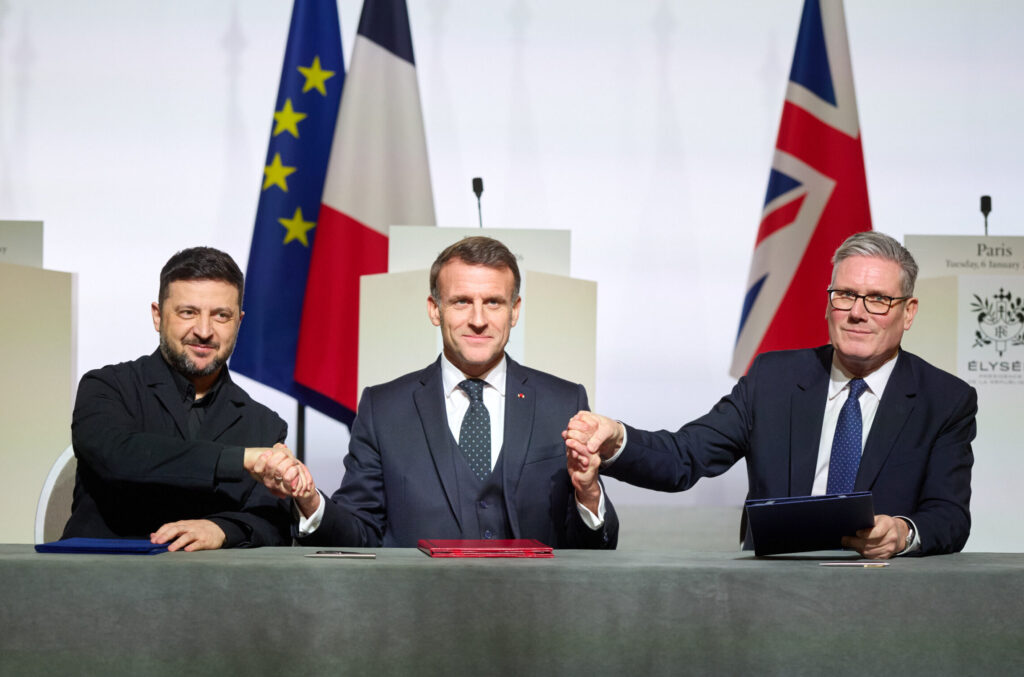
Kyiv’s allies hailed progress toward “robust” security guarantees for Ukraine on January 6 following a meeting in Paris attended by representatives of more than thirty countries who together make up the Coalition of the Willing.
As details of a possible security framework for postwar Ukraine continue to take shape, British Prime Minister Keir Starmer and French President Emmanuel Macron signed a joint declaration committing to deploy troops to Ukraine in the event of a peace agreement between Moscow and Kyiv. Crucially, US officials attending the talks in France also voiced American backing for security guarantees, with the United States expected to play a supporting role that will focus on ceasefire monitoring.
Ukrainian President Volodymyr Zelenskyy praised the “substantive discussions” and suggested that he was now more confident about the credibility of the security commitments being proposed by Ukraine’s partners. “Military officials from France, the United Kingdom, and Ukraine worked in detail on force deployment, numbers, specific types of weapons, and the components of the armed forces required and able to operate effectively. We already have these necessary details,” he commented.
Stay updated
As the world watches the Russian invasion of Ukraine unfold, UkraineAlert delivers the best Atlantic Council expert insight and analysis on Ukraine twice a week directly to your inbox.
This was the latest in a series of meetings over the past year that have sought to define workable security guarantees for Ukraine as a key element of the US-led push to end Russia’s invasion. Since early 2025, Britain and France have been at the forefront of ongoing efforts to establish a Coalition of the Willing bringing together countries prepared to contribute to postwar security measures. The objective is to prevent a resumption of Russia’s war in Ukraine.
The Paris Declaration signed on January 6 is a step in the right direction, but many key questions remain unanswered. The document does not provide the kind of NATO-style commitment to collective security that many believe is essential in order to deter Putin. Nor does it clarify the exact role of a potential European military contingent on Ukrainian territory, or define whether their mandate would include defending themselves in the event of a Russian attack. Instead, it contains vague references to “the use of military capabilities.” This language is hardly likely to convince the Kremlin, especially in light of the escalation fears that have dominated the Western response to Russia’s invasion of Ukraine.
The other obvious problem with the current peace plan is implementation. The signatories of the Paris Declaration all agree that the envisioned package of security guarantees for Ukraine can only be put in place once a ceasefire has been agreed. This will inevitably strengthen Moscow’s objections. Over the past year, Russia has repeatedly rejected ceasefire proposals while stressing its unwavering opposition to any Western military presence in Ukraine. That is exactly what the Coalition of the Willing is now proposing.
Eurasia Center events

As Ukraine’s partners discuss the technical aspects of security guarantees, the elephant in the room remains Russia’s lack of interest in peace. The Kremlin was not represented at talks in the French capital this week, just as it has been absent during a similar series of recent meetings between US, Ukrainian, and European officials.
While the Trump administration has sought to maintain a parallel dialogue with Moscow, there is no indication whatsoever that Russia shares the optimistic assessments being offered by Zelenskyy and other Western leaders. On the contrary, Putin and his Kremlin colleagues continue to signal that they have no intention of compromising and remain committed to the maximalist goals set out at the start of the invasion in February 2022.
Throughout the past year, Putin has been careful to avoid openly rejecting US peace proposals due to concerns over possible retaliatory sanctions. Nevertheless, his actions speak for themselves and underline his opposition to ending the war.
Just one day after Trump and Zelenskyy met in Florida in late December and announced significant progress toward a settlement, Putin called the US leader and accused Ukraine of launching an attack on his presidential residence. The news appeared to shock Trump and placed the entire peace process in jeopardy. However, it soon transpired that the incident had been hastily invented in a bid to discredit Ukraine and derail peace talks. Trump has since acknowledged that Putin’s resident was not targeted. “I don’t believe that strike happened,” he told reporters on January 4.
The Kremlin dictator’s apparent readiness to lie directly to Trump says much about his determination to disrupt peace efforts. The faked attack on Putin’s residence was the latest in a series of Russian steps over the past year to stall or otherwise obstruct negotiations. This has led to mounting claims that Putin is playing for time without having any intention of ending his invasion.
Putin’s rejection of a negotiated settlement should come as no surprise. His army is advancing in Ukraine and retains the upper hand in a war of attrition that strongly favors Russia. With the Ukrainian military suffering from increasingly acute manpower shortages and Kyiv’s allies showing growing signs of weakening resolve, Putin remains confident that he can achieve a decisive breakthrough in 2026.
Even if he did not believe that victory was on the horizon, Putin would be highly unlikely to risk a compromise peace involving limited territorial gains. After all, he is not fighting for land in Ukraine; he fighting for Ukraine itself.
Putin views the invasion of Ukraine in the broadest of possible historical contexts as a sacred mission to reverse the injustice of the Soviet collapse and revive the Russian Empire. The terms currently on offer would leave around 80 percent of Ukraine beyond Kremlin control and free to pursue further European integration. To Putin, that would not be a partial victory; it would be a catastrophic defeat.
In the coming weeks, Russia will almost certainly reject the latest peace framework agreed in Paris. How will the Coalition of the Willing respond to this setback? Unless they are willing to impose more costs on the Kremlin and bolster Ukraine’s ability to hurt Russia militarily, all talk of postwar security guarantees and reassurance forces will continue to ring hollow. If Western leaders are serious about ending the war in Ukraine and safeguarding European security, they must acknowledge that there is no alternative to increasing the pressure on Putin.
Peter Dickinson is editor of the Atlantic Council’s UkraineAlert service.
Further reading

The views expressed in UkraineAlert are solely those of the authors and do not necessarily reflect the views of the Atlantic Council, its staff, or its supporters.

The Eurasia Center’s mission is to enhance transatlantic cooperation in promoting stability, democratic values, and prosperity in Eurasia, from Eastern Europe and Turkey in the West to the Caucasus, Russia, and Central Asia in the East.
Follow us on social media
and support our work
Image: ddp/Sven Simon via Reuters Connect