During the three decades following independence in 1991, Ukraine’s fledgling democracy was forged in an environment of near-constant political upheaval including two pro-democracy revolutions. This helped produce a robust and highly competitive democratic culture marked by regular shifts in power, with the contest between Ukraine’s many rival political forces regulated by an increasingly free press and vibrant civil society.
The election of Volodymyr Zelenskyy as independent Ukraine’s sixth president in 2019, followed by his political party’s landslide success in parliamentary elections of the same year, was a watershed moment in Ukrainian politics. For the first time, a single political force controlled both the presidency and parliament.
This dominance did not translate into anything approaching Kremlin-style one-party rule, however. Instead, Ukraine’s democratic institutions and public opinion remained key factors shaping the country’s political trajectory. By 2021, there were mounting signs that Zelenskyy’s political honeymoon was coming to an end.
Russia’s full-scale invasion in February 2022 led to the emergence of a new social contract between Ukrainians and the state that saw party politics placed on pause. With the survival of the country in question, the Ukrainian public entrusted the government with extraordinary authority, while attention turned to urgent issues of national defense.
In practice, wartime realities meant an unprecedented concentration of power in the office of the president. As a result, the influence of the Ukrainian parliament on policy-making declined markedly. The dangers of this shift did not go unnoticed by politicians and activists alike, but there was a general consensus that such temporary political measures were justified by the existential nature of the fight against Russia’s invasion.
Stay updated
As the world watches the Russian invasion of Ukraine unfold, UkraineAlert delivers the best Atlantic Council expert insight and analysis on Ukraine twice a week directly to your inbox.
The unspoken social contract of 2022 finally began to unravel in summer 2025, when the government passed controversial legislation undermining the independence of Ukraine’s anti-corruption architecture. This was widely perceived as a direct threat to the institutional progress achieved following the country’s 2014 Revolution of Dignity.
The Ukrainian public response was emphatic. Almost immediately, crowds gathered in central Kyiv and in a number of other Ukrainian cities to voice their opposition to the bill. This rapidly escalated into the country’s largest wartime protests. Faced with public outrage and widespread expressions of concern from Ukraine’s international partners, the authorities backed down and introduced fresh legislation protecting the independence of the country’s anti-corruption agencies.
This episode confirmed the underlying strength of Ukraine’s democratic instincts. Even in extreme wartime conditions, Ukrainians were ready to stand up in defense of their democracy. The summer 2025 protests established a clear red line between the temporary delegation of power and the permanent erosion of institutional safeguards.
Eurasia Center events

A further test of the wartime political status quo came in November 2025, when Ukraine’s anti-corruption institutions went public with allegations of systemic corruption within the country’s energy sector and accused numerous senior figures of involvement. The ensuing scandal led to a string of high profile resignations, including multiple ministers and the president’s chief of staff.
This political firestorm has raised fundamental questions about the monopoly of power in wartime Ukraine. While most Ukrainians continue to oppose the idea of holding national elections until a peace deal is in place, the energy sector corruption scandal in late 2025 has led to widespread calls for greater accountability, and has sparked heated debate over the need for changes in the country’s political leadership.
In this dynamic political climate, Ukraine’s parliament has begun to play a more prominent role. In December 2025, parliament voted to establish a temporary investigative commission to examine alleged violations related to corruption, human rights, and the defense sector. Crucially, this move received cross-party support.
An overall picture is emerging of a political system adapting to wartime realities but still very much atuned to core democratic values. Parliament is once again exercising oversight and influencing key political decisions, while anti-corruption institutions, civil society, and the country’s independent media act to expose violations. Meanwhile, Ukrainian society remains ready to defend the country’s hard-won democratic gains.
Most Ukrainians still recognize the need for wartime measures that would be seen as problematic in peacetime. However, the Ukrainian public has also established a number of firm red lines during the past four years of full-scale war. These are boundaries that no Ukrainian politician can afford to ignore, especially as negotiations to end the war progress. In fiercely democratic Ukraine, any potential peace deal must win public approval before it can be successfully implemented.
Oleksiy Goncharenko is a member of the Ukrainian Parliament with the European Solidarity party.
Further reading
The views expressed in UkraineAlert are solely those of the authors and do not necessarily reflect the views of the Atlantic Council, its staff, or its supporters.

The Eurasia Center’s mission is to enhance transatlantic cooperation in promoting stability, democratic values, and prosperity in Eurasia, from Eastern Europe and Turkey in the West to the Caucasus, Russia, and Central Asia in the East.
Follow us on social media
and support our work
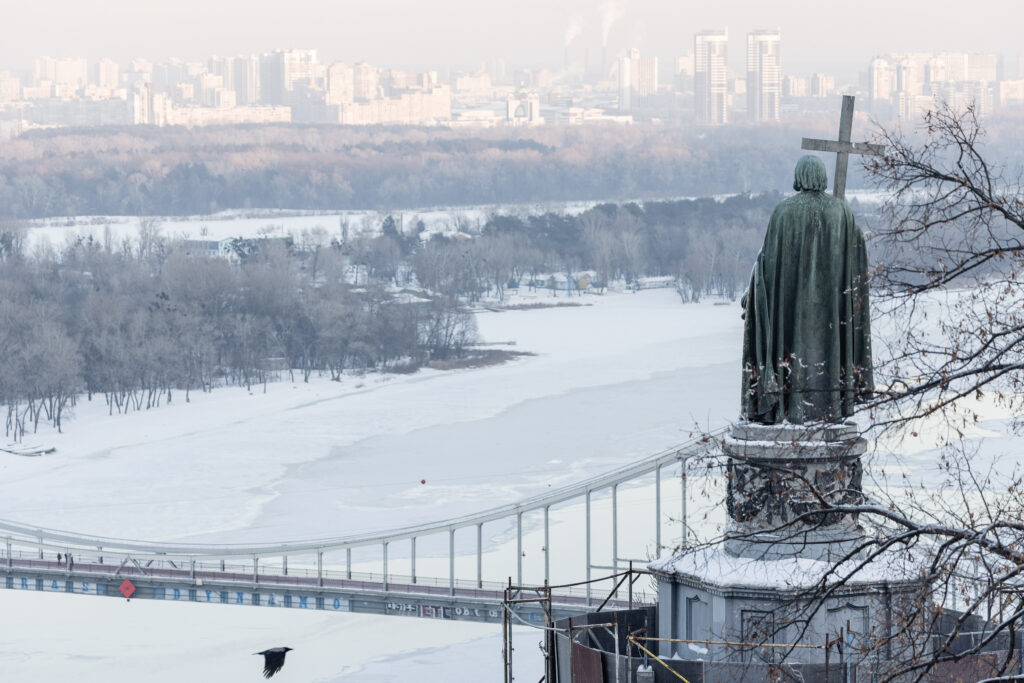
Image: The Volodymyr the Great Monument in Kyiv is seen near the frozen river with the city skyline in the distance and flocks of birds flying in Kyiv, Ukraine on 2 February 2026. The scene captures daily life in the city during winter conditions. (Daniel Yovkov / Hans Lucas via Reuters Connect)