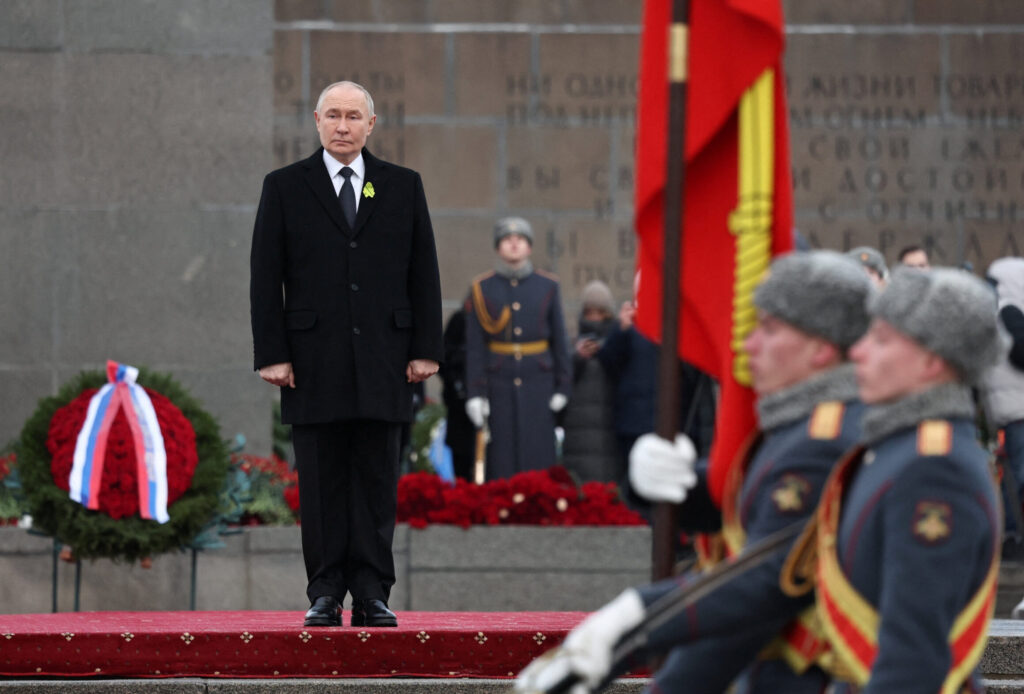
The ongoing US-led peace process to end the Russian invasion of Ukraine continues to lack credibility. Skeptics question whether Russian President Vladimir Putin has any interest whatsoever in a durable settlement. Others doubt the underlying logic of existing peace talks and note that by granting Russia a veto over security guarantees for Ukraine, Kyiv’s Western partners risk prolonging the war indefinitely.
One of the most contentious proposals currently under discussion is the idea of delaying the introduction of European troops to Ukraine until after a ceasefire has been implemented. This approach seems to have been specifically designed to fail. After all, nothing is more likely to deter the Kremlin than the suggestion that a ceasefire will create the conditions to prevent any future advances and end the era of Russian expansionism in Ukraine.
More than a year since US President Donald Trump returned to the White House, it should be abundantly clear to European leaders that the United States no longer sees any vital national interest in guaranteeing Europe’s security. This fundamental shift requires a clear-eyed response. Instead of constantly responding to a geopolitical agenda defined in Washington and Moscow, Europe must seek to reassert its own agency and secure a stake in the negotiations to end the current war.
Stay updated
As the world watches the Russian invasion of Ukraine unfold, UkraineAlert delivers the best Atlantic Council expert insight and analysis on Ukraine twice a week directly to your inbox.
If European leaders wish to participate as equal partners in discussions to determine the future security of their own continent, they cannot afford to rule out the deployment of troops to Ukraine. The Coalition of the Willing initiative, which is being led by the UK and France, was conceived in early 2025 as a way of keeping Trump engaged in European security; it is now the most realistic route to securing a European role in the peace process.
European troops could have a meaningful impact in Ukraine without engaging in combat operations. They could perform a range of support and training roles far from the front lines. For example, European contingents could take on much of the burden for monitoring the Ukrainian border with Belarus and the unrecognized Transnistrian Republic in Moldova, thereby allowing Ukrainian units to be used elsewhere. The deployment of European soldiers could also free up Ukrainian forces currently involved in the protection of critical infrastructure such as power plants and logistics hubs.
Boots on the ground in Ukraine could enhance existing training programs undertaken by Kyiv’s NATO partners. From a practical standpoint, it would certainly make military and economic sense to conduct training inside Ukraine rather than requiring large numbers of Ukrainian troops to travel internationally. The presence of European colleagues would boost morale within the Ukrainian army and demonstrate solidarity.
Crucially, a European military presence in Ukraine would undermine Russian efforts to prevent progress toward the implementation of credible security guarantees. While US officials have endorsed the concept of an assurance force to safeguard any peace deal, this is currently recognized as being conditional on Russian permission. However, Putin will not agree to any measures that rule out the possibility of further Russian gains. Deploying troops would send a signal that Moscow cannot define the debate over security guarantees.
Eurasia Center events

Critics will argue that any decision to deploy European troops to Ukraine would provoke Russia and lead to escalation. Kremlin officials are well aware of these concerns and have frequently warned that any Western military contingent in Ukraine would be legitimate targets. At the same time, the price of continued inaction may be Russian victory in Ukraine or a Kremlin-friendly peace that would leave European security in jeopardy for years to come.
Past experience strongly suggests that calling Putin’s bluff is the right strategy to adopt. Since launching the full-scale invasion of Ukraine almost four years ago, the Kremlin dictator has repeatedly announced red lines and warned of serious consequences, only to subsequently back down when confronted with a resolute response. Previous Russian red lines have included the supply of various categories of military aid to Ukraine, along with the use of long-range Western weapons inside Russia. On each occasion, Putin’s threats have proved to be empty.
Any move to place European forces in Ukraine would involve significant risks, but failure to act would risk leaving Europe sidelined and irrelevant. If European leaders want to secure a place at the negotiating table and avoid finding themselves on the menu, they must assert their agency. This can be achieved by demonstrating to the Kremlin that Russia does not have a veto over security guarantees for Ukraine.
Dr. Iulian Romanyshyn is a senior fellow and lecturer at the Center for Advanced Security, Strategic and Integration Studies (CASSIS) at the University of Bonn.
Further reading
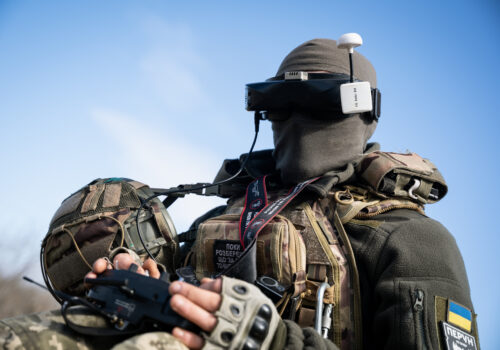
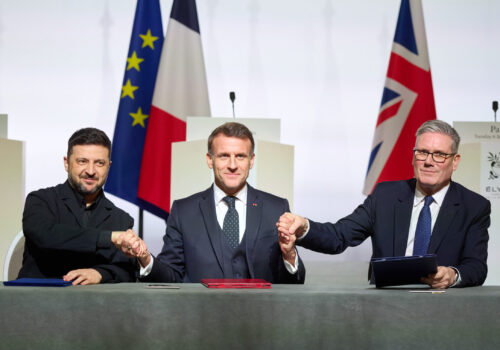

The views expressed in UkraineAlert are solely those of the authors and do not necessarily reflect the views of the Atlantic Council, its staff, or its supporters.
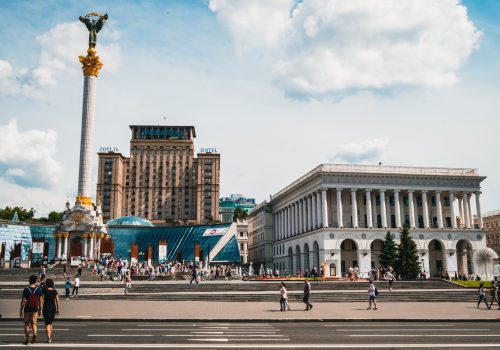

The Eurasia Center’s mission is to enhance transatlantic cooperation in promoting stability, democratic values, and prosperity in Eurasia, from Eastern Europe and Turkey in the West to the Caucasus, Russia, and Central Asia in the East.
Follow us on social media
and support our work
Image: Russian President Vladimir Putin attends a flower-laying ceremony by the Motherland monument at the Piskaryovskoye Memorial Cemetery marking the anniversary of Soviet forces breaking the Nazi siege of Leningrad in 1944 during World War Two, in Saint Petersburg. January 27, 2026. (Sputnik/Alexander Kazakov/Pool via REUTERS)