Watch the full event
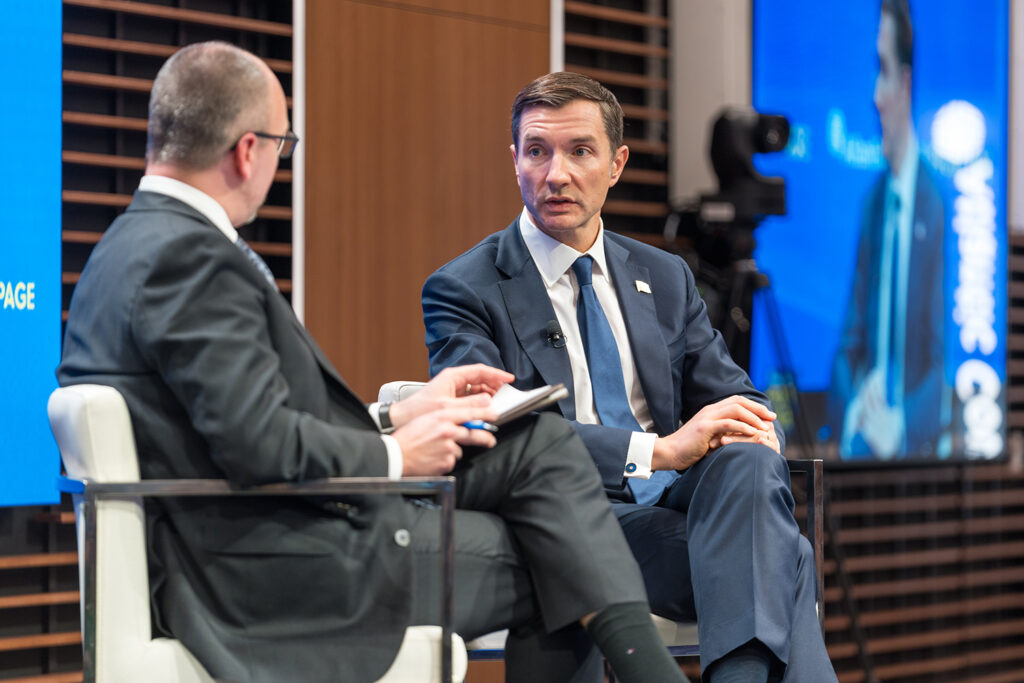
Amid a war in Iran, a slowdown in the Strait of Hormuz, and a surge of tariff uncertainty, leaders around the world have their minds squarely on the risks associated with short-term economic volatility. According to US Export-Import Bank (EXIM) Chairman and President John Jovanovic, “these times call for a very strong, robust export-import bank.”
At an Atlantic Council Front Page event on Wednesday, Jovanovic recalled speaking to President Donald Trump before his appointment as head of EXIM in September, recounting that he told the president, “you need something on the other end of a tariff” to ensure US companies can continue to compete globally.
EXIM, as part of its role, works to shape supply chains in which US companies can be competitive. “We’ve all become overreliant on supply chains that aren’t free, fair, functioning anymore,” he argued, addressing US partners and allies: “It’s not your fault, it’s ours. But let’s solve it together, and if you help us solve it, it’ll accrue value to you as well.”
Below are more highlights from the event, where Jovanovic talked about the supply chains he is working to reshape, from critical minerals to energy.
A look into the vault
- Jovanovic offered a behind-the-scenes look at the discussions behind Project Vault, a new initiative to create a critical mineral strategic reserve. “The fundamental problem” that the president was looking to address, explained Jovanovic, is that manufacturers rely on a “just-in-time inventory model,” which presents risks amid geopolitical shifts.
- Those designing Project Vault, Jovanovic said, wanted to ensure that the model they set up didn’t allow “free riders,” envisioning a scenario in which a company “latches onto this and the US taxpayer subsidizes.” He explained, “if the manufacturers are the ones for whom we’re solving the problem, they’ve got to be on the hook and help us.”
- He also explained that those creating Project Vault intend for it to be “demand-oriented,” because “the market told us what it needed.” He added, “we don’t want to create massive market disruptions.”
- Project Vault, he argued, offers partners an “opportunity to collaborate” with the United States and thus serves as an example of “things that we’re doing to solve our own issues,” which “are going to accrue primary and secondary value to our strategic allies.”
An eye on energy
- Last month, EXIM approved a $400 million deal supporting US liquefied natural gas (LNG) exports headed to Turkey, one of a slate of LNG export deals over recent months totaling up to billions of dollars. “What we’re doing,” he said, “is acknowledging the realities of the world in which we live,” where countries are wondering how to “make the most secure energy supply decisions.”
- Jovanovic said that he’d tell countries considering energy proposals from adversary countries to “think about the holistic risk-reward inherent in it and weigh all the pluses and minuses.”
- Today, with support from EXIM, “American LNG exports are going to places in the world they’ve never been,” he argued, “displacing molecules that they otherwise would have procured from adversaries.”
- Discussing US energy-security cooperation with the Western Balkans, Jovanovic said that it is “mission critical” for the United States to help the region attain the energy security “that they need and they deserve long-term,” with the Western Balkans’ challenges proving particularly persistent. Toward that aim, he said, there’s an “underdeveloped opportunity” to “work together on supply chain security.”
What US businesses are saying
- As EXIM has worked to strengthen supply chains, “we haven’t had to go pound the table and convince CEOs that they need to rethink some of these decisions that they’ve made,” regarding relying on cheaper goods from adversary countries, Jovanovic said. They already understand, he argued, that “what in the near term may yield some financial efficiency opens up considerable operational vulnerability in the mid- to long-term.”
- Jovanovic explained that it isn’t just large companies that will benefit from stronger supply chains. “Ninety percent of what the bank does,” he said, “is actually work with small and medium-sized companies.”
- Yet, he explained, having “the biggest companies participating” at a meaningful scale “creates the room and opportunity for the mids and smaller guys.”
- With artificial intelligence shaking up how businesses of all sizes around the world operate, Jovanovic argued that the technology is “an excellent way to give a shot in the arm to American productivity,” unleashing the country’s “pent-up economic growth.”
Katherine Golden is an associate director of editorial at the Atlantic Council and an anchor of the Council’s flagship newsletter, AC Intel.
Watch the full event
Image: EXIM Bank Chairman John Jovanovic speaks on US priorities for global competitiveness at Atlantic Council HQ on March 4, 2026.