By the end of the Cold War, European NATO nations considered air and missile defense to be a secondary military priority rather than an essential tool of intrawar deterrence, which refers to controlling escalatory patterns within an ongoing conflict.
Russia’s invasion of Ukraine disproved this view, revealing how mass missile and drone salvos can quickly overwhelm limited interceptor supplies and unready command structures. The threat is not about somebody else’s war. When as many as two dozen Russian unmanned aerial vehicles entered Polish airspace on September 10, 2025, NATO allies responded by scrambling one of the most sophisticated tactical defensive contingents in the world. Italian airborne early warning and control aircraft, German Patriot air and missile defense systems, Polish F-16s, fifth-generation Dutch F-35s, and a Belgian A330 Multi Role Tanker Transport aircraft were all brought forth to track and engage the drones. The imbalance between the overall price tags of the offensive and defensive packages clashing in the aerial engagement was gargantuan. More importantly, Russia could pursue similar concepts of operations in a NATO showdown—whereas Europe’s air defenses would experience wear and tear quickly in a high-operational-tempo scenario.
While Europe debates between urgent gap filling and long-term industrial autonomy amid the drone wall talks, Turkey has taken a different path. The Steel Dome initiative demonstrates Ankara’s early understanding that air defense requires integrated, scalable, and mass-produced systems on rapid timelines.
Air defense as a strategic imperative after Europe’s post-Cold War illusion
During the Cold War, NATO treated air defense as a foundational mission. This paradigm eroded after 1991 as threat perceptions faded. For more than three decades after the Cold War, Europe operated under the egregiously naive assumption that peer-level air and missile threats had receded into history. That illusion collapsed with Russia’s full-scale invasion of Ukraine, which reintroduced ballistic missiles, cruise missiles, combat aviation, and mass drone attacks as central tools of interstate warfare. Moreover, the Twelve-Day War between Iran and Israel in June 2025 cemented the new air threat picture. The new conflict trends have forced Europe to confront a long-neglected reality: without a coherent, layered air and missile defense, control of the air cannot be assumed and nations cannot stay safe.
Russia fields two missile types that matter most to European defense: the 500-kilometer range, ground-launched 9M723 Iskander and the air-launched, medium-range Kh-47M2 Kinzhal. Ukrainian intelligence assesses combined annual production at roughly 840 to 1,020 missiles, higher than earlier
estimates. The ballistic and aeroballistic missiles are backed by large salvos of cruise missiles and Shahed drones—the latter marks more than five thousand kamikaze assets raining overwhelming damage onto Ukraine in a given month.
Europe’s defense relies mainly on the US Patriot and the Franco-Italian SAMP/T antimissile systems, both dependent on costly interceptors priced at around $2 million to $4 million each—often far more expensive than the missiles they are meant to defeat. Production is the choke point. Patriot interceptor output across the United States, Japan, and Germany might rise from about 850 today to 1,130 by 2027, and possibly to 1,470 by 2029. Even then, global demand means Europe might receive only a fraction of the output, and combat experience shows two or three interceptors are often needed per incoming missile. Output of the alternative, Aster 30 interceptors for SAMP/T, is projected at only 230 to 270 annually for ballistic missile defense, and their performance in Ukraine has lagged that of Patriots, implying higher interceptor consumption. Compounding the problem, Russia and Iran have been producing large numbers of long-range drones that can saturate defenses, increasing the odds that ballistic missiles penetrate targets. Cheaper, mass-produced systems might eventually counter drones, and lasers could one day address ballistic threats—but neither solution will arrive in time to close the imminent missile defense gap.
Europe’s current air defense posture remains uneven. High-end fighter fleets and a mix of European, US, and Israeli missile systems exist, but warfighting prowess lags behind capability. Interceptor stockpiles are insufficient for sustained high-intensity conflict, production timelines are slow, and short-range air defense gaps leave European forces exposed to the kind of kamikaze drone warfare now routine in Ukraine. These weaknesses are as much industrial as military. The response has revealed a strategic divide between two conceptual camps: the “gap fillers” and the “autonomists.” Gap fillers, as defined in this paper, favor rapid procurement of proven, off-the-shelf systems, primarily from the United States and Israel—predominantly the Arrow-3, Patriot, NASAMS, and Barak systems—to close urgent gaps. In contrast, autonomists, led by France, argue for long-term European autonomy through indigenous systems, even at the cost of slower fielding. This tension defines current debates over air defense initiatives and reinforces Europe’s continued reliance on US-made systems at the upper tier. Meanwhile, Turkey, a sui generis European NATO nation with its national defense technological and industrial base, has an alternative path: the Steel Dome.
Europe’s strategic air defense gaps and Turkey’s Steel Dome architecture
Turkey’s Steel Dome represents a critical leap in framing air defense as a national, system-of-systems architecture rather than a collection of stand-alone platforms. The Russian S-400, therefore, will need to be left out in the cold as a stand-alone weapon in Turkish military capabilities.
Designed as an integrated and layered air and missile defense construct, the Steel Dome aims to address threats across short-, medium-, and long-range engagement envelopes and all endoatmospheric altitude segments, while preserving operational sovereignty through indigenous development. The system-of-defensive system has been endorsed at the highest levels of defense decision-making and support for it continues rising as additional components reach operational status. In late August 2025, Turkey crossed a critical threshold in its pursuit of strategic autonomy in air defense with the first operational delivery of the components for the indigenous Steel Dome air defense system. The delivery coincided with the expansion of military electronics company Aselsan’s industrial base, reflecting Ankara’s view of defense production as a pillar of sovereignty. In November 2025, Turkey’s defense industrial base took a significant step forward with the signing of contracts valued at approximately $6.5 billion to procure a broad range of systems for the Steel Dome.
At the force-employment level, the Steel Dome integrates point and area air defense assets with longer-range interceptors into a unified command-and-control framework. Close-in defense is provided by antiaircraft artillery and very short-range systems optimized for counter-UAS (unmanned aircraft system) and low-altitude cruise missile threats. The Hisar family forms the short- and medium-range surface-to-air missile layer, while the Siper system anchors the long-range air and missile defense mission, extending coverage against high-performance aircraft and missile threats. An artificial intelligence (AI)-assisted command-and-control architecture fuses sensors, shooters, and electronic warfare elements into a unified air picture, compressing decision timelines and enabling commanders to operate in a dynamic, contested airspace. In an era defined by unmanned systems and saturation salvos, this coherence is as decisive as kinetic action. The strategic significance of Steel Dome lies less in individual interceptors than in its integration logic. By fusing sensors, effectors, and command elements into a single air picture and prioritizing serial production under national control, Turkey is building an air defense posture designed for sustained competition rather than episodic procurement. In other words, Steel Dome epitomizes the Turkish leadership’s strategic autonomy agenda. The most critical lesson of Ukraine is not merely about the quantities of missiles or radars, but about strategic coherence. Air defense is no longer a procurement problem to be managed in peacetime cycles. Turkey has already grasped the bitter truth and made its choice to act rapidly and decisively through the Steel Dome initiative—a response Turkey’s European allies should study. The Steel Dome initiative also serves industrial and geopolitical purposes. It is intended to reduce dependence on foreign air defense systems while positioning Turkey as a supplier to states facing similar threat environments. The emphasis on modularity and scalability suggests an export-oriented mindset, enabling partners to buy into the architecture incrementally rather than commit to a single, rigid system.
Conclusion
Europe’s current air defense dilemma is defined by scarcity and sequencing. Interceptors are expensive, production is slow, and operational experience shows that quantity alone does not translate into resilience. The deeper vulnerability lies in fragmentation: multiple systems, limited stockpiles, and insufficient integration across sensors, shooters, and command layers. As long as air defense remains divided between national stopgaps and Alliance bottlenecks, Europe will struggle to convert capability into credible deterrence.
Turkey’s Steel Dome offers a contrasting defense industrial policy. By building a layered, integrated architecture under national coordination from the outset, Ankara has prioritized coherence over perfection and sustainability over symbolic capability or overpriced foreign sales. The emphasis on systems integration, domestic production, and serial scalability is key to the Turkish government. In an era in which airspace is increasingly contested by mass and speed, the strategic advantage revolves around a defense that can endure, adapt, and sustain in highly attritional and prolonged wars.
Dr. Can Kasapoglu is a non-resident senior fellow at Hudson Institute. Dr. Kasapoglu holds a Ph.D. from the Turkish War College and an M.Sci. degree from the Turkish Military Academy. Previously he was an Eisenhower Fellow at the NATO Defense College in Rome and held a visiting research post at the NATO Cyber Center of Excellence in Tallinn.
Explore other issues

Explore the program

Within the Atlantic Council’s longstanding commitment to strengthening the transatlantic relationship, the Atlantic Council Turkey Program conducts research, provides thought leadership, and offers a platform for strategic dialogue between the US, Turkey, and NATO allies to address the region’s toughest challenges and explore opportunities, including in the fields of energy, business & trade, technology, defense, and security.
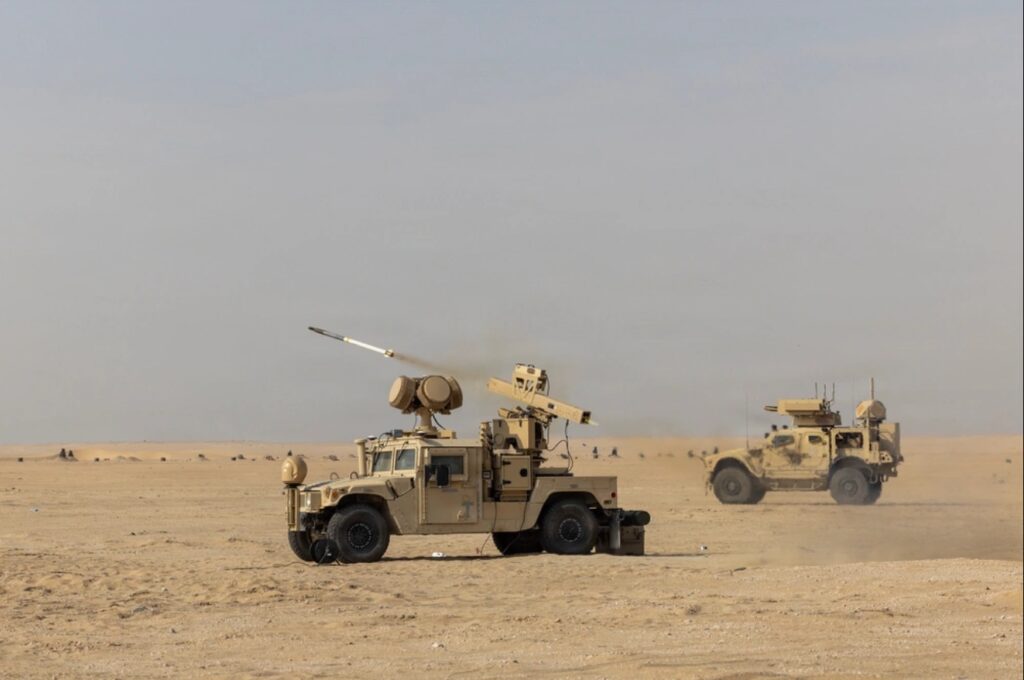
Image: An Electronic Advanced Ground Launcher System (EAGLS) counter-UAS fires an Advanced Precision Kill Weapon System (APKWS) Hydra 70 rocket during an Exercise Sky Shield live-fire event in Kuwait in 2025. US Army photo by Joseph Kumzak