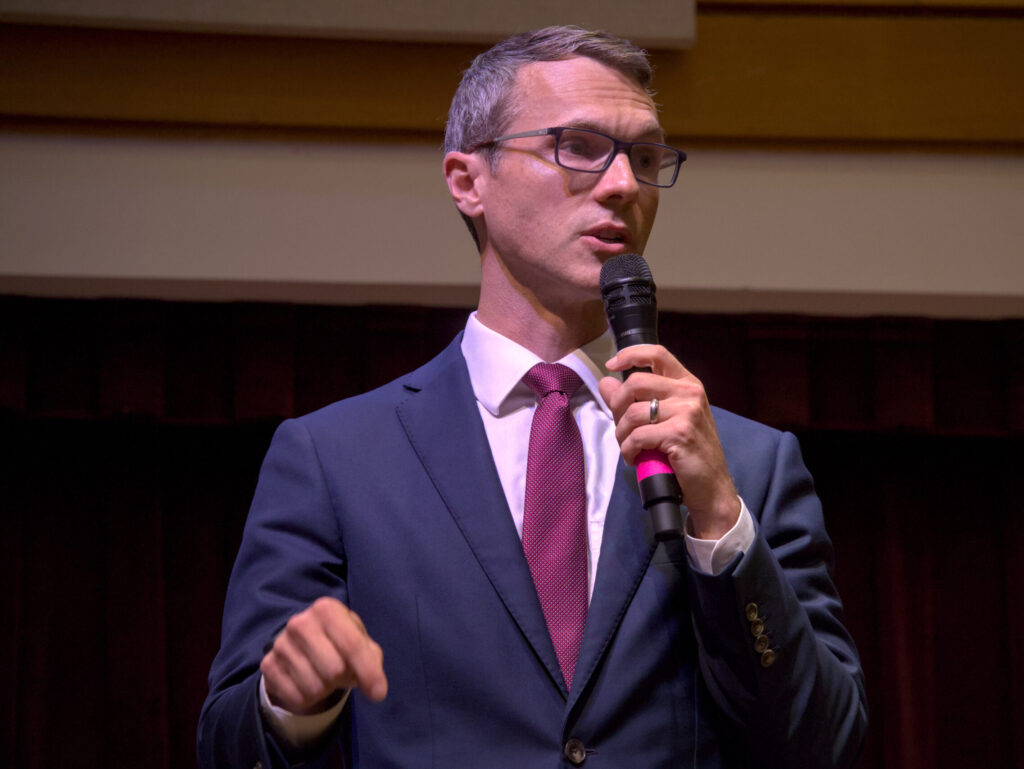
Congressman James Walkinshaw is a first-term representative of Virginia’s eleventh congressional district. The Defense Journal of the Atlantic Council Turkey Program recently interviewed Rep. Walkinshaw covering US-Turkey relations, the Caucus on US-Turkish Relations and Turkish Americans, and Congress’ role in foreign policymaking.
This interview was conducted on January 26, 2026 and has been lightly edited for style.
DJ: We’ve heard that you have agreed to join the Caucus on US-Turkish Relations and Turkish Americans—great news for the bilateral relationship and those interested in it. Can you tell us a little bit about the role of congressional caucuses in general and why we need a Turkey Caucus?
Walkinshaw: I served as chief of staff to the late Rep. Gerry Connolly for nearly a decade. During that time, Rep. Connolly was a member of the House Foreign Affairs Committee and served as a co-chair of the bipartisan Caucus on US-Turkish Relations and Turkish Americans. In my capacity as chief of staff, I supported his leadership on the caucus and, in response to constituent engagement and the strategic importance of the US–Turkish relationship, chose to join the caucus myself.
Congressional country caucuses can play a constructive role in strengthening bilateral relationships, while also providing a bipartisan forum to raise concerns and address areas of disagreement. Rep. Connolly understood the importance of maintaining a strong diplomatic relationship with Turkey, but he was also clear-eyed and outspoken about President Erdoğan’s persistent efforts to consolidate power and suppress political dissent. He used his position as co-chair to consistently sound the alarm about the erosion of democratic norms in Turkey.
I spent years supporting Rep. Connolly’s work in this space, and I intend to use my role on the caucus to continue advocating for a stable, prosperous, and democratic Turkey, and a strong US-Turkish relationship.
DJ: Turkey plays an important role in several major foreign policy priorities for Washington: ending the war in Ukraine, stabilizing Syria, finding a better way out for Israel and the Palestinians in Gaza, and forging a lasting peace in the South Caucasus. And despite the prevailing polarization in US politics, there have been encouraging signs of bipartisan approach in these areas—illustrated by the trip of Sen. Jeanne Shaheen, a Democrat, and Rep. Joe Wilson, a Republican, to Syria and the region last August. How hard is it to work across the aisle on foreign policy matters in the current environment?
Walkinshaw: US foreign policy is framed through bilateral ties, diplomatic and security agreements, treaties, and international organizations with guiding principles to promote democracy, ensure stability, and to invest and work with partners while deterring escalation or military action by adversaries.
It requires balancing the three D’s: defense, diplomacy, and development. Congress may not always agree on how the three D’s should be best implemented, but it’s important to acknowledge that one should not exist without the other and that’s the balance we are always trying to strike when working on foreign policy matters in Congress. Nevertheless, my approach is to identify a path to “yes.” Effective governance requires bipartisan engagement and a willingness to work constructively with colleagues across the aisle. Even in such a polarized environment, I am pleased that Congress worked on consequential issues such as reunifying families separated after the Korean War by passing the Korean American Divided Families National Registry Act, repealing the 1991 and 2002 Authorizations for Use of Military Force, and reestablishing the program at the US State Department to support the Ukrainian government in tracking Ukrainian children abducted by Russia. While significant work remains, these efforts underscore that there are serious foreign policy challenges where Congress can, and must, continue to act in a bipartisan manner.
DJ: How do you see the role of Congress—both houses—in shaping US foreign policy and interacting with the executive branch? What is the right balance between oversight/checks and balances on the one hand and “divisions stop at the water’s edge” on the other?
Walkinshaw: Congress is the preeminent branch of government, with broad powers outlined in Article I of the Constitution. What we have seen over the last twenty years, when the White House and Congress are controlled by different parties, Congress finds its Article 1 powers, and when the White House and Congress are controlled by the same party, Congress loses sight of its Article 1 powers. Article 1 of the US Constitution states clearly that Congress has the power to declare war, to lay and collect taxes and duties, and regulate commerce with foreign nations. President Trump is running roughshod and Congress has the responsibility to assert its authorities under the Constitution. President Trump illegally invaded Venezuela with no congressional authorization, putting US service members’ lives at risk, has implemented tariffs unilaterally and illegally, and recently foolishly threatened to purchase or invade Greenland.
Congress must reassert its powers under Article 1 in a bipartisan manner. I’ve supported War Powers resolutions to withdraw troops from hostilities that haven’t been authorized by Congress and voted to terminate the president’s misuse of International Emergency Economic Powers Act (IEEPA) authorities to implement tariffs on long-standing US allies. This is a consequential moment in modern American history. President Trump has repeatedly undermined the postwar, rules-based international order and pressured long-standing US allies. Congress possesses clear constitutional authorities to act as a check on this behavior. The challenge is not a lack of power, but a lack of political will among some members to exercise it in the face of partisan pressure and potential political retaliation.
DJ: Your district is one of a handful in the Congress that have massive intrinsic interest in foreign policy and foreign affairs—because of a significant foreign-born population, businesses with foreign interests, and constituents involved with foreign policy and defense. Do you get a lot of input from constituents in your district about foreign policy?
Walkinshaw: I’m proud to represent such a diverse district: 31 percent of the residents in my district are foreign-born. VA-11 is home to a vibrant Korean American community, Uyghur community, South Asian community, and many other immigrant communities that enrich our civic life. VA-11 is also home to more than 50,000 federal employees, many of whom bring national security, foreign policy, and public service experience shaped by our proximity to Washington, DC, and the Pentagon. As a result, my constituents are deeply engaged, highly informed, and passionate about international affairs and US foreign policy.
I value that engagement and actively seek input from constituents, welcome substantive dialogue on their priorities and concerns, and work to ensure their perspectives inform the actions I take in Congress. Representing this district carries both a responsibility and an opportunity; to listen, to lead, and to translate constituent expertise into effective policymaking.
DJ: The US-Turkish relationship has traditionally been focused on defense and security and followed the ups and downs of regional crises. Is it possible to broaden that scope a bit through people-to-people ties, parliamentary exchanges, and greater business cooperation? Is there a role for Congress to play in catalyzing that sort of growth?
Walkinshaw: It is possible to broaden and deepen the US-Turkish relationship, and Congress can play a constructive role in catalyzing that progress. Increased people-to-people ties, parliamentary exchange, and greater business cooperation can and should play an important role in advancing the dialogue around the benefits of civil society and democracy.
DJ: Your predecessor, Congressman Connolly, was a co-chair of the Turkey Caucus, and you were a major support to him during your previous work. Is there unfinished work for the caucus, and what do you see as the best priorities for it after several years of being relatively quiet?
Walkinshaw: The late Rep. Connolly was a steadfast advocate for democratic governance and the rule of law in Turkey. He forcefully condemned the 2016 coup attempt and was equally clear-eyed about President Erdoğan’s subsequent consolidation of power and erosion of democratic institutions. I share those concerns.
At the same time, it is important to recognize Turkey’s significant diplomatic role in a volatile region. Owing to its geostrategic position at the crossroads of Europe, the Middle East, and the South Caucasus, Turkey has at times served as a key intermediary, including through its role in brokering the Black Sea Grain Initiative and supporting US efforts to secure a ceasefire between Israel and Hamas.
Moving forward, my approach is to uphold democratic principles while engaging with strategic realities.
DJ: What are your greatest concerns regarding US-Turkish relations currently, and what (if any) advice would you have for leaders in both countries to address those?
Walkinshaw: My primary concerns regarding US-Turkish relations center on President Erdoğan’s consolidation of power and his continued engagement with US adversaries. His suppression of political dissent and pursuit of closer alignment with blocs such as BRICS raise serious questions, particularly given Turkey’s status as a NATO ally.
A stronger and more durable US-Turkish relationship ultimately depends on shared democratic commitments. Reaffirming respect for free and fair elections, the rule of law, and the expressed priorities of the Turkish people would not only strengthen Turkey’s democratic institutions but also improve trust and cooperation with the United States and our allies. With respect to President Trump, his record reflects a disregard for democratic norms and the postwar rules-based international order. While his tenure is limited, Congress retains an enduring responsibility to assert its constitutional authorities. I remain confident that Congress will be positioned to more effectively reassert its role, restore oversight, and serve as a meaningful check on executive overreach in the near future.
Congressman James Walkinshaw is a first-term representative of Virginia’s eleventh congressional district. Congressman Walkinshaw serves on the influential House Oversight and Government Reform Committee, on the Military and Foreign Affairs Subcommittee, and on the Committee on Homeland Security. He is the Founder and Co-Chair of the Federal Workforce Caucus, launched alongside Rep. Steny Hoyer (D-Md.) and Sen. Chris Van Hollen (D-Md.)
Explore other issues
Explore the program
Within the Atlantic Council’s longstanding commitment to strengthening the transatlantic relationship, the Atlantic Council Turkey Program conducts research, provides thought leadership, and offers a platform for strategic dialogue between the US, Turkey, and NATO allies to address the region’s toughest challenges and explore opportunities, including in the fields of energy, business & trade, technology, defense, and security.
Image: James Walkinshaw speaks at a forum, attended by other candidates in the primary to replace Gerry Connolly in the US House of Representatives. Wikimedia Commons