
Institutional architecture and prosperity: What lies beneath the aggregate score
Bottom lines up front
- Countries with similar freedom scores can reflect fundamentally different institutional realities.
- The weakest link matters most— low-performing institutions constrain prosperity regardless of strengths elsewhere.
- Balanced systems support more inclusive prosperity, including lower income inequality and better minority outcomes, while imbalances tend to widen it.
This is the overview chapter in the Freedom and Prosperity Center’s 2026 Atlas, which analyzes the state of freedom and prosperity in ten countries. Drawing on our thirty-year dataset covering political, economic, and legal developments, this year’s Atlas is the evidence-based guide to better policy in 2026.
Introduction
Across countries, institutional development is closely associated with economic and social outcomes. Societies that establish stable political rule, enforce legal norms, and provide a predictable environment for economic interaction tend to display higher levels of income and broader forms of human well-being.1See the evidence based on the Freedom and Prosperity Indexes (from 2023 to the current report and the references therein): “Research and Commentary,” Freedom and Prosperity Center, Atlantic Council. The empirical literature has examined these relationships from different angles. Some studies rely on aggregate institutional indicators that combine multiple dimensions into a single measure.2The Freedom House Index is one of the most popular measures of institutional quality, which assesses a very broad spectrum of civil and political liberties, as well as features related to the rule of law and economic rights. For an example of a highly cited study on the effects of democratization on economic growth using this index, see Daron Acemoglu et al., “Democracy Does Cause Growth,” Journal of Political Economy 127, no. 1 (2019). Others focus on specific areas—such as democratic governance, judicial quality, or market regulation—analyzing their individual effects on growth and development.3Fraser’s Economic Freedom of the World Index is the most widely used measures of economic freedom, which has informed a large body of literature on its relation to different socioeconomic outcomes. For a recent review, see Robert Lawson, “Economic Freedom in the Literature: What Is It Good (Bad) For?,” Prerelease of Chapter, Economic Freedom of the World: 2022 Annual Report, Fraser Institute, 2022. Regarding legal freedom, some highly used indexes include the World Bank’s Worldwide Governance Indicators or, more recently, the World Justice Project Rule of Law Index: See “Worldwide Governance Indicators,” 2025 Revision, World Bank; and “The Global Rule of Law Recession Is Accelerating,” World Justice Project. What has received less systematic attention is whether and how these different institutional dimensions (e.g., socioeconomic, legal, political) interact, and the how they shape prosperity in ways that cannot be understood by looking at each of them separately.
This question is not merely conceptual. Countries with comparable aggregate scores on a given index measuring institutional health may have disparate scores within a subindex or component or multiple ones. The cases of Nigeria and Qatar provide a clear illustration. While their overall institutional scores on the 2024 Freedom Index are not dramatically different (50.8 and 49.7, respectively), the internal makeup of those scores diverge sharply. Nigeria displays relatively stronger political institutions compared to its economic and legal pillars, whereas Qatar combines strong economic and legal institutions with very limited political competition. The radar visualization in figure 1 makes this contrast visible, showing different combinations of institutional strengths and weaknesses. Understanding whether and how such differences affect prosperity is therefore a relevant policy question. If institutional complementarities are strong, changes in one institutional area may spill over into others, shaping the capacity of the overall framework to sustain development. In the current context of democratic backsliding, for instance, it is crucial to understand whether erosion in political institutions weakens legal enforcement or economic predictability, and what the potential implications are for prosperity outcomes.
Understanding how different institutional dimensions relate to each other is central to the mission of the Freedom and Prosperity Center. The center’s research program has consistently focused on the mechanisms through which political, legal, and economic institutions jointly shape development outcomes. In the overview of 2025 Atlas: Freedom and Prosperity Around the World, published by the Atlantic Council, we reviewed several hypotheses proposed in the academic literature regarding the interconnections and complementarities between these institutional dimensions. That discussion highlighted the need for a more systematic empirical assessment of the institutional architectures of countries.
The design of the Freedom and Prosperity Indexes also reflects this objective. The Freedom Index distinguishes three conceptually separate dimensions of a country’s institutional framework, corresponding to three subindexes: The political subindex assesses the degree to which executive power is selected through competitive elections and subject to effective constraints; the legal subindex captures the extent to which citizens and public officials are bound by and comply with clear and predictable laws; and the economic subindex measures the degree to which economic activity is coordinated through voluntary exchange under secure property rights. The Prosperity Index, in turn, measures broad and shared development outcomes across income, education, health, inclusion, inequality, and environmental quality. Because these dimensions of each index are defined rigorously and constructed to avoid conceptual overlap, the two main indexes together provide a framework for the analysis of the combinations of institutional strengths and weaknesses), rather than inference from aggregate or conceptually mixed indicators.4For a detailed explanation of the conceptual framework of the Freedom and Prosperity Indexes, see the Atlantic Council’s 2023 Freedom and Prosperity Report, section 1.
This chapter takes that step. Using the Freedom Index’s three subindexes, we construct two measures that capture the internal structure of a country’s institutional framework: institutional imbalance and the strength of the weakest link. The first reflects the dispersion across institutional areas within a country. The second identifies the pillar that sets the minimum level of institutional performance. Together, these measures allow us to move beyond aggregate scores and examine how countries with similar overall institutional levels differ in their internal configuration. We then analyze how these configurations relate to overall prosperity and to its individual components. The results point to systematic differences: Countries with comparable aggregate institutional levels can display distinct prosperity profiles depending on how their political, legal, and economic institutions are structured. A country’s path to prosperity hinges on which individual institutions are strong and which are weak.
Conceptual framework: Complementarity and threshold effects
Institutional complementarities arise when the effectiveness of one institutional area depends on the level of another. In economic terms, two institutions are complementary if the marginal return to improving one increases with the strength of the other. This idea appears in several strands of the political economy literature. Darren,5Acemoglu, Simon Johnson, and James A. Robinson,Together, they won the 2024 Nobel Prize for Economics for their work on institutions and prosperity. for instance, argue that constraints on executive power and secure property rights tend to reinforce each other in sustaining investment and innovation. Research on state capacity points in a similar direction: fiscal authority, legal enforcement, and administrative capacity often operate jointly in shaping credible public commitments.6See Timothy Besley and Torsten Persson, “The Origins of State Capacity: Property Rights, Taxation, and Politics,” American Economic Review 99, no. 4 (2009): 1218–44. In this perspective, the contribution of any single institutional area depends on the broader configuration within which it is embedded.
Complementarity also implies the possibility of weakest-link effects. When institutional areas are functionally interdependent, sufficiently low performance in one area may constrain the effectiveness of others. Improvements in economic policy, for example, may yield limited results if legal enforcement remains unreliable. Similarly, formal democratic procedures may not translate into accountable governance in the absence of an effective and impartial legal system. In such cases, institutional development is partly noncompensatory: Strong performance in one area cannot fully offset severe weakness in another.
Institutional imbalance, however, does not have a uniform meaning. As shown in figure 2, countries may exhibit uneven scores across dimensions for different reasons. Costa Rica illustrates a case of differentiation within an otherwise strong institutional framework. Its three subindexes display a standard deviation of 11.17 points, indicating moderate dispersion across dimensions. Yet all pillars remain at comparatively high levels—the weakest institutional component still scores above 75—so the institutional floor remains robust despite internal variation. Venezuela, by contrast, displays much lower dispersion across dimensions, with a standard deviation of only 3.4 points. Its institutional pillars are relatively similar in magnitude, but they operate at uniformly low levels. In this case, apparent balance reflects uniformly weak institutional development, which constrains the functioning of the entire framework. Dispersion alone therefore provides incomplete information. While unequal institutional pillars are important signals, what ultimately matters is the absolute level at which the weakest component operates.
These considerations suggest that two aspects of institutional structure are particularly relevant for empirical analysis: the degree of dispersion across institutional areas and the level of the weakest institutional component. Dispersion captures asymmetries within the institutional framework, while the minimum level reflects potential bottlenecks that may constrain the functioning of the system as a whole. A systematic assessment of countries’ institutional architecture therefore requires measures that account for both elements simultaneously. The next section develops such measures and applies them to the Freedom Index subindexes.
Toward a typology of institutional architectures
The conceptual framework developed above suggests that institutional structure can be characterized along two dimensions: dispersion across institutional areas and the level of the weakest institutional component. To operationalize these ideas, we rely on the three subindexes of the Freedom Index and construct measures that capture both elements in a consistent and comparable manner. These measures allow us not only to quantify institutional imbalance and potential bottlenecks, but also to classify countries into distinct institutional types based on their internal configuration.
The first step is to ensure that institutional dispersion is measured on a comparable scale across subindexes. Although the three pillars of the Freedom Index are constructed using a consistent methodology, they rely on different underlying data sources, each of which has its own distribution and average level. Directly comparing raw scores across pillars would therefore reflect these distributional differences rather than genuine internal imbalance. To address this, we express each country’s score in a given pillar as a percentage deviation from the global average in that same year. This transformation allows us to interpret performance relative to the international average and ensures that dispersion captures how far apart a country’s institutional areas stand from each other.7Formally, for country i, subindex j, and year t, the normalized score is computed as: F̃ᵢⱼₜ = 100 · (Fᵢⱼₜ / F̄ᵢⱼₜ − 1) where Fᵢⱼₜ denotes the original subindex score and F̄ᵢⱼₜ is the cross-country average of subindex j in year t.
We construct two indicators from the normalized subindex scores. The first measures institutional imbalance as the range between the highest and lowest pillar within each country. A larger range indicates a wider gap across institutional areas, while a smaller range reflects a more even institutional profile. The second indicator captures the weakest link and is defined as the minimum of the three normalized pillars. This measure identifies the lowest-performing institutional area in each country. Together, these indicators summarize the internal dispersion of institutional development and the level of the institutional floor.
To focus on recent institutional configurations while avoiding short-term volatility, we compute five-year averages over the period of 2019 to 2023 for each subindex before constructing the imbalance and weakest-link indicators. This approach smooths temporary fluctuations and provides a more stable representation of each country’s institutional profile. All subsequent classifications and comparisons are based on these (averaged) values.
To translate these indicators into a typology, we classify countries along two dimensions. First, we distinguish between relatively balanced and relatively asymmetric institutional profiles based on whether a country’s imbalance measure lies below or above the median of the global distribution. Second, we distinguish between countries with a comparatively strong or weak institutional floor depending on whether their weakest-link indicator lies above or below the median. The use of median thresholds provides a transparent and data-driven rule that avoids imposing arbitrary cutoffs while ensuring that countries are compared relative to the observed global distribution.
Figure 3 presents the four institutional types that emerge from combining dispersion and weakest-link thresholds. Countries classified as Balanced–Strong exhibit relatively low dispersion across institutional areas and a strong institutional floor. Italy, for example, falls within this category, displaying comparatively even performance across political, legal, and economic institutions at a high level.
Figure 3. Typology of institutional architecture

Source: Freedom and Prosperity Indexes, Atlantic Council (2025).
Asymmetric–Strong countries combine a strong institutional floor with significant dispersion across pillars. Singapore provides a clear illustration. Despite ranking among the highest-income countries in the world and scoring strongly on legal and economic institutions, it does not fall into the intuitively “most advanced” category of Balanced–Strong because political competition remains comparatively weaker. The typology therefore distinguishes between high aggregate performance and balanced institutional development.
In contrast, Balanced–Weak countries exhibit relatively limited dispersion but low performance across all pillars. Syria represents a case in which political, legal, and economic institutions are uniformly weak, producing a low institutional floor without pronounced asymmetries.
Finally, Asymmetric–Weak countries combine dispersion with a weak minimum pillar. Russia illustrates this configuration: institutional performance varies across areas, yet the weakest pillar remains sufficiently low to constrain the overall institutional framework. In such cases, imbalance is accompanied by a low institutional floor.
The figure also reports the number of countries in each group and their average freedom and prosperity scores, allowing for an initial comparison of how these institutional configurations differ in aggregate outcomes. The descriptive statistics reported in figure 3 reveal clear differences across these groups. Countries classified as Balanced–Strong exhibit, on average, the highest freedom and prosperity scores. Asymmetric–Strong countries also display high average freedom levels, but somewhat lower average prosperity scores. Balanced–Weak and Asymmetric–Weak countries cluster at the lower end of both distributions, patterns that are consistent with the role of the institutional floor in shaping aggregate outcomes. These initial differences provide a first indication that both dispersion and minimum performance are relevant for understanding cross-country variation in development outcomes.
Figure 4 plots all countries according to their level of institutional imbalance (horizontal axis) and the strength of their weakest institutional pillar (vertical axis). The vertical and horizontal lines correspond to the median thresholds used to define the four institutional types.
The upper-left quadrant—Balanced–Strong—is populated primarily by high-income OECD-member democracies such as Australia and Canada, along with countries such as Italy and Chile. It also includes some middle-income countries, including Brazil and Albania, whose institutional performance is relatively even and whose weakest pillar remains above the global median. In this group, institutional development is both comparatively strong and internally coherent.
The upper-right quadrant—Asymmetric–Strong—contains countries with a solid institutional floor but pronounced dispersion across pillars. Switzerland appears in this category because its legal institutions are exceptionally strong even relative to other high-income democracies, generating substantial dispersion vis-à-vis its political and economic pillars, while its weakest pillar remains well above the global median. Botswana, Costa Rica, Georgia, and Ghana also appear in this quadrant. In these cases, at least one institutional area diverges noticeably from the others, yet the minimum level of performance remains comparatively high.
The lower-left quadrant—Balanced–Weak—includes countries such as Syria, Benin, Bangladesh, and Ethiopia. These countries display relatively limited dispersion across institutional areas, but all pillars perform below the median. Here, balance reflects uniformly low institutional development rather than coherence at high levels.
The lower-right quadrant—Asymmetric–Weak—contains a heterogeneous but analytically distinct set of countries. Russia and China fall in this category, as do several Gulf monarchies, including the United Arab Emirates, Qatar, and Saudi Arabia. In these cases, the political pillar lies far below the global median, creating both a weak institutional floor and significant dispersion relative to stronger economic or administrative institutions. The presence of high-income economies in this quadrant underscores that income levels alone do not determine institutional configuration.
The scatterplot also exhibits a visible downward association between imbalance and the weakest-link indicator. Countries with greater dispersion tend, on average, to display lower minimum performance. Part of this pattern reflects the fact that both measures incorporate the lowest-performing pillar. However, the dispersion of observations within each quadrant indicates that imbalance and minimum performance are not reducible to a single development ranking. Countries with such an imbalance can differ markedly in their institutional floor, and countries with comparable minimum performance can exhibit very different degrees of asymmetry. The quadrant structure therefore captures meaningful variation in institutional configuration beyond aggregate institutional levels.
Describing institutional configurations, however, is only a first step. The central issue is whether these structural differences are associated with distinct prosperity outcomes. It is particularly important to assess whether a strong institutional floor is systematically linked to higher levels of prosperity, and whether asymmetries among otherwise strong pillars are reflected in different development patterns. The next section examines how institutional imbalance and the weakest-link indicator relate to overall Prosperity Index scores and to their individual components.
Institutional architecture and the composition of prosperity
Figure 5 reveals a clear ordering across institutional types. Prosperity declines monotonically as we move from Balanced–Strong to Asymmetric–Strong, then to Asymmetric–Weak, and finally to Balanced–Weak. Two patterns stand out.
First, countries with a strong institutional floor—those in the upper half of the typology—achieve substantially higher prosperity levels than those whose weakest pillar falls below the median. The gap between Asymmetric–Strong and Asymmetric–Weak alone is roughly six to seven index points, suggesting that minimum institutional performance is closely associated with aggregate outcomes.
Second, balance appears to affect prosperity differently depending on the strength of the weakest link. Among countries with a strong floor, Balanced–Strong systems outperform Asymmetric–Strong ones by a considerable margin. By contrast, among weak-floor countries, the ordering reverses: Asymmetric–Weak countries display higher average prosperity than Balanced–Weak ones. This pattern likely reflects the heterogeneous nature of the Asymmetric–Weak group. In some cases, asymmetry arises because one institutional area has begun to improve from a low base, increasing dispersion in a way that is associated with rising prosperity. In others, such as certain resource-rich monarchies, strong economic or administrative institutions coexist with very weak political institutions, producing both imbalance and higher income levels. Balanced–Weak systems, by contrast, combine uniformly low institutional performance with limited differentiation across areas, a configuration that captures institutional stagnation rather than coherence and appears particularly unfavorable for prosperity.
Aggregate differences conceal substantial variation in how prosperity is distributed across institutional types. Figure 6 shows that while income, education, and health broadly follow the strength of the institutional floor, distributive outcomes display a more differentiated pattern, particularly with respect to inequality.
Singapore illustrates one side of this pattern: Very high income and human capital coexist with high levels of inequality relative to balanced high-income democracies such as Italy or Canada.
Among strong-floor countries, the contrast between Balanced–Strong and Asymmetric–Strong systems is especially pronounced in inequality performance. Although both groups record high income and education scores on average, Asymmetric–Strong countries exhibit markedly lower inequality scores than Balanced–Strong ones. The gap is sufficiently large that the Asymmetric–Strong average falls below even the Balanced–Weak group on this component. Singapore illustrates one side of this pattern: Very high income and human capital coexist with high levels of inequality relative to balanced high-income democracies such as Italy or Canada. At the other end of the Asymmetric–Strong spectrum, South Africa combines moderate income and education scores with extremely low inequality performance, pulling down the group average. These cases indicate that institutional asymmetry at relatively high levels of development is often associated with less favorable distributive outcomes.
The comparison among weak-floor countries adds further nuance. Asymmetric–Weak countries outperform Balanced–Weak ones on income and, to a lesser extent, on inequality and health. The presence of high-income Gulf monarchies such as the United Arab Emirates and Qatar in this category contributes to this result: Strong economic and administrative institutions elevate income levels despite very weak political scores. Yet when we turn to the minorities component, the distinction between Asymmetric–Weak and Balanced–Weak largely disappears. Both groups record similarly low levels of minority inclusion. Improvements in selected institutional areas therefore do not appear sufficient to lift all dimensions of shared prosperity.
Taken together, the component analysis suggests that institutional structure shapes not only the level of prosperity but also its distribution. Inequality outcomes are particularly sensitive to whether institutional strengths are balanced across pillars, even when overall institutional capacity is high. At the same time, similarities across weak-floor groups in minority inclusion point to the possibility that certain institutional constraints may systematically limit progress in rights-based dimensions of prosperity. The next section examines this issue more directly by identifying which institutional pillar tends to constitute the binding constraint within each type.
Which institutional pillar binds?
The differentiated prosperity profiles documented above suggest that not all institutional weaknesses are equivalent. Figure 7 indicates (for each institutional type) the percentage of countries for which the economic, political, or legal subindex constitutes the weakest pillar. The distribution varies systematically across groups and helps clarify the mechanisms underlying the prosperity patterns observed in the previous section.
Among Asymmetric–Weak countries, the political subindex is by far the most common weakest pillar. In most countries in this quadrant, political institutions fall substantially below their economic or legal performance in percent-deviation terms. Russia and China illustrate this structure, as do several Gulf monarchies. In the United Arab Emirates and Qatar, for example, the political pillar lies far below the global mean while economic institutions perform well above it, generating both high dispersion and a weak institutional floor. This configuration is consistent with the composition patterns discussed earlier. Income and certain material outcomes can improve where economic institutions are strong, but minority inclusion and other participation-sensitive components remain weak when political institutions constitute the binding constraint.
The structure of the Balanced–Weak group differs markedly. In this category, the legal subindex most frequently represents the weakest pillar. Countries such as Benin, Bangladesh, and Ethiopia combine low performance across all institutional areas with especially weak legal systems in percent-deviation terms. Deficiencies in judicial independence, coherence of the legal framework, and predictable enforcement are not offset by stronger performance elsewhere. Unlike the Asymmetric–Weak group, where improvements in selected institutional areas may lift specific outcomes, Balanced–Weak systems appear constrained more uniformly. This helps explain why their prosperity profiles are consistently low across income, education, and distributive dimensions.
The Asymmetric–Strong category presents a more nuanced configuration. While Singapore represents a visible case in which the political subindex is the weakest pillar, most countries in this group exhibit the economic subindex as their minimum. South Africa provides a clear illustration. Its political pillar stands roughly 27 percent above the global mean and its legal pillar nearly 9 percent above it, while the economic pillar lies about 2 percent below the mean. This gap generates measurable dispersion despite a relatively strong institutional floor. Panama, Costa Rica, and Peru display similar patterns in which legal and political institutions outperform the economic pillar in relative terms.
This structure differs from that of Balanced–Strong countries. In many Asymmetric–Strong systems, weaker economic freedom reflects regulatory fragmentation, limited competition in key sectors, or institutional arrangements that allow for selective protection and insider advantages. Such constraints may coexist with strong legal and political institutions and relatively high levels of income, but they can be associated with less favorable inequality outcomes. By contrast, in Balanced–Strong countries, the economic subindex is also frequently the weakest pillar—indeed, it accounts for the majority of cases in that group—but the key difference is its level. The weakest pillar in Balanced–Strong systems typically remains well above the global median and close to the other two pillars in percent-deviation terms. In these contexts, economic constraints are more likely to reflect deliberate redistributive choices embedded within coherent legal and political frameworks rather than structural distortions that generate persistent asymmetry.
Taken together, the evidence indicates that the identity and relative position of the weakest institutional pillar are closely linked to the differentiated prosperity profiles documented above. Where political institutions constitute the binding constraint, gains in economic capacity do not automatically translate into inclusive prosperity. Where legal institutions are weakest, development outcomes appear more uniformly constrained. And where economic institutions lag within otherwise strong systems, aggregate prosperity may remain high while distributive outcomes diverge. These distinctions suggest that reform priorities are likely to differ systematically across institutional architectures.
Implications for institutional reform and stability
The evidence suggests first that institutional reform must begin with the weakest pillar. Countries with a weak institutional floor do not compensate for that weakness through strength elsewhere. Where legal systems lack coherence and predictability, as in many Balanced–Weak countries, progress in economic or political domains is unlikely to translate into sustained improvements in income, human capital, or inclusion. Foundational investments in the rule of law—judicial independence, stable enforcement, and credible legal constraints—are not one reform among many; they are preconditions for others to take effect.
Foundational investments in the rule of law—judicial independence, stable enforcement, and credible legal constraints—are not one reform among many; they are preconditions for others to take effect.
Second, where political institutions constitute the binding constraint, improvements in economic governance alone are unlikely to generate inclusive prosperity. The Asymmetric–Weak profile illustrates this dynamic. Countries with strong administrative or economic capacity but weak political accountability can achieve respectable income levels, yet minority inclusion and distributive outcomes remain limited. In such contexts, reform strategies that focus exclusively on economic modernization risk entrenching dual structures: material progress alongside persistent exclusion. Strengthening political competition, accountability, and checks on executive authority is not merely a normative objective; it is central to broadening the base of prosperity.
Third, asymmetry among otherwise strong institutions carries its own risks. The analysis shows that Asymmetric–Strong systems underperform Balanced–Strong ones in inequality, even when aggregate prosperity is high. Institutional imbalance at high levels of development may allow income gains to coexist with uneven distribution and segmented opportunity structures. Over time, such gaps can fuel social tension, erode trust in institutions, and weaken political stability. Prosperity that is not broadly shared is more vulnerable to reversal.
For policymakers in relatively advanced but asymmetric systems, reforms aimed at strengthening economic competition, reducing insider advantages, and limiting regulatory fragmentation are therefore not marginal adjustments. They are investments in long-term stability.
Fourth, balanced weakness is not institutional coherence. Countries in the Balanced–Weak category often display symmetry at low levels of performance, but this symmetry reflects uniform constraint rather than institutional complementarity. In such contexts, sequencing matters. Attempting simultaneous reform across all pillars may dilute capacity and political capital. Identifying the most binding foundational weakness—frequently in the legal domain—and addressing it first may yield greater returns than broad but shallow reform agendas.
More broadly, the analysis suggests that institutional architecture should shape reform priorities. Policymakers and reform coalitions benefit from diagnosing not only how strong or weak institutions are in aggregate, but how they are configured internally. The same reform package will not have equivalent effects in countries where political institutions bind, where legal systems constrain development, or where economic frameworks lag within otherwise strong systems.
Country chapter summaries
The country chapters contained in this volume provide concrete illustrations of these dynamics. Across Ghana, Serbia, Colombia, Singapore, Tunisia, Italy, Sri Lanka, and others, the authors repeatedly identify institutional imbalances that shape economic performance, distributive outcomes, and political trajectories. Read together with the typology developed in this chapter, these cases underscore a common lesson: development outcomes depend not only on how strong institutions are, but on how their strengths and weaknesses are combined. Understanding that internal configuration is a necessary step toward designing reforms that are both effective and durable.
country chapters
Benin
Gilles Yabi, founder and president of WATHI, a citizen think tank in West Africa, describes Benin’s trajectory as divided into two sharply contrasting phases. From the mid-1990s through roughly 2016, the country consolidated the pluralistic constitutional order born of the 1990 National Conference. Competitive elections, peaceful alternation of power, and an active constitutional court made Benin a reference point in West Africa. Political freedom was the main driver of this performance, while legal continuity provided a degree of predictability uncommon in the region.
Since 2016, however, the institutional equilibrium has shifted decisively. President Patrice Talon justified reforms as necessary to correct what he called a corrupt democracy marked by clientelism and fragmented parties. The response was a rebalancing of power toward the executive. Electoral reforms narrowed political competition, excluding opposition parties from the 2019 legislative elections and raising representation thresholds thereafter. The constitutional court progressively lost its standing as an independent counterweight, and new legal provisions have constrained political organization and expression.
Prosperity indicators show gradual, modest improvement but no structural acceleration following political centralization. Growth remains limited by structural constraints, while education and health gains lag regional averages. The chapter underscores a clear imbalance: Democratic liberalization advanced without parallel state capacity, and recent executive concentration has since weakened political freedom without delivering decisive development gains.
Colombia
José Manuel Restrepo, a nonresident senior fellow at the Atlantic Council’s Adrienne Arsht Latin America Center, sees Colombia as a country whose institutional architecture contains both durable safeguards and persistent bottlenecks. The 1991 constitution established strong macroeconomic anchors, including an independent central bank and fiscal rules, which have preserved stability even amid political change. These guardrails have been central to sustaining investor confidence and preventing deeper crises.
At the same time, Restrepo emphasizes that institutional progress has been uneven. The expansion of rights and decentralization outpaced state capacity, generating fiscal pressures and implementation gaps. Corruption, illicit economies, and informality continue to erode governance, particularly in rural regions where state presence remains weak. Security improvements have been real, yet territorial control is still contested in areas shaped by illegal mining and coca production.
The chapter thus points to complementarities within Colombia’s framework. Macroeconomic discipline cannot substitute for effective territorial enforcement or credible judicial oversight. Restrepo insists that protecting the autonomy of the central bank and the independence of courts and oversight agencies are nonnegotiable conditions for stability. Rebuilding trust between the private sector and the state is presented not as a secondary issue but as essential to restoring growth and preserving Colombia’s democratic and economic gains.
Dominican Republic
Marino Auffant, a nonresident senior fellow at the Atlantic Council’s Scowcroft Center for Strategy and Security, presents the Dominican Republic as a case of institutional steadiness translating into sustained gains. Since the decisive 1996 elections, political power has been contested and transferred through regular, competitive elections without constitutional rupture. Even long periods of single-party dominance did not slide into electoral authoritarianism. This continuity produced cumulative returns: predictability for investors, incremental strengthening of legal frameworks, and a pattern in which dissatisfaction is resolved through elections rather than crisis.
At the same time, the institutional profile reveals asymmetries. Legislative constraints on the executive score persistently low, largely due to presidential dominance and aligned electoral calendars. Oversight often operates informally through civil society and business pressure rather than through Congress. More recently, improvements in the legal dimension have been closely tied to prosecutorial independence after 2020, yet these gains rest heavily on leadership choices rather than fully entrenched safeguards.
This architecture supported one of the region’s strongest growth performances, with diversified expansion across tourism, free trade zones, mining, and services. Inequality has declined in aggregate terms, yet informality and segmentation persist. Auffant’s central warning is that stability-driven expansion has reached its limits. Escaping the middle-income trap will require strengthening fiscal capacity, improving educational quality, and converting recent rule-of-law gains into durable institutional norms rather than episodic improvements.
Ghana
Joseph Asunka, the CEO of Afrobarometer and author of the chapter on Ghana, describes the nation as a democracy sustained by unusually strong civic foundations. Civil society and independent media are the backbone of Ghana’s democracy, and their vigilance has repeatedly checked attempts to narrow civic space. Election monitoring by domestic observers has strengthened confidence in electoral outcomes, and citizens largely see elections as meaningful avenues for political participation.
At the same time, the chapter stresses that institutional weaknesses persist beneath this record of stability. Judicial independence remains fragile and public trust in the courts has declined. The judiciary is perceived as susceptible to executive influence, particularly through appointments in politically sensitive cases. The ongoing constitutional review is therefore framed as an opportunity to reinforce neutrality and restore confidence in the rule of law.
Asunka ultimately argues that delivering justice and jobs is the real test of Ghana’s storied democracy. Youth unemployment and uneven economic opportunities pose risks to democratic legitimacy. Ghana’s political institutions have proven resilient, but their durability will depend on whether they can translate civic strength into economic inclusion and credible legal accountability.
Italy
Massimo Morelli, professor of political science and economics at Bocconi University and director of Pericles at the Baffi research center, argues that Italy’s institutional problem is not a collapse of formal freedom but a widening gap between formal guarantees and effective performance. Since the mid-1990s, political instability has shortened time horizons and fueled legislative overproduction. Annual lawmaking more than doubled compared to the early 1980s, with heavy reliance on emergency decrees. Reforms, including repeated revisions of the public procurement code, were introduced in the name of simplification yet layered new rules onto an already dense framework. The result is not deregulation but opacity. Administrative effort shifts from implementation to interpretation, and legal uncertainty becomes systemic.
Morelli links this institutional dynamic directly to Italy’s long stagnation. Real gross domestic product per capita has barely grown in three decades, labor productivity has been close to zero since the late 1990s, and business investment—especially in intangible capital—remains weak. Legal instability raises the fixed costs of expansion, reinforcing a firm structure dominated by very small enterprises. Small size becomes a strategy of self-protection rather than innovation.
Distributional tensions compound the problem. Wage stagnation, segmented education, and declining political participation reflect weakening expectations of mobility. Proposed judicial reforms, high public debt, demographic decline, and the eventual withdrawal of NextGenerationEU funds (i.e., a postpandemic stimulus program expiring at the end of 2026) create a fragile equilibrium in which institutional credibility and long-term growth are increasingly intertwined.
Philippines
Cesi Cruz, an associate professor of political science and economics at the University of Michigan, describes the Philippines as a system marked by sharp swings in political freedom layered over more gradual legal and economic change. In a highly presidential system with weak parties and strong political families, the effective scope of rights depends heavily on who happens to be president. Elections are regularly held and professionally administered, yet leadership alternations generate large movements in civil liberties and political rights. The Duterte presidency produced the most visible break, with extrajudicial killings, pressure on media, and weakened legislative constraints, even as the electoral machinery itself continued to function.
Legal institutions and the military have remained comparatively professional, preventing volatility from turning into outright institutional collapse. Courts are formally independent, but slow and limited in enforcement capacity. Corruption is highly personalized and fragmented, generating uncertainty rather than predictable informal exchange. Informality remains widespread, aligning the Philippines more with Latin American trajectories than East Asian ones.
Prosperity has risen more steadily than freedom. Remittances from overseas workers underpin income growth and declining inequality, producing gains even amid political instability. The core tension is structural: Economic improvement has not consistently translated into stable accountability. Growth and rights evolve on parallel tracks, leaving the system vulnerable to presidency-driven reversals rather than cumulative institutional consolidation.
Serbia
Richard Grieveson, deputy director of the Vienna Institute for International Economic Studies and a member of the Balkans in Europe Policy Advisory Group, argues that Serbia’s future depends on rebuilding the rule of law and restoring the credibility of its European path. The post-2000 period brought democratic opening and reform momentum, reinforced by the prospect of European Union accession. That external anchor mattered. As accession stalled, reform discipline weakened. Since 2012, institutional backsliding has become more visible.
The chapter emphasizes that elections continue to take place, but media dominance by the ruling party and uneven conditions for opposition actors have narrowed effective competition. More consequential is the deterioration in the rule of law. Corruption remains entrenched, public procurement lacks transparency, and judicial independence is questioned, especially in politically sensitive cases. Institutions operate in routine matters, yet they falter when political power is at stake.
Serbia has maintained macroeconomic stability and attracted foreign investment, but Grieveson stresses that growth cannot remain insulated from legal fragility. Investor confidence ultimately depends on predictable enforcement and impartial courts. The erosion of EU credibility has reduced reform incentives, leaving domestic political will as the main driver. Reestablishing credible legal constraints and a convincing European trajectory is presented as essential for durable prosperity.
Singapore
Linda Y.C. Lim, professor emerita of corporate strategy and international business at the Stephen M. Ross School of Business, University of Michigan, claims that Singapore must shift from state-led expansion to productivity-led growth. The existing model—market-oriented but heavily steered by the state—has delivered high income and global competitiveness. Strong administrative capacity, policy consistency, and commercial rule of law have underpinned that success.
Yet the chapter highlights mounting pressures. Growth has relied heavily on capital accumulation and labor force expansion, particularly through foreign workers, rather than sustained productivity gains. High housing costs, rising inequality, and social stratification signal structural strain. Lim notes that socioeconomic inequality is a direct product of the Singapore model, reflecting skill premiums, asset inflation, and the distributional consequences of openness.
Politically, elections are regularly held and efficiently administered, but competition remains tightly managed. The dominance of the ruling party shapes policy direction and limits adversarial contestation. This arrangement has supported long-term planning, yet it also narrows public debate over redistribution and social trade-offs.
Lim calls for a new social compact focused on productivity, capability upgrading, and broader inclusion. Sustaining prosperity will require not just economic adjustment but recalibrating the balance between growth, distribution, and political participation.
Sri Lanka
Nishan de Mel, an economist and executive director of Verité Research, describes Sri Lanka’s institutional trajectory as marked by sharp swings, missed opportunities, and fragile gains that repeatedly failed to consolidate. Although the overall freedom score today remains higher than in 1995, gains in individual dimensions were rarely synchronized, and improvements have oscillated significantly with changes in political leadership. Legislative constraints on the executive show some of the largest swings across the entire index, tracking constitutional amendments that expanded and contracted presidential power. When parliament and president aligned politically, oversight weakened and executive dominance grew.
Economic freedom fluctuated alongside these political cycles. Trade openness and investment freedom rose during periods of peace or reform, then declined amid conflict, crisis, or inward-facing policy turns. Durable economic freedom grows on the soil of solid institutions and governance, and neglecting governance makes economic progress unstable and unsustainable. That vulnerability became evident in the mid-2020s debt crisis.
Prosperity reflects the same pattern. Early investments in health and education produced strong human-development outcomes, yet growth relied heavily on domestic demand and external borrowing rather than export dynamism. Rising inequality, weak redistribution, and policy volatility magnified the shock when crisis struck. Advances occurred, but without institutional consistency they proved reversible rather than cumulative.
Syria
Ibrahim Al-Assil, a senior research fellow at Harvard University’s Middle East Initiative at the Belfer Center for Science and International Affairs and a nonresident senior fellow at the Atlantic Council, argues that a year into its post-Assad era, Syria needs a rules-first reset. Ahmed al-Sharaa has kept Syria’s postwar state standing for a year—but endurance alone cannot define success. Prosperity will depend as much on legitimacy and rules-based governance as on physical reconstruction. In his account, Syria’s freedom over the past quarter century follows three phases: managed optimism and limited reform, tightening control and economic capture, and comprehensive collapse in political, legal, and economic freedoms during the long war.
Al-Assil stresses that stabilization cannot be anchored in national elections. What can anchor stability is predictable administration, impartial security provision, and credible remedies for everyday corruption. Electricity, water, and education are not merely utilities; they are the daily symbols citizens use to determine if a state has truly returned. Without a minimal legal core—clear rules, enforcement, and functioning courts—investment will not return and social tensions will fester, regardless of political rhetoric. The judiciary, local police, and municipal offices must become predictable entities rather than instruments of discretion. Syria’s challenge is dual: restoring the state’s capacity while reconstructing a shared sense of belonging.
Tunisia
Ameni Mehrez, a College of William & Mary assistant professor of government and a nonresident fellow at Harvard Kennedy School’s Middle East Initiative, describes Tunisia’s trajectory as a story of rupture followed by imbalance. The post-2011 leap was overwhelmingly political, while legal and economic change was slower and more contested. That imbalance is central to understanding both the promise of the democratic transition and the disillusionment that followed. Elections became genuinely competitive, civil liberties expanded, and the 2014 constitution enshrined checks on executive power. Yet improvements in political freedom were not matched by substantive reforms capable of addressing structural economic problems or strengthening the rule of law.
Daily interactions with the state continued to be shaped by bureaucratic inefficiency, informality, and limited economic opportunity. The constitutional court was never effectively established, leaving a missing pillar in the institutional design. When President Kais Saied dismantled key features of the post-2011 balance of power in 2021—suspending parliament and recentralizing authority—judicial independence, one of the transition’s main institutional gains, plummeted again.
Since 2011, income growth remained modest, unemployment—especially among educated youth—persisted, and regional disparities endured. The failure of prosperity indicators to respond to political liberalization proved politically consequential. Tunisia’s experience underscores that political openness, when not embedded in credible legal guarantees and economic reform capacity, becomes fragile and reversible.
Authors




Explore the data
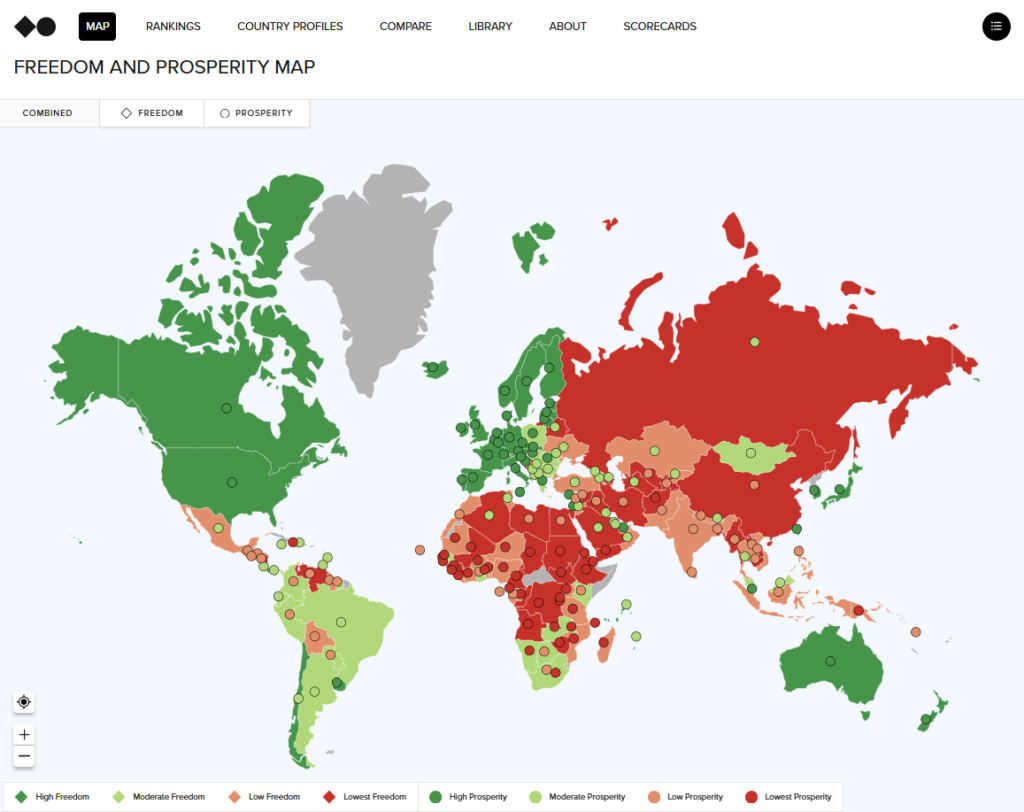
The Indexes rank 164 countries around the world. Use our site to explore thirty years of data, compare countries and regions, and examine the subindexes and indicators that comprise our Indexes.
Stay Updated
Get the Freedom and Prosperity Center’s latest reports, research, and events.
Stay connected
Read all editions
2026 Atlas: Freedom and Prosperity Around the World
Against a global backdrop of uncertainty, fragmentation, and shifting priorities, we invited leading economists and scholars to dive deep into the state of freedom and prosperity in ten countries around the world. Drawing on our thirty-year dataset covering political, economic, and legal developments, this year’s Atlas is the evidence-based guide to better policy in 2026.
2025 Atlas: Freedom and Prosperity Around the World
Twenty leading economists, scholars, and diplomats analyze the state of freedom and prosperity in eighteen countries around the world, looking back not only on a consequential year but across twenty-nine years of data on markets, rights, and the rule of law.
2024 Atlas: Freedom and Prosperity Around the World
Twenty leading economists and government officials from eighteen countries contributed to this comprehensive volume, which serves as a roadmap for navigating the complexities of contemporary governance.
Explore the program
The Freedom and Prosperity Center aims to increase the well-being of people everywhere and especially that of the poor and marginalized in developing countries through unbiased, data-based research on the relationship between prosperity and economic, political, and legal freedoms, in support of sound policy choices.
Image: Photo by jean wimmerlin on Unsplash
Keep up with the Freedom and Prosperity Center’s work on social media