
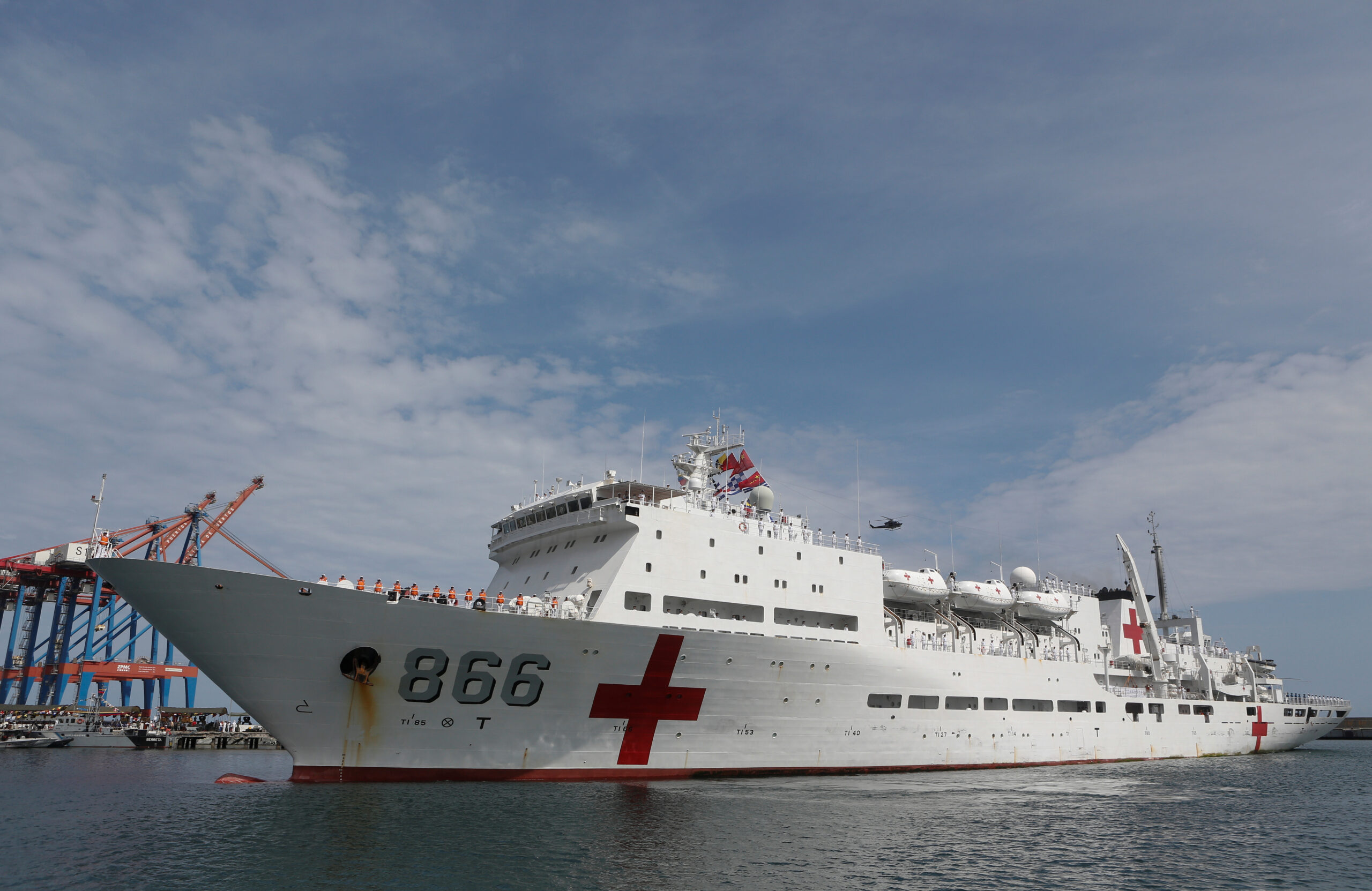
BRASÍLIA—Brazil’s decision to allow a Chinese military hospital ship to dock in Rio de Janeiro could provide a case study of how Beijing is expanding its naval presence in the Western Hemisphere. It also demonstrates how regional powers are dealing with the pressures arising from the intensifying competition between the United States and China.
This past fall, China requested authorization from the Brazilian government for the People’s Liberation Army Navy hospital ship Ark Silk Road to dock in Rio de Janeiro from January 8 to 15. The request seemed, at first glance, to be just another routine stop on a humanitarian mission.
But in Brasília, the request triggered unusual discomfort. The Chinese diplomatic note, sent on September 15 last year, omitted any reference to Harmony Mission 2025, Beijing’s first global humanitarian naval operation. And it offered few details beyond a statement that no research activities were planned in Brazilian waters and that the vessel would not use any radio equipment. In fact, the note did not explain why the ship wanted to dock in Rio de Janeiro at all.
The lack of clarity raised concerns within Brazil’s Ministry of Foreign Affairs and among some Brazilian Navy officers who spoke with me on the condition of anonymity. These officials were especially concerned because of the geopolitical context that served as the visit’s backdrop: China’s growing presence in a region traditionally perceived by Washington as part of its security sphere, just as the Trump administration is prioritizing Latin America and asserting itself with military force to impose its interests there.
Brazilian officials’ concerns over the Ark Silk Road, which have so far been raised only behind the scenes, highlight a structural tension in the country’s foreign policy: Brazil is economically dependent on China but has maintained a solid security partnership with the United States for decades. This duality is currently on full display. The US oceanographic vessel Ronald H. Brown is scheduled to dock at the Port of Suape, in northeastern Brazil, from January 14 to 21, for a scientific mission approved by the Navy General Staff. This means the US Navy mission will overlap with that of the Ark Silk Road, which arrived in Rio de Janeiro on January 8 as scheduled.
The coincidence of these maritime visits makes Brazil a reluctant arena for US-China competition. But it also offers Brazil an opportunity to demonstrate that the country wishes to act as a partner to both powers, without allowing itself to be instrumentalized by either of them.
Instrument of power projection
The Ark Silk Road is the second-largest ocean-going hospital ship designed and built by China. Weighing ten thousand tons and equipped with fourteen clinical departments, seven diagnostic units, and the capacity to perform more than sixty types of medical procedures, the ship is among the most visible faces of Chinese “smart power”: the deliberate combination of soft power and hard power that China’s defense doctrine increasingly relies on.
The humanitarian results so far, according to statistics publicized by Chinese officials, are impressive:
- 3,330 patients treated in Fiji, with 426 surgeries in just one week;
- 3,995 local patients treated, 679 surgical procedures, and 2,718 medical tests in Tonga;
- 771 consultations and 177 surgeries in Montego Bay, Jamaica, weeks after Hurricane Melissa devastated the country;
- 2,769 local patients treated and 207 surgeries completed in only three days in Kingston, Jamaica.
The Ark Silk Road, or the “ship of hope and envoy of peace” as Chinese authorities describe it, represents smart power in its purest form: It projects benevolence and technical capability, but this humanitarian narrative coexists with clear strategic calculations.
When I spoke with Rafael Almeida, a retired Brazilian Army colonel and defense and strategy analyst who holds a master’s degree from the National Defence University of China, he suggested that the Ark Silk Road’s capabilities extend well beyond medical functions for a hospital ship. For instance, he pointed to the ship’s unusually large number of sensors, antennas, and radar systems.
The ship’s itinerary included stops in need of humanitarian assistance, but it was also carefully designed with diplomacy in mind: With the exception of Mexico and Brazil, all of the Latin American countries included in the mission are part of China’s Belt and Road Initiative. In some countries, such as Nicaragua, the ship was received with military honors. The Nicaraguan National Assembly formally approved the ship’s visit as part of an exchange with its national army, marking the first time the People’s Liberation Army Navy has docked in the country.
The implicit message is unequivocal: China is gradually expanding its naval presence in the Western Hemisphere, and it is doing so under the banner of a humanitarian ship.
The South Atlantic enters the geopolitical arena
The Ark Silk Road’s passage along the Brazilian coast is occurring in an increasingly disputed region. In recent months, Washington has reinforced its presence in the Caribbean, following the resurgence of tensions between the United States and the regime of Venezuelan leader Nicolás Maduro, which culminated in Maduro’s extraction and arrest on January 3.
But the United States’ maritime military actions have gone beyond its policy toward Venezuela. Since September 2, the United States has destroyed more than thirty vessels in dozens of attacks carried out in the Caribbean and the Pacific Ocean against ships that, according to the White House, were transporting narcotics, though the administration has not presented any conclusive evidence linking these boats to drug trafficking.
Meanwhile, the Chinese humanitarian mission in the South Atlantic highlights the region’s growing strategic importance. The Ark Silk Road normalizes the Chinese navy’s presence in areas it was seen as unlikely to operate in until recently. Additionally, China has invested in ports in these areas for years, especially the mega-port of Chancay in Peru. This investment reinforces Beijing’s logistical capacity on the Pacific coast of South America. With Beijing’s humanitarian missions now reaching the Caribbean and the Atlantic, an arc of Chinese strategic infrastructure, naval diplomacy, and political influence is emerging.
It is no coincidence that China released an official document explaining its policy toward Latin America and the Caribbean less than a week after the United States unveiled its latest National Security Strategy, which places Latin America at the center of US foreign policy concerns.
Brazil’s discomfort
China’s request for the Ark Silk Road to visit Brazil thus comes at a sensitive moment for Brazilian foreign policy. This timing, as well as the opaque nature of the request, have caused discomfort in Brasília.
When I reached out to Mauricio Santoro, a political scientist who specializes in Sino-Brazilian relations and collaborates with the Brazilian Navy’s Center for Political-Strategic Studies, he told me that Brazil does not require the kind of humanitarian support that China is offering to other countries with its mission. The Brazilian Navy has its own disaster response capabilities, Santoro noted, including the Multipurpose Atlantic Aircraft Carrier, the largest warship in Latin America. Moreover, Brazil’s United Health System is recognized as the largest public health system in the world. Free and universal, it serves a population of more than 200 million Brazilians.
But rejecting the Chinese request would have been politically and perhaps economically costly. China is Brazil’s largest trading partner and a significant investor in the country’s infrastructure. An explicit “no” could have been interpreted as a pro-Washington geopolitical signal.
Given these factors, Brazil opted to buy time for a few months, but in November authorized the Ark Silk Road to dock in Rio de Janeiro on the requested dates. The announcement was made with little fanfare. Unlike in other countries in which the Ark Silk Road has operated, the Brazilian government has not yet issued a public statement on the matter and has refused to answer questions about the visit.
When I reached out to ask questions about the Ark Silk Roads’s visit, the Brazilian government passed the buck. The Ministry of Foreign Affairs recommended that questions be directed to the Brazilian Navy and the Chinese embassy in Brazil. The Navy stated that it is only responsible for the technical and logistical aspects of the request. The Chinese embassy did not respond. I also contacted the Brazilian Ministry of Defense, which pointed me back to the Foreign Ministry. Documents obtained through the Access to Information Act confirm that official messages were exchanged only between the Ministry of Foreign Affairs and the Navy.
Even after the Ark Silk Road docked in Rio de Janeiro on January 8, the Brazilian government has not commented on the matter, in contrast to the Chinese Embassy in Brazil and the Chinese Consulate in Rio de Janeiro.
Meanwhile, the Regional Medical Council of Rio de Janeiro (CREMERJ) formally notified the state health department, requesting clarification as to whether the ship would be providing medical services to the local population. Citing Brazilian law and Federal Medical Council regulations, the CREMERJ emphasized that any medical act performed within Brazilian territory—even during humanitarian or diplomatic missions—must be subject to oversight. However, there is no official authorization for the Ark Silk Road to provide medical care to Brazilians.
An ‘embarrassing’ situation
On January 10, a Brazilian Navy delegation, led by Captain Gustavo Sant’anna Coutinho, chief of staff of the 1st Naval District Command, met with People’s Liberation Army Navy officers aboard the Ark Silk Road. Brazilian Navy musicians also performed on the ship’s deck. According to a senior Brazilian military officer I spoke with, the visit was accompanied by a series of confidence-building activities, including courtesy calls, invitations to tour the vessel, and a friendly football match at the Navy’s Physical Education Center. Beyond these engagements, the same officer told me, there was little substantive interaction, and the agenda remained largely routine—consistent with standard naval diplomacy.
However, this routine contrasted sharply with the level of control surrounding access to the vessel. Spontaneous visitors were not permitted. According to multiple sources I spoke with, entry required prior authorization from the Chinese consulate, and visitor lists closed in December. The Chinese Consulate General in Rio de Janeiro did not respond when I contacted it.
Despite these restrictions, the ship’s arrival was met with a visible public reception. Chinese citizens gathered at Pier Mauá to welcome the vessel, waving Brazilian and Chinese flags—scenes reminiscent of organized demonstrations during the 2025 BRICS summit in Rio de Janeiro. Brazilian media outlets have reported that similar groups at previous events were coordinated by intermediaries and accompanied by private security.
The tightly controlled access and carefully managed optics have fueled unease among some Brazilian military analysts and officers. Speaking on condition of anonymity, several of them described the visit to me as “embarrassing.” A Brazilian Navy officer told me that there had been pressure from Brazilian diplomats to ensure the Chinese were well received. However, the military did not know how to proceed since the visit had not been properly publicized.
Port visits routinely allow foreign navies to update their knowledge of port infrastructure, logistics, and coastal conditions. Such practices are common among long-established naval powers operating under bilateral frameworks. But according to Almeida, the retired Brazilian Army colonel, this marked the first time a Chinese military vessel conducted such an exercise in Brazil without a formal defense agreement in place.
Against this backdrop, Brasília’s refusal to provide more detail or otherwise draw attention to the Ark Silk Road’s docking, unlike several other countries on the itinerary, demonstrates that it is seeking maximum discretion to prevent any unwelcome geopolitical interpretations.
At the same time, this posture reflects an awareness that the convergence of Chinese and US naval presence creates a limited but significant opportunity for Brazil to reaffirm its longstanding preference for strategic autonomy. This means engaging both powers as partners, while making clear that such engagement does not amount to alignment and that Brazil does not intend to be instrumentalized in a dispute it did not choose.