
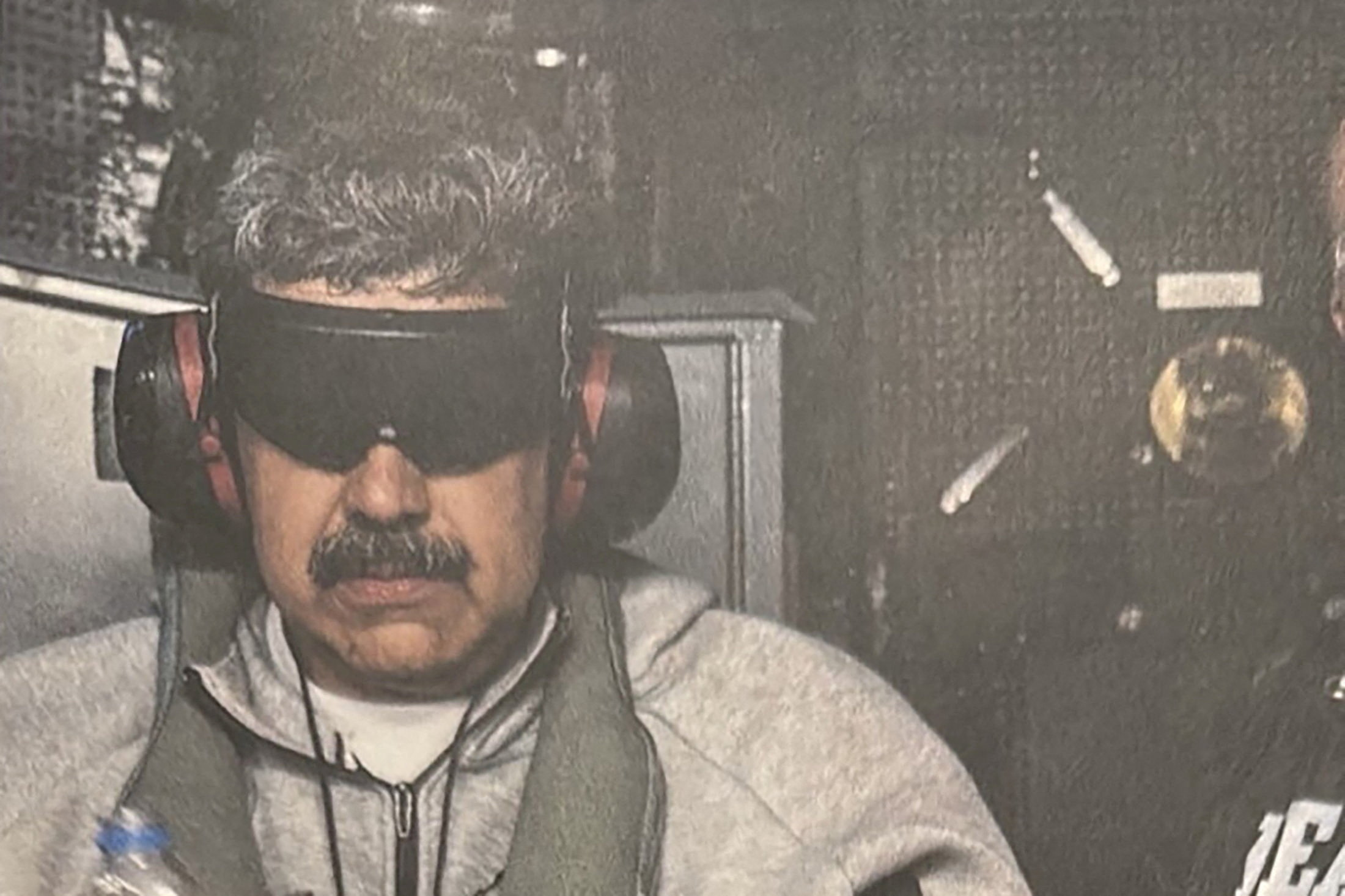
“We are reasserting American power.” That’s what US President Donald Trump said Saturday, hours after the US military launched a strike and raid on Venezuela that resulted in the capture of strongman Nicolás Maduro. The Venezuelan leader and his wife were moved to the USS Iwo Jima en route to New York, where Maduro has been indicted on multiple charges, including narcoterrorism. The US operation comes after months of pressure on the Venezuelan regime to halt drug trafficking and move the country toward democracy. “We are going to run the country until such time as we can do a safe, proper, and judicious transition,” Trump said.
So, what’s next for Maduro, Venezuelans, and US efforts in the region? Below, Atlantic Council experts share their insights.
Click to jump to an expert analysis:
Jason Marczak: The US needs to remain committed to a democratic transition
Matthew Kroenig: A win for regional security, the Venezuelan people, and the US military
Alexander B. Gray: This operation sends a signal to Beijing and Moscow
David Goldwyn: Opening up Venezuela’s energy industry will come down to the details
Celeste Kmiotek: The US strikes most likely fall afoul of international law
Iria Puyosa: Delcy Rodríguez cannot guarantee the stability Trump wants
Geoff Ramsey: The mission is not accomplished until Venezuelans get free and fair elections
Nizar El Fakih: Multilateralism failed Venezuela. But it failed long before today.
Tressa Guenov: Success will require years-long US diplomatic and economic efforts in Venezuela
Kirsten Fontenrose: Watching Venezuela from Tehran
Thomas S. Warrick: Maduro’s ouster will cause shock waves in the Middle East
Alex Plitsas: Three scenarios for what could come next
The US needs to remain committed to a democratic transition
Many Venezuelans are hopeful that today marks the beginning of a new era. The removal of Nicolás Maduro from power is a reality that Venezuelans in the country and the nearly eight million forced to flee under his regime have long sought.
Here are three key takeaways from the operation:
First, this is the most consequential moment in recent Venezuelan history—and for the broader Latin American region. Trump’s Saturday announcement made it clear that this operation goes beyond a simple extradition: It is a regime-change effort. Maduro is now en route to New York City to face criminal charges, but the United States intends to “run the country” until “a safe and judicious transition” takes place. That means Delcy Rodríguez, Maduro’s vice president, cannot simply take power and continue his policies. In assuming the presidency, she is constitutionally obligated to hold elections within thirty days. But remember, there was a prior election in July 2024 which opposition leader Edmundo González won, according to released vote tallies.
Second, the US military operation is the start—not the end—of a new level of direct US engagement in Venezuela. Trump confirmed that a team has been designated to run Venezuela, with key figures such as Secretary of State Marco Rubio engaging with Rodríguez. While US forces are expected to provide security around critical infrastructure, broader public security and the protection of citizens remain pressing challenges in a country plagued by gangs, paramilitary groups, guerrillas, and transnational cartels. Hundreds of political prisoners still remain locked up, with their fate of top importance.
Third, today’s actions are the first concrete deliverables of Trump’s new National Security Strategy with its heavy emphasis on the Western Hemisphere. And the president has made it clear that future US operations in the region are fair game as well. Trump mentioned Colombia and Cuba as countries whose leaders should now know the consequences of not cooperating with the United States.
Fourth, the United States now bears responsibility for the eventual outcome in Venezuela. The challenge will be ensuring a “safe and judicious transition” in a country where many entrenched actors are likely to resist meaningful change, but where real change is fundamental to US interests and to the Venezuelan people.
Some commentators are arguing that the strike is illegal under international law. I am not a legal expert, but it’s worth noting that even though heads of state do enjoy immunity from prosecution under international law, few world leaders recognize Maduro as a legitimate head of state. Since 2019, the Organization of American States, the premier multilateral body for the hemisphere, has refused to recognize Maduro as president following that year’s stolen elections.
—Jason Marczak is vice president and senior director at the Atlantic Council’s Adrienne Arsht Latin America Center.
A win for regional security, the Venezuelan people, and the US military
There are five winners of the successful US operation to remove Maduro from power in Venezuela:
- US, regional, and global security. The world is better off without an anti-American dictator who traffics narcotics, prompts irregular migration flows, and provides a foothold to the “axis of aggressors” (China, Russia, and Iran) in the Western Hemisphere.
- The Venezuelan people. They now have the opportunity for a better government and a freer and more prosperous future.
- US military power. This shows that the US military is still the finest fighting force in the world and may help Washington find its confidence and get over its Iraq-Afghanistan hangover.
- Special operations forces. They have been eager to show higher-level officials in Washington that they are still relevant after the war on terror—and indeed even more so now.
- Trump’s foreign policy. This is a dramatic foreign policy victory, among the top three of the first year in Trump’s second term, alongside degrading Iran’s nuclear program and increasing NATO defense spending.
—Matthew Kroenig is vice president and senior director of the Atlantic Council’s Scowcroft Center for Strategy and Security and the Council’s director of studies.
This operation sends a signal to Beijing and Moscow
The “Trump Corollary” to the Monroe Doctrine, as outlined in the 2025 National Security Strategy, is officially in effect. Just days after the Chinese People’s Liberation Army was reported to be war-gaming combat operations in the Western Hemisphere, and a new official Chinese strategy for Latin America refused to recognize the region as of special significance to US security, Washington has demonstrated a long-overdue commitment to hemispheric security.
The Trump administration’s removal of Maduro from power in Venezuela is not simply a message to antagonistic regimes in the hemisphere, like Cuba and Nicaragua; it is a global reestablishment of deterrence that will be seen in Beijing and Moscow as an unambiguous sign of the Trump administration’s commitment to a security order compatible with American interests.
Going forward, the administration has a unique opportunity to build upon the success of its pressure campaign against Maduro to reestablish overwhelming US strategic predominance in the hemisphere, including by tacitly shaping a post-Maduro settlement that ensures extra-hemispheric powers like China and Russia are excluded from meaningful influence in Caracas. The success of this operation creates a once-in-a-generation opportunity for Washington to translate its security preferences into strategic reality.
—Alexander B. Gray is a nonresident senior fellow with the GeoStrategy Initiative at the Atlantic Council’s Scowcroft Center for Strategy and Security. Gray most recently served as deputy assistant to the president and chief of staff of the White House National Security Council.

Opening up Venezuela’s energy industry will come down to the details
From an energy perspective the key questions will be who governs the country, the timeline and nature of a transitional government, the security situation in the country at large and in the oil production sites and ports, and if the US government modulates the sanctions regime and the blockade to financially support a potential transitional government. At this writing, Trump has declared that the United States will run the country until the situation is stabilized, and he declined to endorse González. Trump also asserted that US oil companies would return to Venezuela.
It remains to be seen whether there will be resistance from loyalists of the regime and remaining members of Cuban intelligence. Few US companies are likely to return to the country until there is a reliable legal and fiscal regime and stable security situation. Companies that have existing operations are much more likely to revive and expand them if the environment is secure.
It is highly uncertain how the US administration will approach exports and management of those revenues. It could allow oil currently on tankers to be exported, expand licensing, and permit Venezuela to sell oil at market prices, all for the purpose of maximizing national revenue. It is also possible that those revenues would go into a blocked account for the benefit of a new Venezuela government.
But for now, we have no details about how these fiscal and legal arrangements will evolve. Until there is clarity on sanctions and licensing and more information on who is actually managing the central bank and ministry of finance, the prospects for Venezuelan oil production and exports will remain uncertain.
—David Goldwyn is president of Goldwyn Global Strategies, LLC, an international energy advisory consultancy, and chairman of the Atlantic Council Global Energy Center’s Energy Advisory Group.
The US strikes most likely fall afoul of international law
Maduro oversaw a brutal regime engaged in violent human rights violations against Venezuelan citizens. Regardless of this, the US strikes on Venezuela were illegal under international law.
The United Nations (UN) Charter forbids use of force against a state’s “territorial integrity or political independence,” with exceptions permitted for self-defense and Security Council authorizations. Self-defense requires that the force used be necessary and proportional, and that the threat be imminent. None of these conditions appear to have been met. As such, the attacks appear to fall under Article 3(a) of the UN General Assembly’s definition of the crime of aggression. This provision is customary, meaning it is binding and applies regardless of US arguments that the actions are legal under domestic law.
The use of force also marked the onset of an international armed conflict between the United States and Venezuela, triggering the applicability of international humanitarian law. While so far most targets appear to have been military, Trump threatened a second “and much larger” attack “if needed.” Trump’s announcement that the United States will “run” Venezuela and may deploy forces also raises alarms around potential occupation.
Finally, as sitting head of state, international law affords Maduro full personal immunity under domestic courts—including in the United States. Since 2019, the United States and other countries have not recognized Maduro as head of state, in response to widespread election fraud, and he is widely considered an illegitimate ruler. However, as argued by the French Cour de Cassation, this immunity should apply regardless of whether a state recognizes a head of state’s leadership—precisely to prevent politically motivated arrests.
While Maduro must be held accountable for the human rights violations he has inflicted, the United States’ unlawful actions must be condemned. Allowing such precedents to go unchallenged will further undermine respect for international law, state sovereignty, and civilian protections.
—Celeste Kmiotek is a senior staff lawyer for the Strategic Litigation Project at the Atlantic Council.
Delcy Rodríguez cannot guarantee the stability Trump wants
The US decapitation operation against the autocratic regime that ruled Venezuela for over twenty-five years—first led by Hugo Chavez, then by Maduro—marks the beginning of the restoration of democracy in the country. The regime was unable to mount any effective defensive military actions. Its usually strong communication apparatus failed catastrophically during the first twelve hours following the US operation to take Maduro from his residence inside Fuerte Tiuna, the principal military base of the Venezuelan army. The military command-and-control chains were clearly disrupted.
Venezuelans are eager to reclaim their country and restore democracy. There is hope that González—who was rightfully elected president in 2024—will soon take the oath, and many trust that María Corina Machado will successfully lead the transition process, which may take months or even years. The second-in-command figure in the regime, Rodríguez, who was sworn in today to take Maduro’s place, does not appear to have the backing of all factions within the ruling party. Rodríguez cannot guarantee the stability required for the business operations Trump emphasized several times during his remarks on the operation. Chavismo no longer enjoys the widespread popular support it had two decades ago.
The Venezuelan people who have fought nonviolently against a highly repressive regime for over two decades will continue their struggle until freedom and democracy are fully restored.
—Iria Puyosa is a senior research fellow at the Atlantic Council’s Democracy+Tech Initiative. Puyosa was previously an associate professor at the College of Social Sciences at the Central University of Venezuela.
The mission is not accomplished until Venezuelans get free and fair elections
With Rodríguez appearing on state television Saturday afternoon and convening a “National Council in Defense of the Nation” made up of every heavyweight in the ruling party, it seems likely that she is indeed serving as the country’s de facto leader—for now.
While she claimed that Maduro remains “the only president,” called for his release, and said that Venezuela would never be “a colony of any empire,” she also noted that the Supreme Court will be reviewing a national emergency decree signed by Maduro as his last executive act. This points to further announcements to come, in which Rodríguez will almost certainly claim that she is now the country’s interim leader.
Whoever emerges on top of the power struggle in Caracas, it is fundamental that the United States use its considerable leverage to incentivize a roadmap for a transition. It is essential that the Venezuelan people are presented with a credible plan for free and fair elections, the release of political prisoners, and a path toward economic recovery. The United States can help pave this path by offering gradual, phased sanctions relief in exchange for verifiable progress toward democratization.
It is logical for the United States to advance its own energy, migration, and broader geopolitical interests in Venezuela, but US policymakers should not consider their mission accomplished until Venezuelans’ fundamental right to elect their own leaders is restored.
—Geoff Ramsey is a nonresident senior fellow at the Atlantic Council’s Adrienne Arsht Latin America Center.
Multilateralism failed Venezuela. But it failed long before today.
Many today are emphasizing the importance of multilateralism and warning about its erosion as a result of the unilateral US actions in Venezuela. But the reality is different: Multilateralism in the face of the Venezuelan crisis did not fail today—it failed years ago.
That failure—resounding, stark, and undeniable—is measured in millions of exiles, many now undocumented or living in precarious conditions across dozens of countries, constituting one of the largest forced displacements in the world without a conventional war or internal armed conflict. It is measured in millions of families torn apart by a regime that systematically destroyed its own society: opposition parties dismantled, dissidents disappeared, deaths under custody, widespread torture, the mass closure of independent media, expropriations that crippled the productive economy (years before any international sanction), hyperinflation that impoverished millions of working families, and sustained repression.
Meanwhile, diplomacy and multilateral institutions proved unable to deliver a single effective negotiation process leading to an orderly, peaceful, and negotiated transition—despite years of appeals by millions of Venezuelans who voted, protested, and exhausted every available civic mechanism at enormous personal cost.
And international justice? The International Criminal Court, with an investigation open since 2021, has yet to issue a single indictment—despite extensive documentation of crimes against humanity by the United Nations Fact-Finding Mission on Venezuela, Human Rights Watch, Amnesty International, and hundreds of victims. Their testimonies provided detailed accounts of a sophisticated, systematic, and nationwide apparatus of repression designed to crush dissent that has been operating in the country for several years under this regime.
Looking ahead, a central concern among Venezuelans—both inside and outside the country—is whether stability will follow, and what political order will emerge from the vacuum left by Maduro, particularly given the competing factions within the former regime. What is clear is that Venezuelans expressed their will at the ballot box: In the July 2024 presidential election, the opposition—led by González and Machado—won decisively, a result the Maduro government refused to recognize, further deepening the crisis that culminated in today’s events.
Any sustainable transition will require that this legitimate leadership, with broad and demonstrable support inside Venezuela, be empowered to lead a democratic transition through a credible and legitimate process.
—Nizar El Fakih is a nonresident senior fellow with the Strategic Litigation Project at the Atlantic Council.
Success will require years-long US diplomatic and economic efforts in Venezuela
While it’s far too soon to know Venezuela’s ultimate disposition following today’s operations, we do know that Trump says that the United States will essentially “run” the country for now. Trump has prided himself on touching many conflicts around the world—from those between Rwanda and the Democratic Republic of the Congo and Azerbaijan and Armenia to Gaza and Ukraine—quickly claiming several as resolved. But one thing the administration has yet to prove in nearly all cases, especially Venezuela, is whether it has the sustained attention span for the years-long diplomatic and economic efforts required to bring societies out of chaos and repression.
Even a short-term endeavor of running Venezuela will cost significant US military and taxpayer resources. It will also require real diplomatic finesse to ensure that the United States remains a credible leader in the region, which has now become the centerpiece of US national security strategy. Meanwhile, China will likely continue its lower-key but serious commitment to economic development in Latin America and elsewhere around the world.
Venezuela will be a test of Trump’s strategy for US dominance in the region and whether his collective peace and security efforts—from Caracas to Kyiv—can result in real strategic advantages for the United States. The alternative would be a stack of unfinished US projects that leave real lives affected in the wake.
—Tressa Guenov is the director for programs and operations and a senior fellow at the Scowcroft Center for Strategy and Security at the Atlantic Council. She previously served as the principal deputy assistant secretary of defense for international security affairs in the Office of the Under Secretary of Defense for Policy.
Watching Venezuela from Tehran
From a technical and military standpoint, the US operation in Venezuela signals to Iran that Washington is increasingly confident operating against Russian-derived, layered air-defense architectures without needing to dismantle them through a prolonged, overt suppression of enemy air defenses (or SEAD) campaign. Venezuela’s inventory—anchored by S-300VM, Buk-M2, and point defenses such as Pantsir-S1, supported by Russian and Chinese radars—closely resembles the architecture Iran fields around critical sites. Yet the US operation appears to have achieved its objectives without forcing visible air-defense engagement.
Available reporting suggests the US operation evaded detection and engagement by leaning on standoff effects; persistent intelligence, surveillance, and reconnaissance (ISR); electronic attack; and compressed timelines. Under such conditions, systems like Buk and Pantsir may never generate a usable firing solution, while high-value S-300-class assets become difficult to employ without sustained targets, clear attribution, and political authorization. The issue is not only theoretical capability, but whether layered defenses can meaningfully influence outcomes during brief, tightly sequenced operations.
This reinforces a broader pattern Iran will recognize. Russian air defenses have struggled to impose decisive effects in other theaters—including Syria, where Israeli strikes have repeatedly penetrated layered systems, and Ukraine, where Pantsir, Buk, and S-300 variants have suffered attrition under modern ISR-strike cycles.
Equally relevant is the diplomatic dimension. In Venezuela, as with Iran, US military action coincided with standing diplomatic offers—sanctions relief, normalization steps, and elements of proposed deals—kept on the table before and during the use of force. The combined signal to Tehran is that neither reliance on Russian air defenses nor the slow-rolling of US proposals necessarily alters the pace or structure of US action.
Recent US strikes in Nigeria send a reinforcing signal. There the United States acted without prolonged warning or phased escalation, using remote airstrikes supported by the Nigerian government. These operations underscore a reduced tolerance for drawn-out escalation dynamics and a preference for short-duration, outcome-oriented use of force.
For Iran, the relevance lies not in the specific targets or theaters, but in the demonstrated willingness of the United States to move decisively once thresholds are crossed.
—Kirsten Fontenrose is a nonresident senior fellow at the Scowcroft Middle East Security Initiative in the Atlantic Council’s Middle East Programs. She was previously the senior director for the Gulf at the National Security Council.
Maduro’s ouster will cause shock waves in the Middle East
The success of Trump’s bold operation to remove Maduro will cause global shock waves, including in the Middle East. Saturday’s successful operation puts Trump’s “locked and loaded” message on Friday to Iran’s leaders in a different perspective. However, the Venezuelan operation took months of planning, and there are no signs that the United States has the capability, or the intention, to pull off something similar in Iran.
Still, as a demonstration of Trump’s willingness to back months of rhetoric against Maduro with dramatic—and effective—action, Saturday’s operation should concern Iran’s leaders. Those who know their history—and the Trump administration has some like Sebastian Gorka who do—will remember that in 1956 the United States failed to follow up on its encouragement of Hungarian protesters against Soviet rule. The Trump administration ought to be aware of the dangers of vague rhetoric that cannot be followed up with action. Trump’s words to Iran and the Middle East in the coming weeks need to be made with steely-eyed capability and intention.
—Thomas S. Warrick is a nonresident senior fellow in the Scowcroft Middle East Security Initiative and a former deputy assistant secretary for counterterrorism policy in the US Department of Homeland Security.
Three scenarios for what could come next
The US operation to capture Maduro and transfer him to stand trial in the United States on criminal charges dating back to 2020 marks a decisive inflection point for Venezuela. What follows will hinge less on Washington’s next move than on the calculations of the regime’s remaining power brokers, military commanders, intelligence chiefs, and political enablers who are now confronted with a stark choice: negotiate an orderly exit or risk annihilation alongside a collapsing system.
In the best-case scenario, Maduro’s arrest catalyzes elite defection. Faced with legal exposure, sanctions, and loss of patronage, regime underlings could seek guarantees for safe passage, limited amnesty, or third-country exile in exchange for transferring authority to the legitimately elected opposition. Such a negotiated handover would avert mass violence, stabilize institutions, and open a narrow but viable path toward economic recovery and international reintegration.
Another scenario is that the United States has been working secretly with elements of the Venezuelan government who will take over.
The worst-case scenario is far darker. If regime remnants reject negotiation and fragment, Venezuela could descend into a protracted guerrilla conflict. Armed colectivos, criminalized military units, and narco-linked factions could wage asymmetric warfare, turning parts of the country into contested zones and prolonging civilian suffering long after the regime’s formal collapse.
—Alex Plitsas is a nonresident senior fellow with the Scowcroft Middle East Security Initiative, the head of the Atlantic Council’s Counterterrorism Project, and a former chief of sensitive activities for special operations and combating terrorism in the Office of the Secretary of Defense.