How to equip Canada’s defense industrial base to meet NATO’s Hague summit commitments
Bottom lines up front
- In 2025 Canada met NATO’s target of spending 2 percent of GDP on defense for the first time and committed to the new target of 5 percent by 2035, but its defense industrial base will struggle to deliver in its current state.
- Canada will need to grow its defense industrial base through consistent and predictable contracts, streamline the procurement process, and develop expertise in niche markets such as specialized Arctic capabilities.
- Canada is diversifying its defense industrial partnerships globally, particularly with European partners—a logical step and one to build on.
At the June 2025 NATO summit in The Hague, allies committed to spend 5 percent of their GDP on defense, with 3.5 percent focused on core defense and 1.5 percent on related defense expenditures. Canadian Prime Minister Mark Carney says his country is committed to reaching NATO’s new defense spending target of 5 percent of GDP by 2035—and his government is also on track to meet the previous 2 percent target for the first time by spending an additional C$8.7 billion ($6.58 billion) this fiscal year (which ends in March 2026). Canada has struggled to meet NATO goals in the past. In 2023, it failed to meet both of NATO’s defense spending targets of 2 percent of GDP on defense and 20 percent of that spending allocated for research, development, and equipment.
Although there is now support for increased defense expenditure at the highest levels of government, Canada has underinvested in its defense industrial base for decades and will need renewed focus, resources, and support to meet the country’s Hague commitments. How will Canada’s defense industrial base adapt to meet the current moment? Carney has put forward the bold claim that “Canada is meeting this moment with determination and resolve—modernising our defence capabilities, strengthening our industrial base, and reaffirming our role as a reliable partner in global security.” But what must its defense industrial base do to match this commitment?
In late 2025, the Atlantic Council’s Transatlantic Security Initiative hosted a workshop with government officials, academic experts, and participants from the public and private sectors of Canada, the United States, and Europe. The insights gathered from these conversations helped inform this issue brief, which assesses challenges, recommendations, and opportunities for Canada’s defense industrial base in an era defined by multiple conflicts and increased coordination by adversaries.
Canada’s defense industry at a crossroads
Canada has an extensive list of military equipment it needs to either produce domestically or purchase internationally, such as new warships, submarines, coastal defense vessels, fighter aircraft, and surveillance aircraft. This new equipment is needed for both national defense and to modernize Canada’s military to meet the current threat environment. In addition to renewing its leadership of the multinational NATO forces in Latvia, Canada has needed to strengthen its military capabilities along its three seas: in the Atlantic, Pacific, and Arctic Oceans. This comes at a time when Canada is also juggling bilateral border security cooperation and engaging in a major renewal of North American Aerospace Defense Command (NORAD) in close cooperation with the United States.
Central to Canada’s defense industry is its reliance on the US market and US companies, which supply much of Canada’s defense needs. Carney has often noted that one challenge facing Canada’s defense industry is that approximately 75 cents of every dollar in capital spending on defense winds up going to firms based in the United States. The relative size of the Canadian defense industrial base and its ability to compete internationally for contracts remain concerns as new funding flows to industry at an unprecedented rate.
For the first time, Canada’s military is poised to receive additional funding through the new federal budget and facing “the uncomfortable position of having so much cash it will be hard to keep up.” This represents a dramatic mindset shift for the military, which has had to cope with deficits of people, equipment, training, and sustainment. Now, with more funding allocated for defense, the hard work begins as Canada tries to use that funding effectively to address gaps in equipment, personnel shortages, and better training opportunities for its military.
With this increased available funding, the question matters of Canada’s procurement process and how to adapt it to meet the current moment. Canada’s procurement process, sometimes described as “glacial,” has received more attention lately and has a new agency focused on eliminating waste and accelerating the process. At the same time, Canada should recognize the constraints it faces regarding the size and scope of its defense industry; it should instead focus on niche areas in which it can excel, such as the maritime or Arctic domains. Many hurdles remain for Canada to meet the current moment, including personnel shortages in both the Canadian Armed Forces and industry roles. The Canadian Armed Forces (CAF), in its army modernization report, outlines the challenges facing the CAF to modernize, with at least another fourteen thousand recruits needed to meet the current security environment.
Recommendations for the Department of National Defence
1. Create consistent and predictable defense contracts for industry
A frequent refrain from industry is that the lack of consistency and predictably about defense contracts makes it challenging to scale and expand. A stable defense industrial base can foster innovation and address evolving challenges facing Euro-Atlantic security. The Canadian defense industry contributes about $10 billion annually to the economy and supports an estimated eighty-one thousand jobs. By investing in its domestic defense industry, niche capabilities, and evergreen infrastructure in the near term, the Canadian government can not only meet its NATO commitments but also expand job growth and economic performance. The long-term timeline for this investment in Canada’s defense industrial base will be key—Carney leads a minority government and this inevitably leads to a degree of uncertainty about long-term government commitment. Canada’s defense industrial base will not be able to meet the current moment with a one-off surge in available funding; it requires consistent and predictable funding over a longer-term horizon.
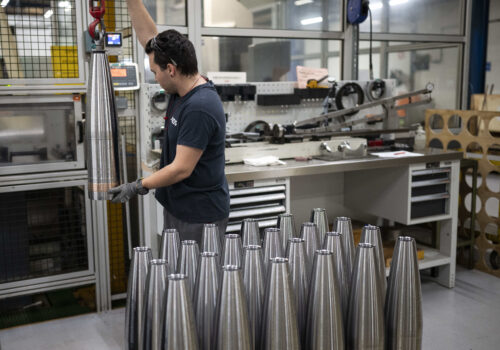
To get a sense of the importance of consistent and predictable defense contracts, look no further than the Canadian Patrol Submarine Project (CPSP) modernization process. Canada has been in the market for a new submarine fleet that is deployable in the Arctic with extended range and endurance. Two qualified suppliers—a German company and a South Korean company—will work with the Canadian maritime and defense sectors to deliver new submarines by 2035. So far, there is no project budget for this initiative, leading to uncertainty from an industry perspective. The Justin Trudeau government frequently made promises about defense spending that failed to materialize. The Parliamentary Budget Office recently quantified past underspending: between 2017 and 2023, efforts to buy new equipment fell short by C$18.3 billion. Ammunition producers claim they need at least C$800 million to open new production lines. Ultimately, for industry to respond to government decisions regarding its defense and security needs, a level of consistency and predictability must be provided, which has been a challenge for Canada’s defense industrial base in the past.
2. Streamline and strengthen the procurement process
If defense spending is now a given, the question then turns to how the Canadian Armed Forces will acquire the materiel they need. On October 2, Carney announced the formation of a new agency, the Defence Investment Agency (DIA), to facilitate and accelerate the defense procurement process. The procurement process had previously been fragmented across multiple departments, resulting in significant slowdowns in obtaining critical equipment. The DIA removes some of the red tape and redundancies with a centralized review and approval process. The agency has a specific aim to bolster Canada’s domestic defense industry, to empower Canadian companies to compete globally while also investing in dual-use capabilities. This will specifically address a frequent criticism that by the time equipment is delivered it is either out of date or unfit for the current mission. Additionally, the agency hopes to bridge the divide between industry and government by bolstering awareness on both sides of the timelines, costs, and expectations for equipment deliveries.
The formation of the DIA is the first step in an overdue streamlining and strengthening exercise for procurement. As the Canadian government seeks to foster innovation and create national champions in the defense space, it needs to continue bridging the divide between industry and government. Additional work can be done to ensure a role for Canada’s many small and medium-sized enterprises (SMEs) in its industrial base, which is critical to ensure agility and flexibility. The current conflict in Ukraine has demonstrated the significance of drones, but the next conflict might look very different and, in turn, might require industry to adapt to changing battlefield conditions. SMEs are better poised to adapt and pivot as technology evolves at a rapid pace and ensure Canada’s military is ready to respond to future conflicts.
3. Balance “Buy Canadian” with buying the right equipment for the mission
Despite the improvements to the procurement process, the Canadian Armed Forces still needs to ensure they are buying the best possible equipment for the mission. As the CAF seeks more expeditionary and proactive capabilities, this modernization effort places a premium on not just buying domestically but buying the best possible equipment. The prime minister’s new goal of focusing investment on domestic manufacturers will naturally come into conflict with the army’s modernization efforts if Canada’s defense industrial base cannot produce equipment to meet its operational needs. In turn, this decision to “Buy Canadian” will impact Canada’s ability to export its materiel and potentially raise barriers to other markets. Canada exports about half of the defense materiel it produces, with 63 percent destined for the United States and a further 12 percent to the Middle East and Africa. Striking the right balance between investing in its domestic industrial base and strengthening ties to international markets will be key to the long-term sustainability of Canada’s defense industrial base.
4. Strengthen ties with Europe
The conversation around bolstering Canada’s defense industrial base mirrors those conversations taking place in Germany, France, and elsewhere across Europe. Indeed, a deepening of Canada-Europe relations has been on display in the last year in response to the growing complexity of international conflicts and crises. This includes a landmark security and defense partnership between the European Union (EU) and Canada, which was agreed to in June 2025. This defense pact paves the way for the two to cooperate on cyber, maritime, and space security, and also opens the door to joint weapon procurement. Additionally, Canada has been proposed as a potential participant in the EU’s Security Action for Europe (SAFE) program, offering low-interest loans to accelerate procurement and investment in defense capabilities.
Diversifying and increasing the number of strategic partnerships globally, instead of over-relying on a single provider for its defense materiel, is a logical step to strengthen Canada’s defense industrial base—and also spurs innovation and supply chain resilience. Beyond the EU, Canada has sought to strengthen opportunities to collaborate with its fellow Five Eyes members, particularly the United Kingdom and Australia. The newly formed Canadian DIA aims to facilitate conversations with its counterparts in France, the United Kingdom, and Australia. Due to the similarity of their intentions to spend more on defense, Canada will have natural partners in European nations, as well as the EU more broadly.
5. Focus on doing a few things well rather than trying to do everything all at once
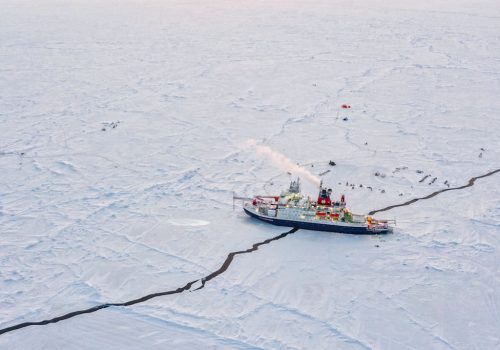
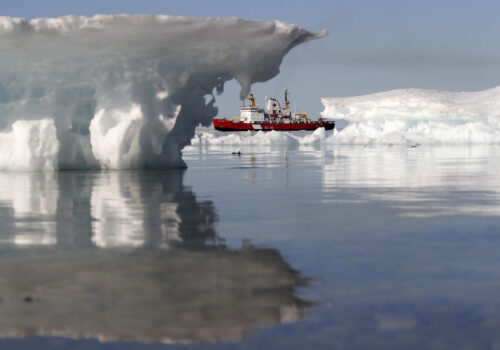
A consistent theme across the various challenges facing Canada’s defense industry—its size, speed, and reliance on the US market—can all be partially solved by specializing in a few niche areas rather than doing too much all at once. Three specific areas in which Canada has both urgent needs for development and the opportunity to specialize are: unmanned autonomous systems (aerial and underwater vehicles in particular); Arctic-specific technologies, including icebreakers; and maritime capabilities leveraging Canada’s three-ocean geography. The Arctic region emerges repeatedly as a unique domain in which Canada should invest more, for both its own national security purposes and for enhancing wider Alliance capabilities. Canada has the most icebreakers of any NATO ally and is working through the trilateral ICE Pact (with Finland and the United States) to build even more of these highly specialized vessels. Capitalizing on the dearth of icebreakers within NATO would give Canada a unique opportunity to leverage its Arctic capabilities to support its shipbuilding industry while enhancing Alliance capabilities in the Arctic.
Conclusion
Carney’s government is taking unprecedented steps to strengthen Canada’s armed forces, invest in the country’s industrial base, and reaffirm Canada’s role as a reliable partner within NATO and the wider global security context. While his government’s approach and announcements so far are laudable, Canada now must turn to the task of how to support and expand its defense industrial base to meet these goals. Without this foundation, Carney’s pledges will fail to translate into improved capabilities and will hinder attempts to modernize the CAF. Time is short, the amount of work ahead is significant, and history will remember how Canada meets the current moment and security environment.
About the authors

Related content
Explore the program
The Transatlantic Security Initiative aims to reinforce the strong and resilient transatlantic relationship that is prepared to deter and defend, succeed in strategic competition, and harness emerging capabilities to address future threats and opportunities.
Image: Photo by sebastiaan stam on Unsplash