
The economic and political traps awaiting aging societies
Bottom lines up front
- High-income and middle-income countries are approaching the same demographic cliff, with middle-income countries in line for a more abrupt contraction in the workforce supporting aging citizens.
- Low-income countries face a different set of challenges posed by a large group of economically inactive young people.
- The policies needed to address these problems will be politically difficult, and the longer policymakers wait to act the more decision space will narrow.
Demographic change is a critical variable affecting long-term economic development, including economic growth, capital accumulation, government budgets and debt, technology adaptation, and prosperity. Global demographic trends differ markedly, with some countries experiencing population stagnation or even decline, while other countries’ populations expand rapidly. Governments are not powerless in the face of the headwinds these demographic shifts produce. Mitigating the effects, however, of a shrinking working-age population in advanced economies and leveraging demographic expansion in developing economies will require far-sighted public policies.
Countries with declining working-age populations face significant challenges. Economically, the combination of low growth and increased government social spending creates financial pressures. Politically, demographic aging creates so-called “gray majorities” that can make it difficult for governments, particularly democratic ones, to enact the reforms necessary to maintain long-term financial stability. To the extent that voters view health and pension expenditures as acquired rights, political opposition to reform tends to be significant. Similarly, countries with a large share of young people may be more prone to political instability, particularly in the context of uneven economic growth and limited employment opportunities. These countries also often lack the ability to mobilize the resources necessary to invest in human and physical capital.
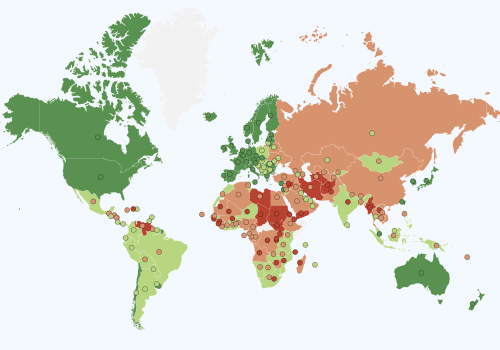
This issue brief is divided into three parts. First is an overview of demographic trends in advanced, emerging, and developing economies. These three groups of countries largely coincide with those identified in the Atlantic Council’s Freedom and Prosperity Indexes: high prosperity/high freedom, medium and low prosperity/medium and low freedom, and low prosperity/low freedom. Second is a discussion of the various economic, financial, and political challenges faced by the three groups, followed finally by high-level recommendations to cope with the economic challenges of demographic change.
Demographic change in advanced, emerging, and developing economies
When discussing the impact of demographic change on prosperity, it is helpful to divide countries into three categories: advanced economies (or high-income countries), emerging economies (or middle-income countries), and developing economies (or low-income countries). Demographic trends in advanced, emerging, and developing economies differ markedly, leading to different economic and political challenges. The median age in high-, middle-, and low-income countries is forty, thirty, and twenty years old, respectively.
Advanced economies are characterized by high per capita income, slow economic growth, and a rapidly increasing elderly population. (See Figure 1.) In some cases, even the overall population is declining after decades of below-replacement fertility rates. (See Figure 2.) Where the overall population continues to increase, it is often due to net immigration. The so-called old-age dependency ratio—the share of people over sixty-five relative to the working-age population—averages thirty in advanced economies, meaning that for every person of retirement age there are roughly three people of working age. In Japan, a demographically very advanced country, the ratio is currently fifty, meaning there are two people of working age for every person over sixty-five.
Emerging economies, characterized by middling per capita income but generally fair economic growth, are also aging, in some cases very rapidly (e.g., China). Their old-age dependency ratios, however, remain lower than those of most advanced economies. Until recently, emerging economies were in a demographic sweet spot as they experienced declining overall dependency ratios. Today, fertility rates have fallen to near or below replacement levels in many upper-middle-income countries, setting them up for what are likely to be rapid increases in their old-age dependency ratios over the next few decades. In advanced economies, this transition was comparatively gradual. In many emerging economies, the transition will be considerably faster. The related economic challenges will affect these countries more precipitously, if more predictably.
Developing economies have low per capita income and are characterized by young, growing populations. The variability of economic growth is significant within this group of countries, with some registering very rapid economic expansion, while others are experiencing stagnation, typically in the context of domestic civil strife and political instability. Like high old-age dependency in advanced economies, a high youth dependency ratio in developing economies translates into a large share of economically inactive youth relative to the working-age population. This in part helps explain low levels of savings and investment.
How demographic change affects prosperity
Favorable demographic momentum enhances a country’s economic potential. But there are many other factors that can affect economic outcomes, either favorably—sensible economic policy, strong human capital (e.g., high-quality schooling)—or unfavorably (e.g., political instability). The economic and financial outlook for each group differs markedly.
First, advanced economies have a significantly lower growth potential than emerging and developing economies. (See Figure 3.) Advanced economies grow less rapidly because they operate near the so-called technological frontier. By comparison, emerging and developing economies find it easier to generate productivity gains due to physical capital accumulation and the adaptation of existing technologies. In principle, developing economies are even more favorably positioned, but they often fail to fully exploit their potential catch-up growth because of political and economic instability.
Second, advanced economies are faced with adverse labor supply dynamics, compared to emerging and developing economies. An increasing old-age dependency ratio means the share of workers shrinks relative to older, economically inactive individuals. (See Figure 4.) According to the standard economic growth model, labor, in addition to capital and technology, contributes to economic output. Provided they are fully employed, expanding working-age populations will add to economic output, while a declining working-age population will subtract from it, all other things equal.
Third, advanced economies’ aging can affect the level of savings and hence investment and economic growth. As the share of economically inactive people—namely retirees, who do not produce but consume—increases, consumption tends to also increase and savings to decrease (relative to the baseline scenario where the old-age dependency ratio remains constant). This is akin to the life cycle hypothesis, which posits that savings peak in middle age. Indeed, the savings ratio in “middle-aged” emerging economies is significantly higher than in advanced and developing economies. (See Figure 5.) Of course, many other factors affect savings and investment in an economy, but an increasing old-dependency ratio should, all other things equal, reduce or at least limit savings, while a declining overall dependency should increase savings.
Fourth, advanced economies are, on average, characterized by high debt–to–GDP ratios and face significant increases in age-related government spending. (See Figure 6.) Social transfers and age-related spending (e.g., on health care and pensions) typically constitute the largest spending category in advanced economies. Moreover, advanced economies, and also some emerging economies, face large increases in age-related expenditures, as represented by the net present value of future pension and health care spending. By contrast, the government debt burden (measured as a share of GDP) in developing economies is typically lower, as is age-related spending. But while advanced and emerging economies have higher debt than developing economies, they also have a broader tax base, a more captive investor base, superior governance, and higher per capita income. Nonetheless, the financial challenges in the face of demographic change are significant in advanced economies; somewhat less significant, though rapidly increasing, in emerging economies; and virtually absent in developing economies.
Finally, distributional conflict is easier to manage in rapidly growing emerging economies than in slow-growing advanced economies, particularly in regard to age-related spending. It is more challenging to rein in spending or increase revenue in slow-growing economies, as a “pie” that is growing less rapidly makes distributional conflict more intense. In advanced economies especially, an expanding “gray majority” keen on defending acquired rights is electorally influential given its growing share of the voting population. By contrast, a rapidly expanding youth population can lead to instability (“youth bulge”). This also can make it harder to pursue a forward-looking policy consistent with long-term financial stability. Compared to advanced economies, emerging economies may find it easier to deal with distributional conflict given generally high economic growth rates as well as less pressure to rein in age-related spending. (See Figure 7.)
Policy recommendations
Demographic change will have a major impact on economic outlook and government finances, particularly in advanced economies and increasingly in many emerging economies. Developing economies also face demographics-related economic challenges. Following are high-level recommendations for coping with demographic change.
For advanced economies
Advanced economies faced with declining or slow-growing working-age populations, slow economic growth, and increasing government debt should do the following:
- Devise policies aimed at slowing and, if possible, reversing declines in fertility rates. Few if any countries have thus far proved successful at increasing fertility rates. Even countries with supportive childcare and education policies have seen their rates decline significantly (e.g., Scandinavia). It is worth experimenting with policies to prevent a further, potentially catastrophic decline.
- Pursue policies to prevent further decline in economic growth. Such policies include creating incentives for older workers to remain in the workforce for longer, if only part-time, and supporting the development and integration of productivity-enhancing technologies (e.g., AI). Higher growth will help make demographic aging slightly more manageable.
- Reduce upward pressure on age-related spending. Adjust benefits and make spending more targeted and efficient in addition to automatically adjusting expenditures for increases in longevity.
- Increase immigration to counteract an accelerating decline of the labor force and thus slow the increase in old-age dependency ratios. In view of political headwinds in many advanced countries, it is important to explain the benefits of immigration and put in place appropriate policies aimed at rapidly integrating immigrants economically, politically, and socially. Consider issuing temporary or conditional work permits and conduct recurrent cost-benefit analysis of various types of immigration based on economic needs (e.g., individuals with specific educational or professional backgrounds, like medical professionals to meet increased demand in healthcare sector).
For emerging economies
Emerging economies faced with a rapidly slowing demographic momentum, a fair economic growth outlook, and middling debt levels should avoid replicating the mistakes of advanced economies and do the following:
- Devise policies to sustain continued high economic growth. Individual policies will vary by country, as different economies face different challenges (e.g., China has a high rate of saving; Brazil’s is low). Economically closed countries can generate efficiency gains by way of trade liberalization or creating more attractive conditions for foreign investment.
- Attract high-quality, low-risk capital inflows from less rapidly expanding advanced economies. This requires a credible commitment to sensible economic policies and macroeconomic stability and favorable regulatory and attractive tax policies, among other things. Enshrining such commitments in difficult-to-change laws or constitutional law may prove helpful.
- Limit future age-related government spending in view of rapid demographic aging. Avoid making expenditure commitments that will put stress on government finances by, for example, tying contributions and expenditures to projected demographic developments before a politically strong gray majority capable of preventing forward-looking age-related policies emerges.
For developing economies
Developing economies have low savings rates due to a high youth dependency ratio, while a rapidly expanding young population creates economic and political challenges. To address this, they should do the following:
- Maintain and/or increase political and economic stability to exploit their considerable economic catch-up potential and reduce the incentives for skilled individuals to immigrate to high-wage economies where there is strong demand and both political stability and living standards are higher. Political and economic stability are likely to prove self-reinforcing.
- Mobilize greater fiscal and financial resources, including from abroad, to invest in infrastructure and education in order to increase physical and human capital and facilitate integration of young people into the formal economy.
- Pursue policies aimed at lowering the youth dependency ratio to enhance the economy’s savings potential. This should be done through incentives, ideally by providing women with better access to education and offering targeted, affordable age-related policies to reduce the incentives to have large numbers of children, particularly in poor, rural areas.
- Create conditions to facilitate the return of skilled emigrants through incentives, such as tax benefits. Emigrants often gain valuable economic experience and skills in their host countries. They can also help create transnational economic networks, allowing knowledge, skills, and even capital to move more easily between advanced and developing economies. The easier it is for emigrants to return to their country of origin, without forfeiting the right to reside in either country, the more likely they are to return or engage in economic activities in their home country.
About the author

Related reading


explore the data
Explore the program

The Freedom and Prosperity Center aims to increase the prosperity of the poor and marginalized in developing countries and to explore the nature of the relationship between freedom and prosperity in both developing and developed nations.
Image: Ryoji Iwata/Unsplash