In Iraq, China’s long game unfolds
Bottom lines up front
- As China seeks new markets abroad and energy security at home, Iraq has become integral to Beijing’s plans in the Middle East.
- Demographic and economic trends inside Iraq are pushing the country toward China.
- Because Baghdad remains reliant on US protection, it is likely to continue hedging between Beijing and Washington.
When it comes to the beginning of the China-Iraq relationship, there are a number of starting points. Some are framed within the longue durée and civilizational discourse favored by the Chinese and cherished by the Iraqis. For instance, in his March 15, 2023, speech introducing the Global Civilization Initiative, Chinese President Xi Jinping invoked ancient cross-cultural exchange as the foundation of China’s modern outreach. Chinese officials talk about Iraq in similar terms. When Cui Wei, China’s ambassador in Baghdad, visited a local research center, he opened by recalling that “our ancestors—more than two thousand years ago—built the ancient Silk Road for friendly communication with the countries of the world . . . As for Iraq, it is a shining pearl on the Silk Road, which left China and Iraq with good memories.” In this narrative, Abbasid-era trade brought Chinese papermaking, gunpowder, printing, compasses, silk, porcelain, and tea to Iraq and, through Iraq, to the wider Middle East and Europe. In return, astronomy, calendars, medicine, spices, and arts moved eastward into China. This semi-mythical view of the Silk Road allows Beijing to distinguish itself from Western powers and present its presence in Iraq as rooted in deep history rather than modern geopolitics.
Alongside this civilizational rhetoric sits an official diplomatic starting point, and these two stories are mutually enhancing. China recognized the Kingdom of Iraq in 1942, though ties remained limited. A substantive relationship emerged after the 1958 coup led by Abd al-Karim Qasim and the two countries formally established diplomatic relations on August 25, 1958. Beijing viewed Qasim’s coup as part of a broader anti-imperialist realignment and saw Iraq through the lens of Cold War polarization. The Iraqi Communist Party’s strength reinforced this perception. During this period, China’s embassy in Baghdad became a key hub for distributing Maoist literature, part of Beijing’s effort to export revolutionary ideology.
A third foundation of the two countries’ relationship is personal and ideological, as demonstrated through figures such as former Iraqi President Jalal Talabani and, later, Adil Abdul-Mahdi. Talabani visited China in 1955 and met Premier Zhou Enlai, seeking support for the Kurdish national movement in Iraq. China declined, and Talabani later recalled realizing that Beijing’s stance on national questions was incompatible with Kurdish aspirations. Despite this refusal, he remained drawn to Maoist thought. Material links also emerged early: During the Great Leap Forward famine, Iraqi dates became an important ration for Chinese households, a memory now invoked in cultural exchanges pairing Iraqi dates with Chinese tea. These civilizational, diplomatic, personal, and material strands gave China a multilayered story about its presence in Iraq and prepared the ground for the more strategic phase that followed.
The modern relationship: War, weapons, and debt
The modern China-Iraq relationship took shape in post-Mao China, especially during the 1980s. By the onset of the Iran-Iraq War, China had begun prioritizing economic development and external markets—priorities later embodied in the Belt and Road Initiative (BRI). But Beijing’s approach to the two countries and their conflict was never purely economic. Deng Xiaoping saw an opportunity to counter Soviet influence as Moscow appeared to pivot toward Tehran. According to historian Pierre Razoux, China pursued three goals: containing the Soviet Union, expanding markets, and maintaining a balance between the two belligerents.
In practice, Beijing discreetly armed Iraq while avoiding any outcome that might destabilize Iran. Chinese shipments included T-59 and T-69 tanks (copies of the Soviet T-55 and T-62), Type 59 towed field guns (copies of the 130-milimeter M-46), Type 56 assault rifles (copies of the Soviet Kalashnikov), and millions of shells and assorted munitions. Throughout the war, China became Iraq’s third-largest arms supplier, after the Soviet Union and France. This arms trade generated substantial Iraqi debt and Chinese claims became the largest portion of Saddam Hussein’s external war debt, including roughly $8.5 billion in commercial obligations. These debts later provided Beijing with leverage as Iraq reentered the international system after 2003.
For much of the Shia elite, China—not the United States—is the preferred long-term partner.
The 1990–2003 sanctions era further shaped the economic relationship. Iraq’s isolation created openings for Chinese firms willing to operate under sanctions. In 1997, the China National Petroleum Corporation (CNPC) signed a production-sharing agreement (PSA) for the al-Ahdab field in the southern Iraqi city of Kut—an uncommon contract model in Iraq, where service contracts had become the norm after the 1970s nationalization. Baghdad’s weakened negotiating position and China’s opposition to sanctions facilitated the deal. Although the PSA did not fully materialize in the 1990s, it laid the contractual groundwork for Beijing’s return in the post-Hussein era.
Talabani turns to Beijing for debt relief
After 2003, Talabani’s long-standing ties with China became politically consequential. While serving with the US-run Coalition Provisional Authority in 2003, he traveled to Beijing. China reopened its Baghdad embassy in 2004. The decisive moment came in 2007, when Talabani, as Iraq’s president, returned to China to negotiate debt relief. Beijing agreed to cancel all Iraqi sovereign debt and 80 percent of commercial debt—roughly $6.4 billion. This forgiveness cleared the way for reviving pre-2003 energy contracts.
When the Ahdab project was relaunched, its PSA was converted to a service contract aligned with Iraq’s post-nationalization model. Chinese officials cast the project as a flagship for renewed cooperation.
China’s emergence as a major oil partner aligned with the preferences of Iraq’s new Shia-led political class. Reporting from 2008 indicated that Iran encouraged Iraqi authorities to steer contracts away from US oil majors. For many Shia actors, Western oil companies symbolized the risk of external interference—a view shaped partly by the legacy of the 1950s struggle over Iranian oil nationalization. Chinese firms, by contrast, were seen as politically neutral and commercially pragmatic. Their willingness to operate amid insecurity, corruption, and low margins further strengthened their position.
As ties deepened, Iraqi leaders sought broader economic engagement with China. After Talabani’s visit, then Prime Minister Nouri al-Maliki traveled to Beijing in 2011 to solicit Chinese participation in infrastructure and power generation to “help Iraq restore its own industry.” The partial withdrawal of US forces then opened additional space for China. With much of Iraq’s oil revenue consumed by salaries and routine government spending, officials looked for alternative ways to finance major projects. Prominent Iraqi politician Ahmed Chalabi proposed borrowing from China for large-scale infrastructure—a concept that fed into the 2019 “oil-for-infrastructure” framework.
Prime Minister Adil Abdul-Mahdi’s 2019 trip to Beijing marked the high point of this approach. He described China as a partner for rebuilding Iraq’s infrastructure and embraced an explicitly pro-China development narrative. In an op-ed for China Daily, he argued that “a new world is emerging as the old one disintegrates” and cast the BRI as an inclusive path to long-term mutual benefit. The delegation’s message—with its emphasis on speed, efficiency, and technology transfer—captured Baghdad’s hope that China could deliver what Western firms, in Iraqi eyes, had not.
‘Everyday dependence’ leads to lasting ties
These elite choices reflect deeper social and economic shifts. Iraq’s 2024 population census revealed that the country is urbanizing rapidly: More than 70 percent of Iraqis now live in cities. Urban households demand appliances, cars, electronics, and clothing, but face limited purchasing power. Chinese products—cheaper and increasingly familiar—meet these households’ needs. Over time, this has created a form of everyday dependence on Chinese goods that reinforces the broader geopolitical relationship. Affordability has gradually translated into acceptance, and acceptance into trust.
These economic dynamics intersect with a changing political discourse. Recent election cycles in Iraq have seen a sharp decline in the prominence of democratic norms—rule of law, human rights, institutional accountability—in party narratives. As Western states also appear less committed to these values, Iraqi elites increasingly feel less pressure and elevate other priorities. Concepts linked to China’s development model—service provision over rights, infrastructure over institutions, efficiency over process—have gained traction across the political spectrum.
China did not originate these trends, but its model resonates with and, in some cases, strengthens them. Beijing offers investment without political conditions, engagement without democratization requirements, and diplomatic rhetoric emphasizing non-interference in domestic politics—particularly in places such as Iraq. For many Iraqi leaders, this combination is appealing. And for many Iraqi consumers, China’s presence is already embedded in daily economic life.
Together, these forces—historical narratives, wartime ties, debt diplomacy, energy cooperation, and structural shifts in Iraq’s society and political culture—have produced a relationship that is both durable and expanding. While Iraq’s future trajectory will depend on broader regional and global dynamics, China’s position in the country is now anchored in multiple layers of the Iraqi state and society, making it a long-term feature of Iraq’s economic and geopolitical landscape.
Where China is most active in Iraq
China has established an expansive and multisectoral presence in Iraq, spanning energy, telecommunications, consumer markets, and education. Its strategy appears aimed at deepening Iraq’s economic reliance on China across vital sectors, thereby embedding Beijing’s influence within Iraq’s long-term development trajectory. Bilateral trade between the two countries amounted to $54 billion in 2024, and China is the major source of foreign direct investment in Iraq, contributing $34 billion in 2023.
Energy dominance
For decades, China’s interest in Iraq has centered primarily on its vast energy resources. This manifests in purchasing Iraqi oil and developing Iraq’s energy infrastructure—both of which are vital to China’s energy security and geopolitical ambitions. In 2024, China imported slightly more than 1 million barrels per day (bpd) from Iraq, or 10 percent of its total crude imports.
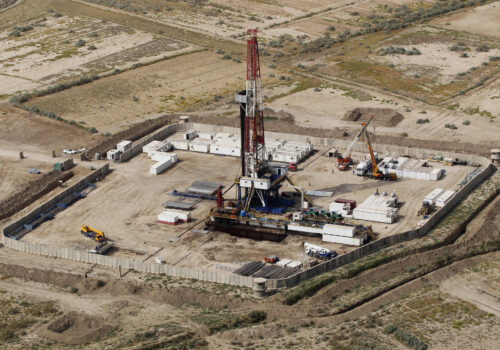
Chinese state-owned firms dominate the oil sector in Iraq, which is the second-largest producer in the Organization of the Petroleum Exporting Countries (OPEC) after Saudi Arabia and home to the world’s fifth-largest reserves. Reports suggest Chinese companies manage about one-third of Iraq’s 145 billion barrels of proven reserves and hold direct shares in roughly 24 billion barrels. They produce two-thirds to three-quarters of Iraq’s output of slightly more than 4 million bpd, with CNPC alone accounting for half of total production.
Initially limited to state firms, Chinese investment has recently expanded to include private energy companies attracted by Baghdad’s favorable contract terms. These firms were licensed in August 2025 to develop several new fields and plan to add 500,000 bpd to Iraq’s production by 2030, as Baghdad targets 6-million-bpd capacity.
While Beijing’s role secures its energy interests, it also deepens Iraq’s tilt toward the East—an orientation encouraged by Shia political factions allied with Iran. These groups promote stronger ties with China (and, to a lesser degree, Russia) as a means of reducing dependence on Washington and circumventing US pressure.
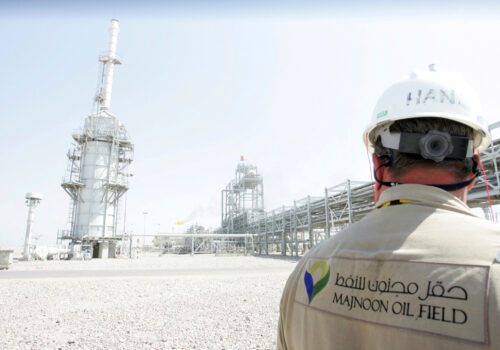
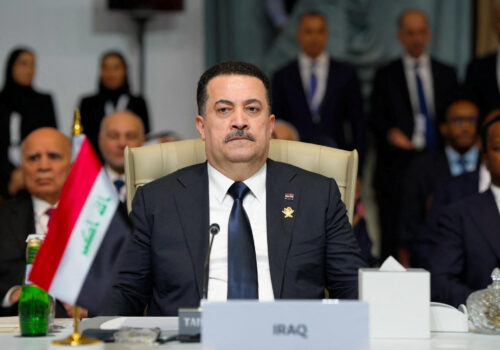
Mindful of the optics of deepening ties with China, Prime Minister Mohammed Shia al-Sudani sought to reengage US energy firms. During his April 2024 visit to the United States, he met oil executives in Houston and urged them to renew investment. The effort appeared to bear some fruit. In October 2025, Exxon Mobil signed an agreement to re-enter the Iraqi market and operate the Majnoon field in Basra, after its full exit from Iraq in January 2024 and subsequently handing over of the West Qurna 1 field to PetroChina.
Telecommunications and digital infrastructure
China’s involvement in Iraq’s telecom sector predates Hussein’s fall. Chinese company Zhongxing Telecom Co. first entered Iraq in 1999, when the country remained under international sanctions. Around the same time, Huawei began clandestinely building a fiber-optic network for Iraq’s military, which was later bombed during a 2001 US-UK air raid—an episode that led to Washington’s view of Huawei as a national security threat.
In 2003, following the overthrow of the Baath regime by the United States and its allies, Huawei returned to Iraq’s emerging telecom market via Asiacell, the country’s leading carrier. In 2011, Robert C. Fonow, a US State Department adviser to Iraq’s Telecommunication Ministry, told the Washington Times that Huawei effectively “owned” Iraq’s telecom sector, alleging the firm had received more than six hundred contracts worth billions of dollars—some indirectly financed by US reconstruction funds.
Today, Chinese technology firms remain central to Iraq’s digital expansion. In June 2025, Asiacell and China Mobile International (CMI) signed a memorandum of understanding (MoU) to expand enterprise-level digital services, billed as accelerating Iraq’s digital transformation through CMI’s global expertise. Huawei also partnered with Iraq’s Communication and Media Commission, Iraq’s top regulatory body in the field, to train personnel in cybersecurity. Iraqi officials have publicly encouraged deeper Chinese investment in telecommunications, signaling a sustained partnership in digital infrastructure.
Consumer markets and renewable energy
China’s commercial reach extends to Iraq’s consumer markets—from electronics to vehicles to solar energy. In the first half of 2025, Iraq imported eighteen thousand Chinese cars worth $639 million, a 30-percent increase over the same period in the previous year. The Kurdistan region accounted for the largest share, as consumers favored affordable yet feature-rich Chinese vehicles. For example, a 2025 MG GT sedan sells for about $8,850, compared with around $20,000 for comparable Asian or Western models. Similarly, a BYD hybrid sport utility vehicle (SUV) retails for $24,300, well below competitors’ SUVs. Local dealers report that “buyers who once paid more for American cars from Dubai now prefer Chinese cars with leather interiors, large screens, and panoramic roofs at a fraction of the cost.”
Chinese solar panels have also surged. According to the Washington-based Attaqa Energy Research Group, Iraq ranked third in 2025 among Arab-majority states for Chinese solar imports. In the year’s first half, Iraq imported 0.9 gigawatts of solar panels—a nearly 600-percent increase in terms of solar generation capacity from 2024—driven by state-backed projects to install solar systems in homes, schools, and public buildings.
Education, media, and cultural outreach
Alongside its economic footprint, China has ramped up soft-power efforts to win Iraqi hearts and minds. Keen to counter critical media coverage of China, Chinese diplomats at times engage with Iraqi media—particularly to push back against criticism on issues such as the Uyghur crisis in Xinjiang.
Chinese universities are offering around eighty scholarships to Iraqi students for the 2025–2026 academic year. The Chinese consulate in Erbil has backed the 2019 establishment of a Chinese language program at Salahaddin University in Erbil—one of only two such programs in the Middle East. It also helped create a China Studies Center at Sulaimaniyah University, which publishes a Kurdish-language magazine introducing China and supports translation of Chinese books.
While Washington’s retreat from democratization and aid has eroded its image, China’s cultural outreach, development model, and messaging resonate with many Iraqis.
China’s exchange programs regularly bring Iraqi civil servants and professionals to Chinese institutions for technical training. The Chinese consulate in Erbil now plans to establish the Great Wall organization to strengthen bilateral relations by bringing together Iraqi Kurds who have visited China through various Beijing-sponsored exchange programs. Beijing has further expanded scientific cooperation by signing an agreement with Iraq in 2025 to develop a “peaceful nuclear technology program,” including construction of Iraq’s first nuclear training reactor for academic use in nuclear physics and radiological sciences. The initiative, led by Minister of Higher Education Na’im al-Abboudi—a senior member of the Iran-backed Asa’ib Ahl al-Haq movement—has drawn scrutiny in Washington for its potential geopolitical implications.
Beijing has a distinct approach to Kurdistan
China’s relationship with the Kurdistan Region of Iraq (KRI) differs in tone and texture from its engagement with federal Iraq, yet both align with Beijing’s broader strategy. Energy remains the core of China-Iraq relations, and China’s activities in the KRI ultimately reinforce that foundation. However, the China-Kurdistan relationship appears more diverse, shaped by the autonomous region’s social openness and China’s preference for a low-risk, apolitical presence.
Historically, the relationship has two main strands. The first dates to Talabani’s 1955 visit to Beijing and his fascination with Maoism, which shaped aspects of his political worldview and indirectly influenced the early identity of his party, the Patriotic Union of Kurdistan (PUK). After 2003, the PUK became essential for rebuilding China-Iraq ties, and it is no coincidence that every Iraqi ambassador to China since 2003 has been from the PUK, reflecting both personal networks and political continuity.
Another key moment in the relationship was China’s opening of its consulate in Erbil in 2014. At the ceremony, then Kurdistan Regional Government (KRG) Prime Minister Nechirvan Barzani described it as “the first step toward building a new phase in bilateral relations,” signaling opportunities in politics, culture, infrastructure, and commerce. As the KRG’s former foreign relations chief, Falah Mustafa, put it, China’s permanent seat on the UN Security Council gives its presence in Erbil symbolic and practical weight. Yet Beijing has remained cautious in its political engagement with Kurdish authorities, consistent with its 1991 abstention on UN Resolution 688 condemning Hussein’s repression of the Kurds.
Despite this reticence, China has built a wide-ranging network of relationships. The Chinese consulate in Erbil regularly invites Kurdish political parties, universities, media outlets, and government ministries to short study programs in China. This resembles earlier US public diplomacy programs but is more ideologically neutral. Beijing makes a point of engaging all political currents, including leftist, nationalist, and Islamist parties. As a former KRG adviser noted in an interview with one of the authors, “During a trip to China, I met a member of the Kurdistan Communist Party and a cadre of an Islamic party attending the same course.” Kurdish officials appear increasingly attentive to China’s rise and its willingness to support development in Iraq and Kurdistan. This was reflected in comments by Sulaimaniyah Governor Haval Abubakr, who recently described China as “the America of the East.”
China’s expanding activity in the KRI also intersects with the US-KRG relationship. As the United States has constructed a massive new consulate complex in Erbil, intended as a physical symbol of long-term commitment, China has also signaled interest in building a new consulate of its own. However, while the KRI has deep diplomatic and security ties with the United States, its relationship with China remains overwhelmingly concentrated in trade and cultural domains. Indeed, this is a deliberate choice on Beijing’s part. By avoiding security and identity questions, China cultivates what might be described as a “decaf” relationship—active and useful, yet stripped of political commitments.
Kurdistan’s openness to the world enables this strategy. Travel is highly valued socially, and China’s invitations arrive at times when economic hardship—such as salary delays by Baghdad—limits mobility. “I managed to have a trip in a time of salary crises,” a Sulaymaniyah lecturer interviewed for this report noted after joining a Chinese study program. This openness has provided fertile ground for Beijing’s soft-power outreach.
China’s public diplomacy is more developed in the KRI than in the rest of Iraq. It promotes familiarity with Chinese institutions, culture, and political narratives through sustained engagement. This has shifted public perceptions and increased interest among Kurdish students and professionals. As noted earlier, Beijing has supported institutions such as China in Kurdish, the China Studies Center in Sulaimaniyah, and the Chinese Department at Salahaddin University, with plans for additional language programs. Events like Chinese Film Week and commemorations of the “80th Anniversary of the Victory of the Chinese People’s War of Resistance Against Japanese Aggression” give China cultural visibility and institutional depth. Collectively, these centers make cultural programming and exchanges smoother and more consistent.
Over the past two decades, China’s expanding presence has begun to shape Iraq’s economic future, regional role, and relations with the United States.
This network also supports China’s commercial aims. The long-standing Asiacell-Huawei partnership is illustrative. Asiacell, headquartered in Sulaymaniyah, is Iraq’s largest telecom company, and its relationship with Huawei began on the eve of the 2003 US invasion. In February 2003—anticipating conflict—Huawei scouted opportunities in Kurdistan. When Washington issued its ultimatum to Hussein in March, Huawei moved Asiacell staff to Shenzhen for emergency training. In 2023, the two firms celebrated the twentieth anniversary of their “precious partnership,” outlining plans to integrate artificial intelligence into Iraq’s telecom services. Today, Huawei is the primary equipment provider to all major Iraqi telecom operators, a position rooted partly in its early foothold in the KRI.
China’s presence also shapes Kurdistan’s sociopolitical landscape. Chinese goods—from household items to solar panels to electric vehicles—dominate local markets. As a Sulaymaniyah trader interviewed for this paper explained, “You cannot produce anything in Kurdistan, as the Chinese make it cheaper, even if it’s a pillow cover.” This economic dependency affects local production and, over time, influences political imagination. Concepts associated with China’s governance model—especially centralized party control and the importance of family connections—mirror existing patterns and appeal of China in Kurdistan and federal Iraq.
It is important to note that when it comes to strategic economic sectors, the KRG is not linked to China in the same way the federal government and the areas under its control are. For example, while the federal government’s energy sector is dominated by Chinese firms, there is only one Chinese-owned company—Addax Petroleum, owned by Sinopec—operating in the Kurdistan region’s oil sector.
How this growing closeness affects US policy
As China prioritizes securing new markets abroad and ensuring energy security at home, Iraq has become integral to Beijing’s geoeconomic ambitions and economic statecraft in the Middle East region. Over the past two decades, China’s expanding presence has begun to shape Iraq’s economic future, regional role, and relations with the United States. Baghdad now faces the delicate task of balancing ties with both powers to avoid alienating either side. There is an economic and geographical logic driving Iraq’s relationship with China. China is the world’s largest energy importer, and Iraq—one of the world’s top oil producers—naturally falls within Beijing’s orbit of interest. Iraq’s infrastructure gaps and development needs also make Chinese capital and expertise attractive, if not indispensable, while Chinese consumer goods remain affordable for most Iraqis.
However, the broader implications of this relationship cannot be understood solely through economics. China’s increasing footprint unfolds against the backdrop of intensifying US-China rivalry and the global drift toward multipolarity. Iraq is gradually emerging as a site of subtle competition between these two powers—particularly in areas such as infrastructure (especially energy), digital networks, and potential land-based transit corridors. Yet, given the deeply interconnected nature of today’s global economy and Iraq’s heavy reliance on external actors for technology, investment, consumer products, and security, it is unrealistic to expect Iraq to de-link from either China or the United States.
Beyond economic logic, Iraq’s deepening engagement with China reflects political calculations and rationale at the domestic, regional, and global levels. Globally, China’s ascent since the mid-2010s has offered states like Iraq an alternative pole through which to diversify partnerships and reduce dependence on the West. Engagement with Beijing thus forms part of Baghdad’s broader hedging strategy—maintaining ties with multiple global actors to avoid overreliance on any single one.
Domestically, this orientation intensified as Shia parties consolidated unprecedented control of the Iraqi state, particularly after the war against the Islamic State of Iraq and al-Sham (ISIS) and the weakening of Kurdish autonomy and political influence in Iraqi politics after the unsuccessful Kurdish independence bid in 2017. Many among Iraq’s new Iran-backed power brokers view China as a politically neutral strategic partner—one that provides investment without demanding reforms or pressing governance conditions. At the elite level, China appears to have the upper hand in the soft-power contest with Washington concerning the appeal of the two countries and their approaches to Iraq. While Washington’s retreat from democratization and aid has eroded its image, China’s cultural outreach, development model, and messaging resonate with many Iraqis.
The Iran factor
Regionally, openness toward China has grown since the early 2010s, amid the rise of the Iran-led Shia axis. Many dominant Iraqi Shia parties maintain deep ties with Tehran, and their affinity for China aligns with Iran’s own pursuit of a closer relationship with Beijing. Aware of the risks of being perceived as leaning too heavily toward China—and also Iran, particularly in the aftermath of the October 7, 2023, conflict between Israel and Gaza and the gradual weakening of the Iranian-led axis—Baghdad has recently sought to rebalance its approach by inviting more US investment in its energy sector.
Iraq’s recent deals with US energy companies such as ExxonMobil, Chevron, and others reflect the recognition among the dominant Shia political class that excessive dependence on China risks political backlash and economic vulnerability, particularly as Washington intensifies efforts to contain Beijing’s global influence. This dynamic highlights the limits of hedging for resource-rich countries like Iraq that lack the structural leverage to shape regional outcomes or reduce dependence on the United States.
It remains unclear whether Iraq’s renewed outreach to US companies signals a genuine attempt at balanced relations or a tactical effort to ease US pressure determined to squeeze Iraq as part of its maximum pressure campaign against Iran. What is clear is that China’s expanding economic role in Iraq is a growing concern for Washington. Greater Chinese market share means shrinking space for US businesses and, more broadly, a potent erosion of US influence that is more than symbolic. Given that the post-2003 Iraqi order was created through US intervention—and later saved from ISIS’s existential threat through a massive US-led coalition—China’s growing role in Iraq reflects a deeper transformation in the landscape of external influence shaping the country.
Beijing’s digital infrastructure deals, including telecommunications and cybersecurity, could create new vulnerabilities for US-Iraq security cooperation not unlike Huawei’s engagement with Iraq under Hussein. The use of Chinese companies in strategic sectors—ports, refineries, and data networks—risks limiting the space for US and Western governments and companies’ engagement with Iraq. Crucially, Iraq’s ambitious Development Road Project (DRP) connecting the Gulf to Turkey and Europe could also intersect with China’s BRI, particularly its sea route portion, and diversify Beijing’s options for trade with the Middle East and from there to Europe. Despite a cool initial reception, Beijing now appears open to supporting the Iraqi DRP, perhaps recognizing its value in shortening overland trade routes with Europe. This all fits into China’s geoeconomic strategy, expanding trade, increasing access to critical energy resources, and creating new markets for Chinese companies.
However, this is not the entire story. Iraq appears to follow a compartmentalized approach to relations with both the United States and China, whereby Baghdad has cultivated deeper ties with China in trade, energy, and telecommunications while remaining heavily dependent on the United States in finance, security, and diplomacy. Revenue from Iraq’s oil exports flows into the Federal Reserve Bank of New York, from which the Central Bank of Iraq withdraws regularly. Iraq’s monetary and financial systems thus remain deeply tethered to the US financial system and Washington’s oversight. Any disruption in this relationship—such as sanctions or delayed clearances—could trigger liquidity crises in Iraq’s fragile economy.
Iraq’s security dependence on Washington also remains quite firm for now. The Iraqi security forces rely on US intelligence, equipment, and training for operations against ISIS and for broader defense needs. Advanced systems such as F-16s and Abrams tanks further anchor this relationship. Iraq sits at the intersection of three core US priorities: countering Iranian influence, stabilizing global energy markets, and—after the transformations set off by October 7, 2023—rebuilding a regional order friendly to Washington. As part of this broader regional reality security links remain important for both sides, particularly as Iraq’s Shia ruling class feel threatened by the developments over the past couple of years.
Diplomatic asymmetry is even deeper: Iraqi prime ministers routinely seek White House invitations as symbols of legitimacy and international recognition. Since 2003, Iraqi leaders at the presidential, prime-ministerial, and foreign-ministerial levels have visited Beijing on numerous occasions, yet the only senior Chinese official of comparable rank to visit Iraq during that period was Foreign Minister Wang Yi in February 2014. Iraq invests in the relationship far more than China does.
This produces a paradox: Iraq remains reliant on US protection but is increasingly integrated into China’s commercial ecosystem. Unless the United States expands its economic engagement, its influence will continue to erode. For much of the Shia elite, China—not the United States—is the preferred long-term partner. Yet Iraq cannot function without engagement with both in some form. Historically, Iraqi attempts to shift too far toward one camp produced destabilization, including coups during the Cold War. The country’s social, economic, and security needs, along with its geopolitical position, require a diversified and compartmentalized approach to major global powers—though not one that entails equal reliance across all sectors.
Energy is a key arena. China is a major importer of Iraqi oil while increasingly serving as Iraq’s primary supplier of solar panels and renewable technologies. At the same time, China’s domestic energy consumption is shifting. The International Energy Agency (IEA) notes that China’s use of gasoline, jet fuel, and diesel—totaling 8.1 million bpd—declined slightly in 2024 and stood 2.5 percent below 2021 levels. As global oil demand plateaus and buyers gain greater leverage, Iraq has become increasingly anxious not to lose China as a primary customer.
Demographic and economic trends inside Iraq are particularly important as they further push the country toward China. Rapid urbanization, high birth rates, and low incomes make Iraqi households dependent on inexpensive imported goods. China is often the only viable supplier. As Iraqi society and consumption patterns evolve, so will its economic and political tilt toward Beijing. By contrast, the United States has lost most of its non-military leverage—aside from sanctions and coercive tools—partly due to years of inconsistent engagement. Moreover, the nature of Iraq’s rentier economy, and its governance model built on patron-client relations and the informal patronage networks that sustain it, requires the rapid development of oil resources as the main pillar supporting this system. For the reasons outlined above, Chinese firms represent a more reliable option for Iraq to ensure the continued expansion of its oil sector and the conversion of those revenues into political power.
Against this backdrop, Iraq’s trajectory suggests an ongoing use of hedging as its primary policy, albeit an uneasy one. Hedging is a strategic behavior through which a state avoids clearly aligning vis-à-vis two powerful actors, maintaining instead an in-between, ambiguous, flexible position. Over the past couple of years, the Shia Coordination Framework-led government under Sudani has noticeably embraced this posture. Yet Iraq’s hedging exercise remains constrained by internal and external pressures, particularly Iran’s influence. Tehran’s networks—militias, political allies, and economic ties—limit Baghdad’s freedom of maneuver. Other constraints include anti-normalization legislation in the Iraqi Parliament targeting Israel, which prevents Iraq from joining the Abraham Accords and expanding ties with US allies. The outcome of recent Iraqi parliamentary elections will likely reinforce this dynamic. Although Sudani’s coalition performed strongly, Iran-aligned militias and parties performed far better, ensuring that hedging will continue—but in a narrow and contested space at least for the foreseeable future.
About the authors
Sardar Aziz, PhD, is a researcher, columnist, and adviser, and a nonresidential affiliate at the IRIS center at the American University of Iraq, Sulaimani. He is a former senior adviser to the Kurdistan Parliament in Iraq. He has worked extensively on China and Iraq.
Mohammed A. Salih is a nonresident senior fellow in the Foreign Policy Research Institute’s National Security Program and a researcher and journalist based in the United States. He holds a PhD from the University of Pennsylvania and has written extensively for more than two decades on Iraq, Kurdish, and regional affairs.
related content
Explore the program
The Iraq Initiative is driving policy-oriented programs and analysis that advance Iraq’s stability and sovereignty, regional integration, and democratic and economic development. It also aims to promote a strengthened US-Iraq partnership.
Image: Iraqi President Abdul Latif Jamal Rashid receives the Ambassador of the People's Republic of China to Iraq, Cui Wei, in Baghdad on August 11, 2025. Photo by Iraqi Presidency Office/apaimages